Gorgasliani. The Banner of Vakhtang Gorgasali
How Tamar’s chronicler described the royal banner, and what guided our reconstruction of its cloth and finial.
 According to tradition, the standard of Vakhtang Gorgasali, the fifth-century king of Kartli, became the royal banner of Georgia. Its name preserves the king’s memory. Gorgasliani means “Gorgasali’s banner.” The historian Aleksandre Tvaradze suggested that Vakhtang himself may have begun the tradition. The sources do not say where or when the king first raised the banner.
Centuries later, the Gorgasliani appears in an account of Queen Tamar. In autumn, before a campaign in Persia, the army assembled in Tbilisi. Tamar inspected the armour and horses, then took the banner and entrusted it to the protection of the Mother of God of Vardzia. After blessing the banner and the army, she placed the standard in the hands of the commander Zakaria. The chronicler gives this one banner two names, “Gorgasliani and Davitiani.”
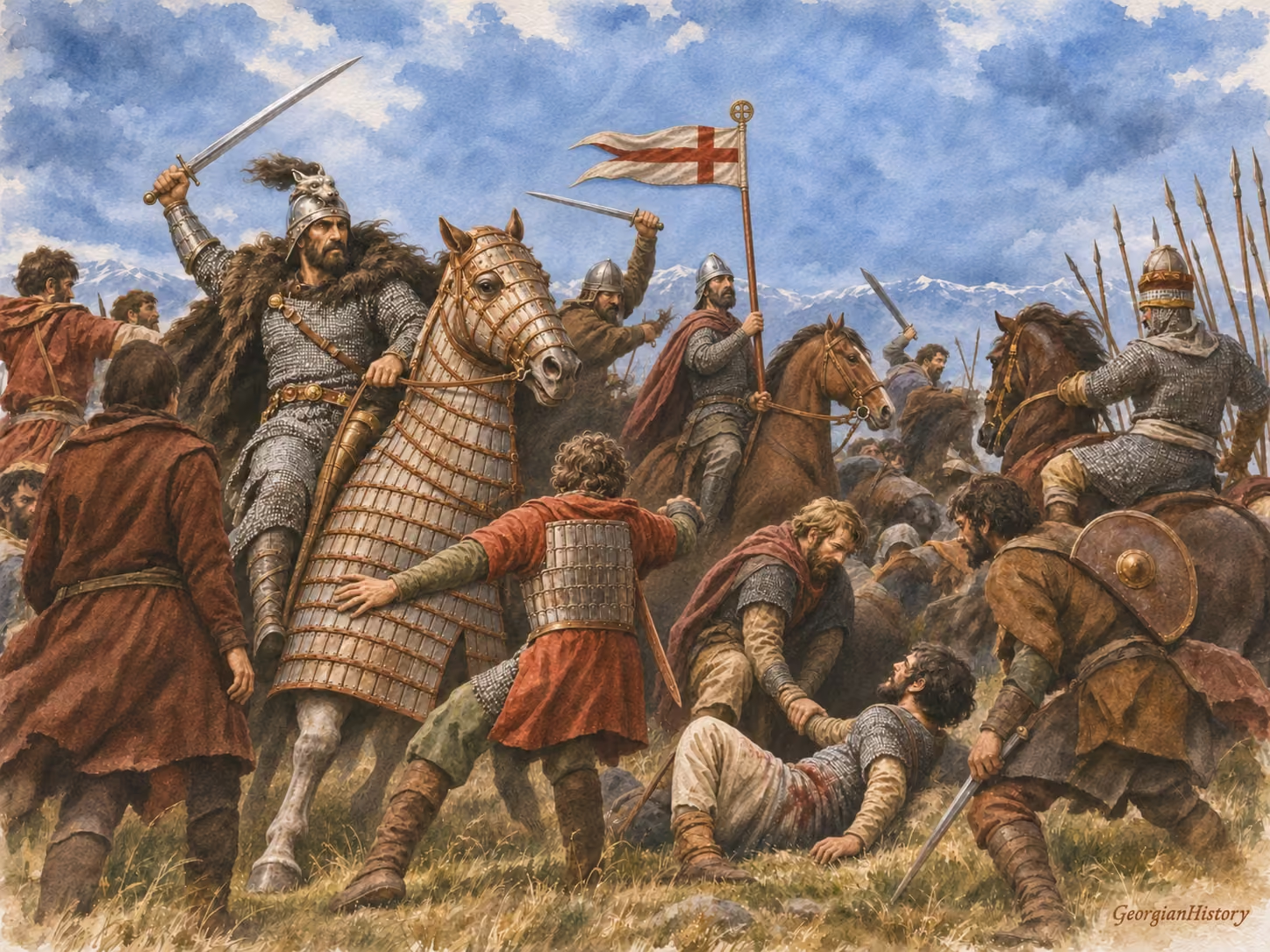
For us, this episode gives the banner its meaning. Those who would ride on campaign together gathered beneath it, and the queen saw them off with a prayer. In our watercolour, the cross above the army expresses that same sense of faith in God and loyalty to one’s homeland.
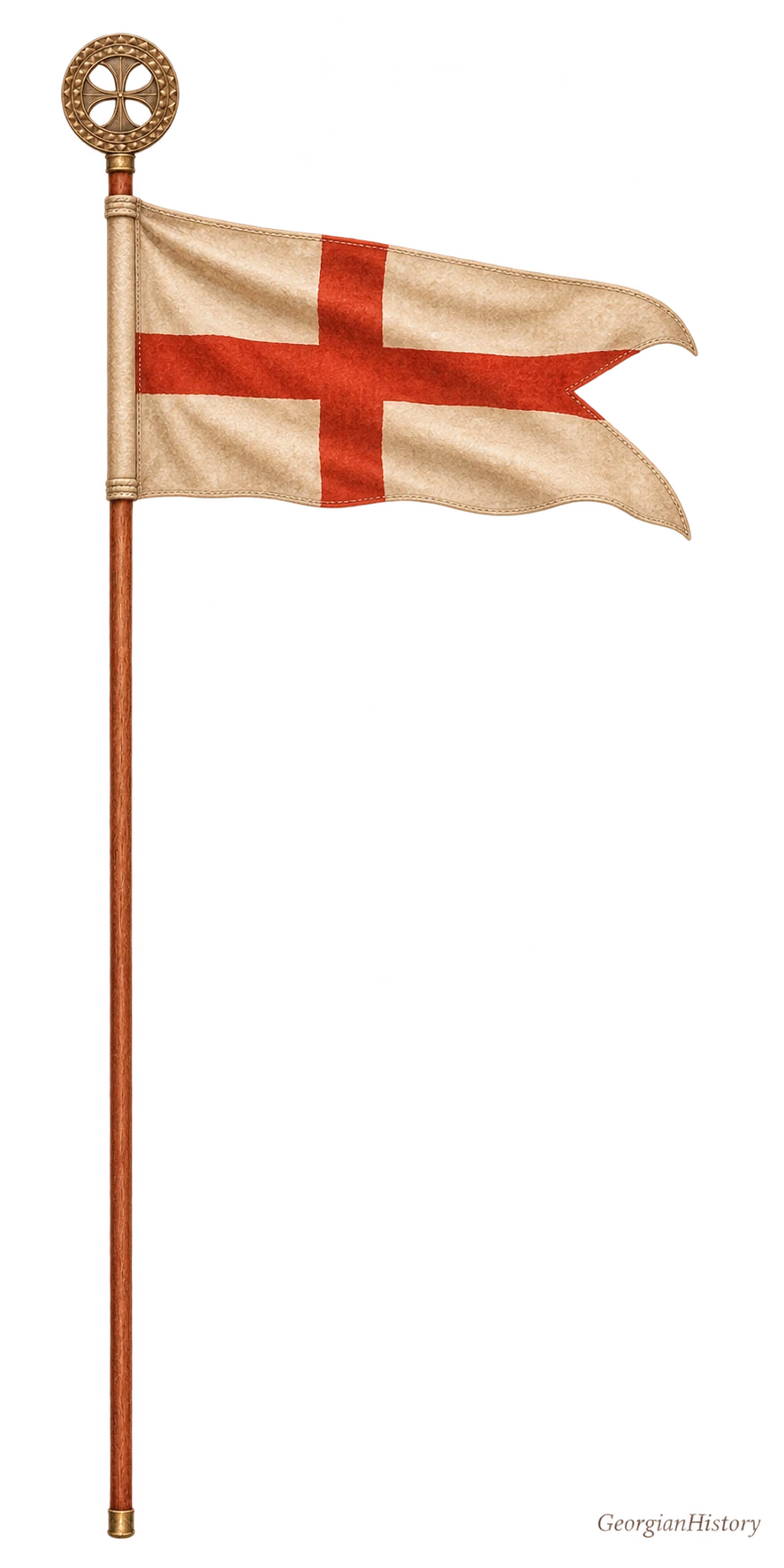
What did the cloth look like? The thirteenth-century Armenian historian Stepanos Orbelian mentioned a white royal banner bearing a red device. He did not describe its shape. Giorgi Macharashvili suggested that the fabric had a golden sheen and bore a Bolnisi cross. For our watercolour we chose a single straight red cross. At the top of the staff we placed a second cross, with equal arms enclosed in a circle, modelled on a stone relief at Bolnisi Sioni.
The cloth and finial
A single straight red cross runs to the edges of the light-coloured cloth. A stitched hem is visible at the staff, and the free edge ends in two points. The shape of the cross, the cut and the way the cloth is attached are details of our reconstruction.
Above the cloth is a second cross with flared arms, enclosed in a circle. We took its outline from a stone relief on the east wall of Bolnisi Sioni and used it for the metal finial in the watercolour.
Sources and further reading
- I. Bichikashvili. On Georgia’s historical state flag and coat of arms, p. 135.
- A. Tvaradze. Georgia and the Caucasus in European Sources, 2004, pp. 74–75.
- Kartlis Tskhovreba, vol. II, p. 104, lines 5–10. Georgian text.
- G. Macharashvili. The Gorgasliani Banner, 2011, p. 72. Author’s summary.
- T. Asatiani. The Story of Georgian Heraldry, 2023, fig. 138.