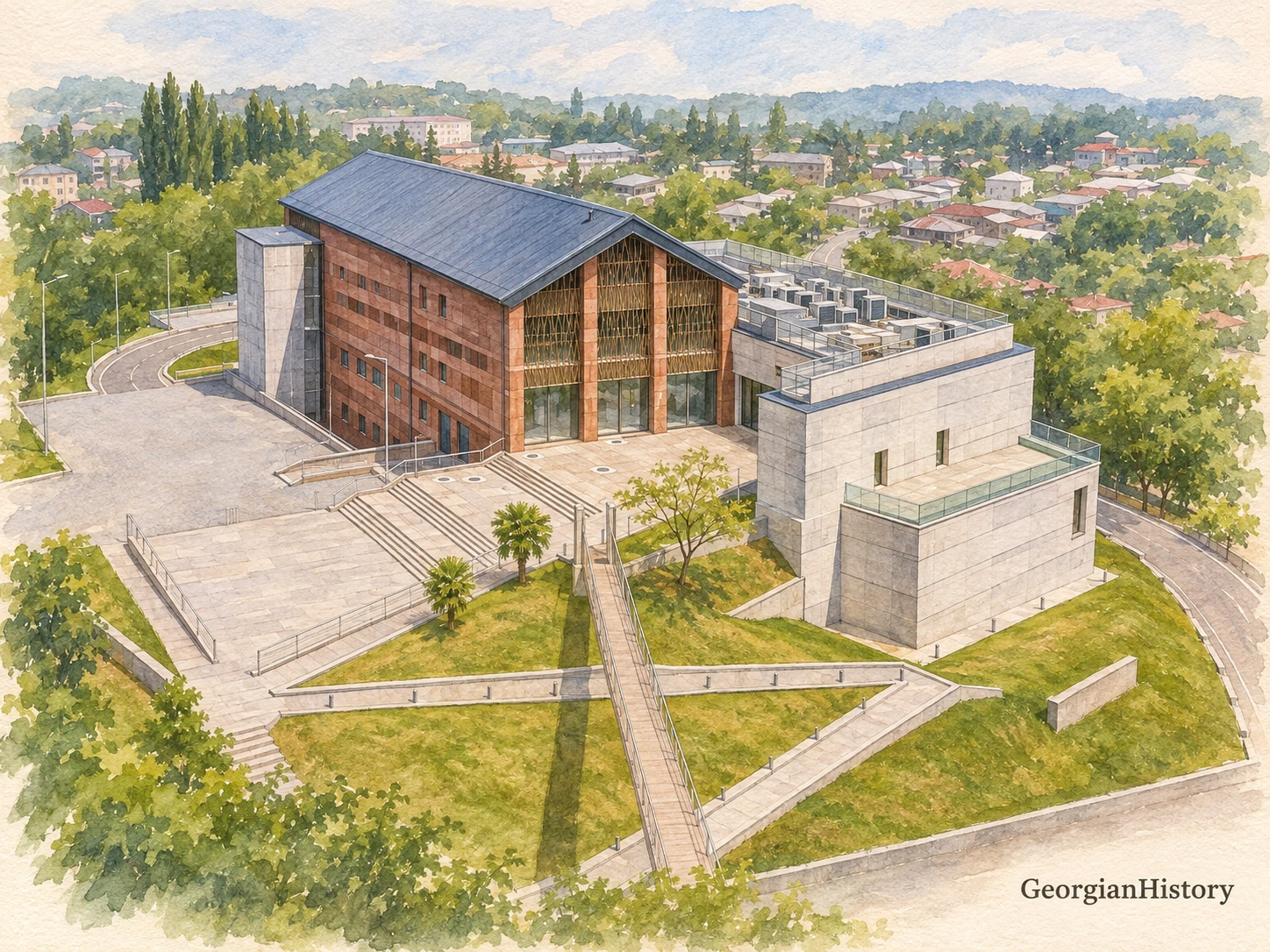
Colchis and Iberia: Kingdoms and Peoples of Ancient Georgia
Cities, crafts, royal power, arms, and relations with neighbouring states in two ancient kingdoms.
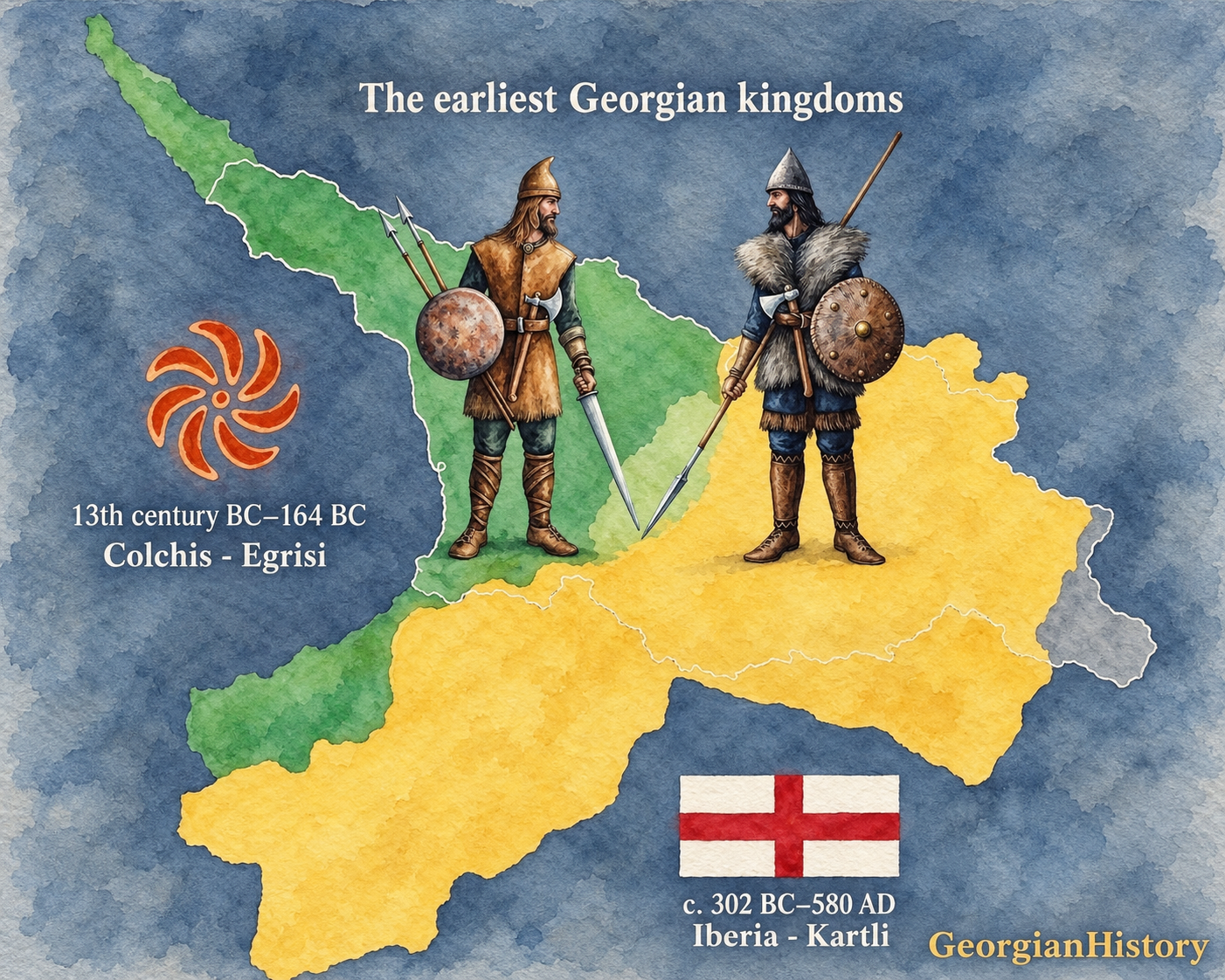
 Long before a united Kingdom of Georgia emerged, two major historical worlds took shape in the west and east of the country: Colchis and Iberia. Roads, proximity and cultural exchange connected them. Each had its own centres of power, economic ties and relations with surrounding states.
Colchis faced the Black Sea and the Rioni valley. Iberia, known as Kartli in Georgian tradition, grew in the valleys of eastern Georgia. The history of both kingdoms shows how the foundations of later Georgian statehood formed around towns and sanctuaries, farming communities, local nobles and royal power. [1–4]
Ancient Georgia and its origins
The Colchian culture of the Late Bronze and Early Iron Ages preceded classical Colchis. Eastern Georgia also had ancient settlements and centres of craftsmanship long before the Kingdom of Iberia. This background matters, but an archaeological culture and a kingdom are separated by a long period of social change and should be studied in their own terms. [4]
Colchis and the Black Sea
The rivers of western Georgia linked inland areas with the coast. People grew grain and grapes in the fertile valleys, and local craftspeople worked metal. Maritime trade brought access to Mediterranean goods and artistic traditions. Contact with Greeks widened those connections, while local communities and nobles retained important roles. [1, 2]
The formation of the Kingdom of Colchis is usually dated to the sixth century BCE, although historians can reconstruct the organisation and reach of early royal authority only in part. In Greek mythology Colchis became the land of Aeëtes, Medea and the Golden Fleece. This image gave it a reputation as a wealthy, distant country. Excavations tell us most about the history of its actual settlements. [1]
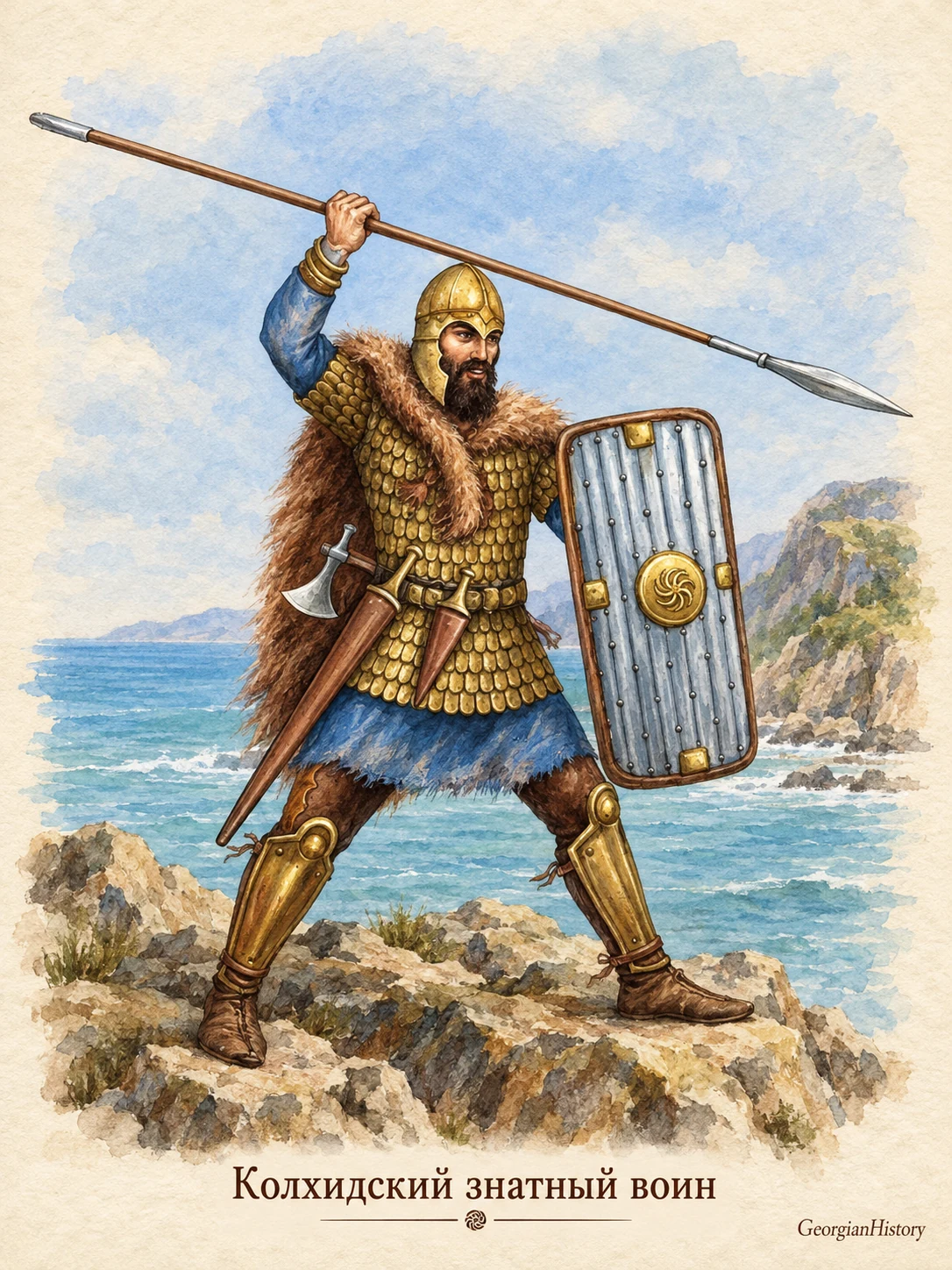
Vani is one of the most striking Colchian sites, with evidence of occupation from the eighth to the first century BCE. Rich burials of the sixth to fourth centuries BCE attest to a powerful local elite. Monumental structures and a developed religious complex appeared later. Vani's role changed over time, and the evidence does not establish it as the capital of all Colchis. [2]
Iberia and royal power
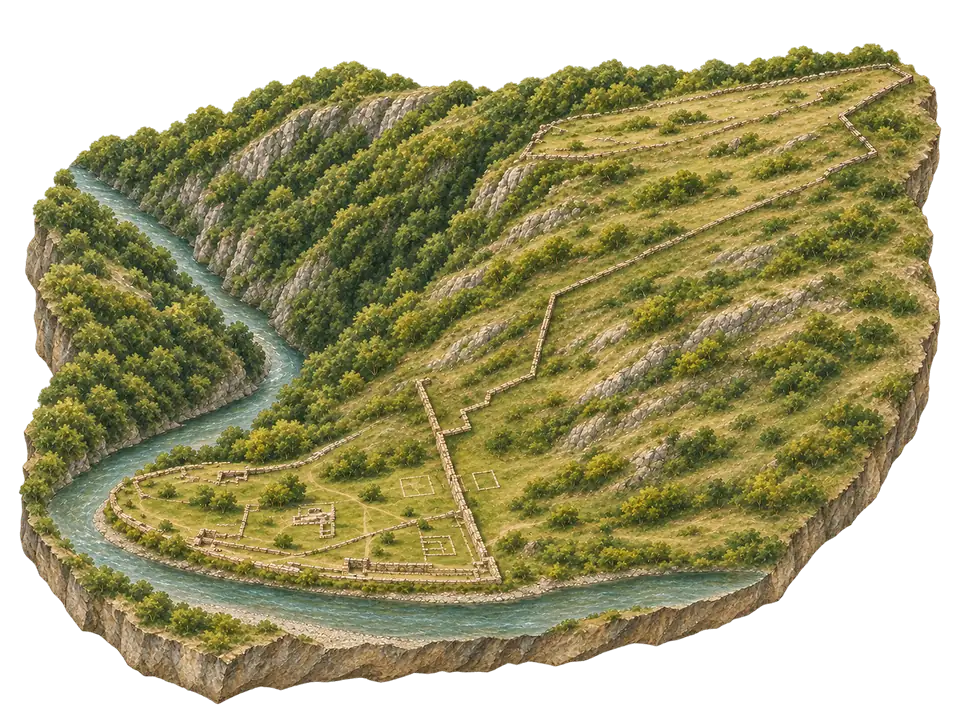
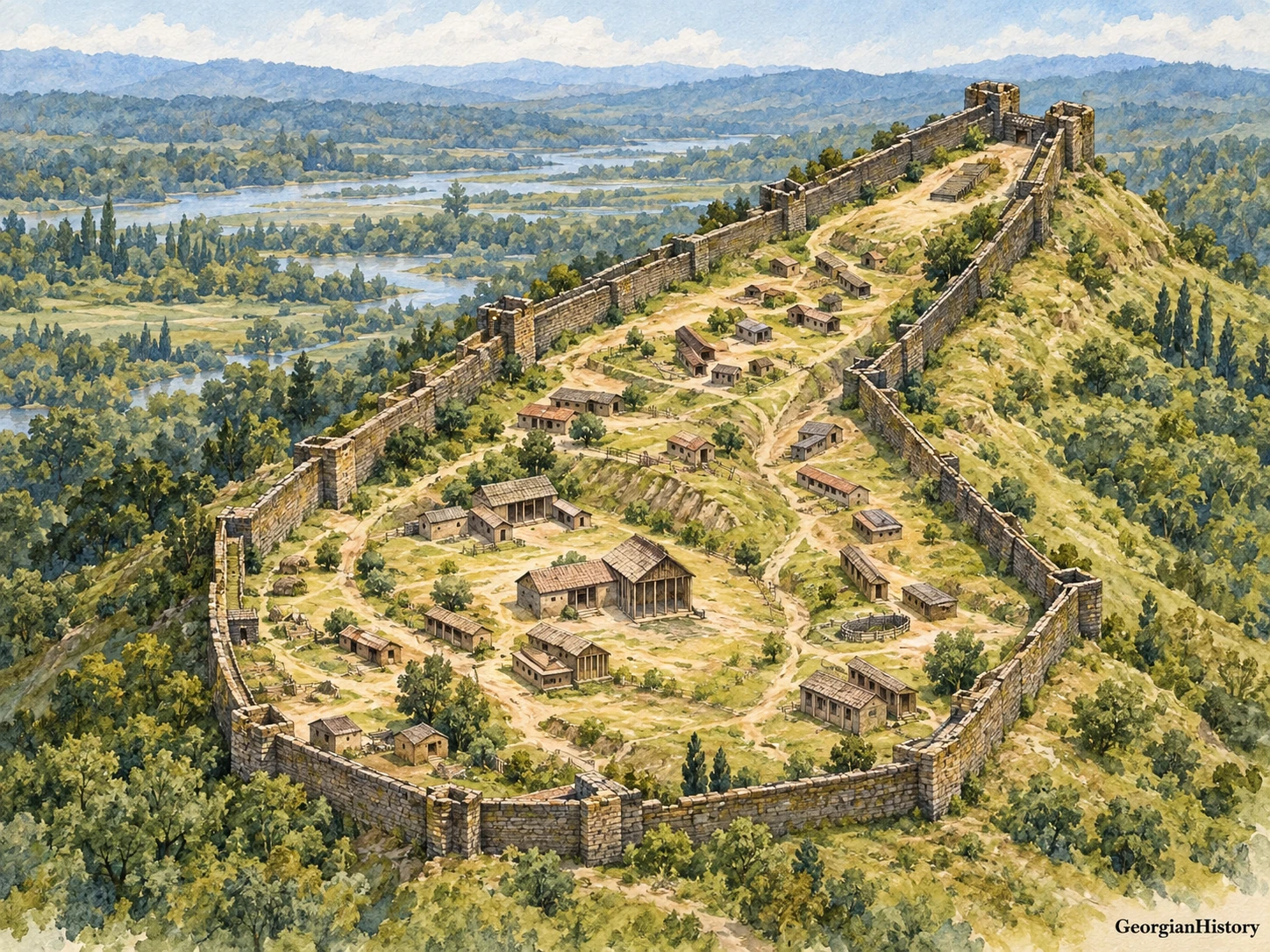
Kartli formed the core of Iberia. At the confluence of the Kura and Aragvi, Mtskheta occupied an important position among river valleys and routes through the Caucasus. Fortified centres known to classical authors stood nearby. Control of roads and passes helped royal authorities defend the country and maintain relations with its neighbours. [3, 5]
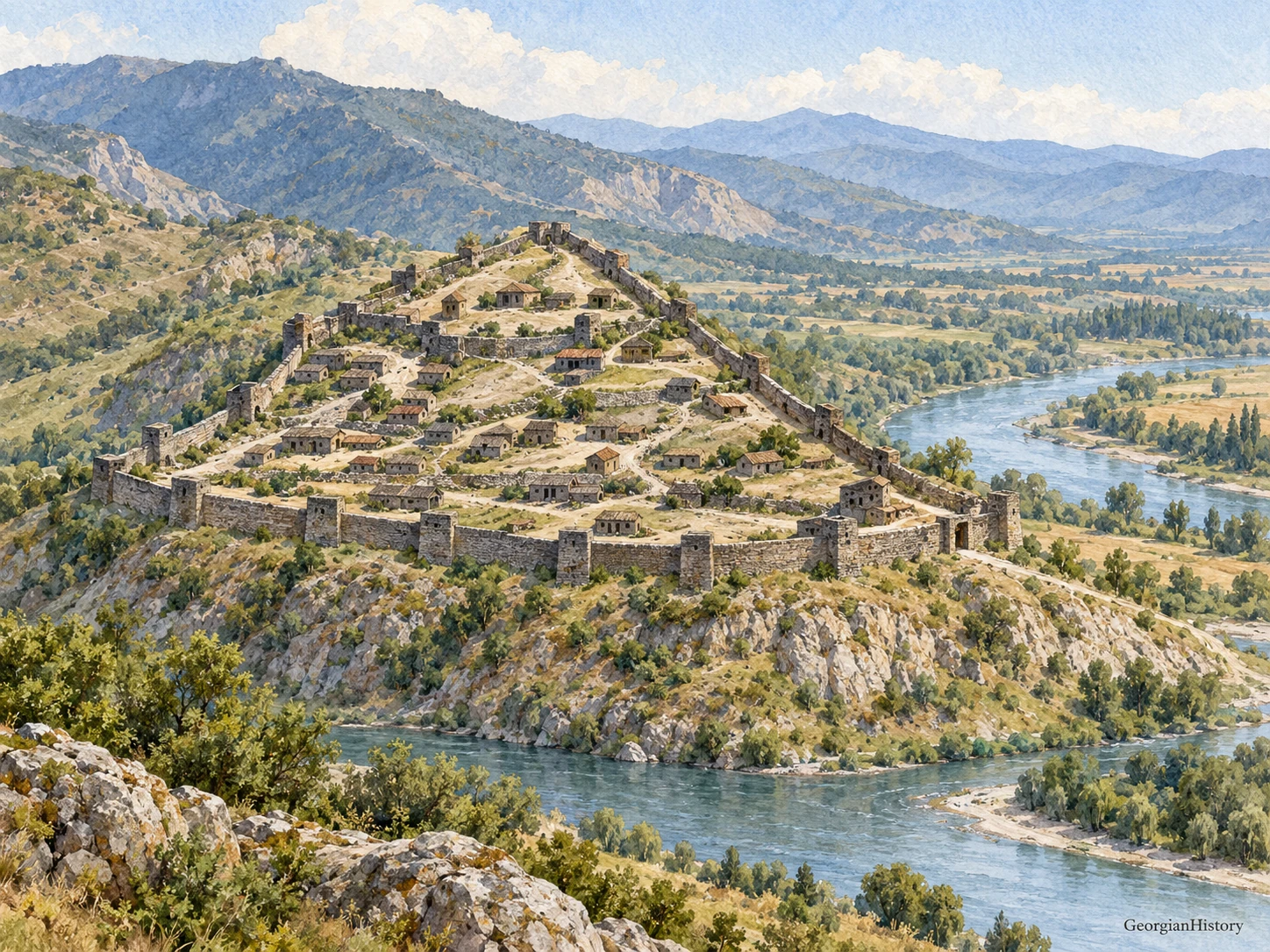
The emergence of the Kingdom of Iberia is associated with the late fourth and third centuries BCE. Georgian chronicle tradition names Pharnavaz as its founder and credits him with organising the state. The account of the first kings survives in much later texts, so the precise dates of the early reigns are still a subject of research. [3, 6]
Strabo described Iberia around the beginning of the Common Era. He wrote of towns, houses with tiled roofs, public buildings and farming settlements. His account distinguishes between the lowlands and the mountains and shows the importance of fortresses at the approaches to the country. It depicts a society with a developed economy, a social hierarchy and durable centres of power. [5]
Craftsmanship and elite wealth
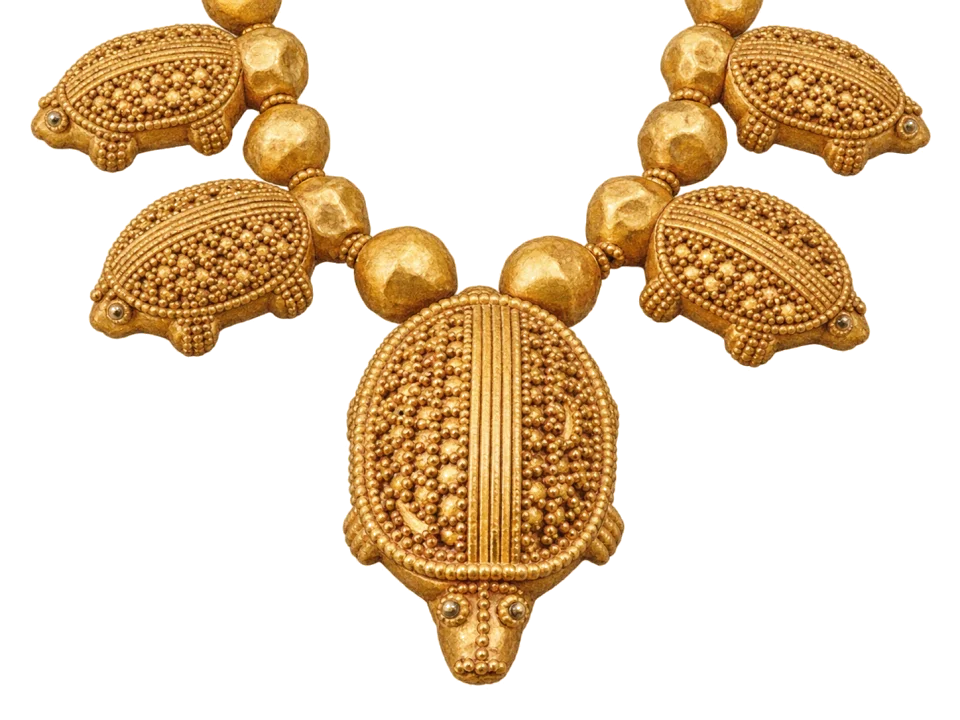
Finds from Vani show how far the Colchian elite's connections reached. Local gold jewellery appears alongside Greek vessels and objects of Iranian origin. Borrowed forms took on new life in the hands of local craftspeople. Colchian wealth found expression in both imported goods and local art. [2, 7]
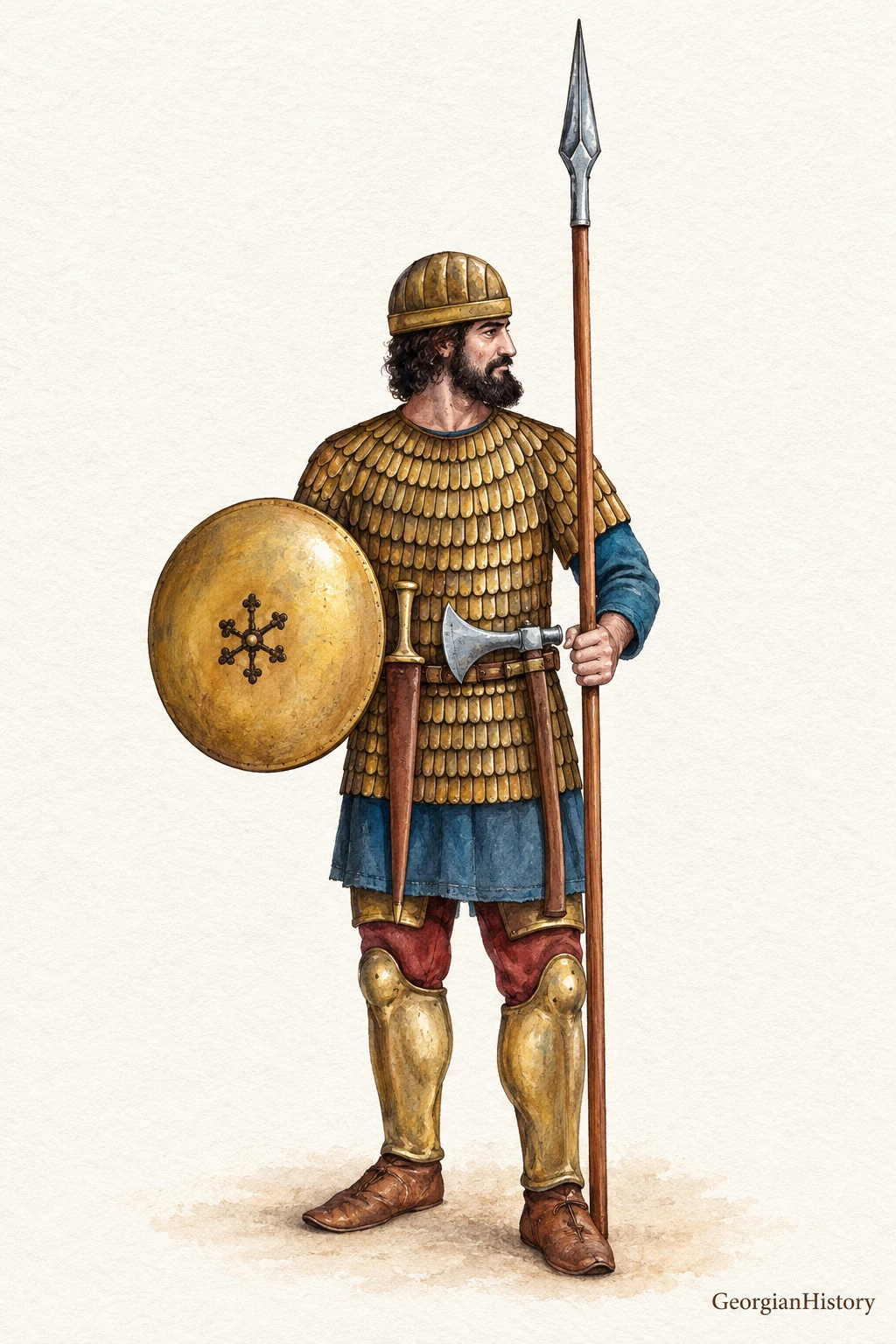
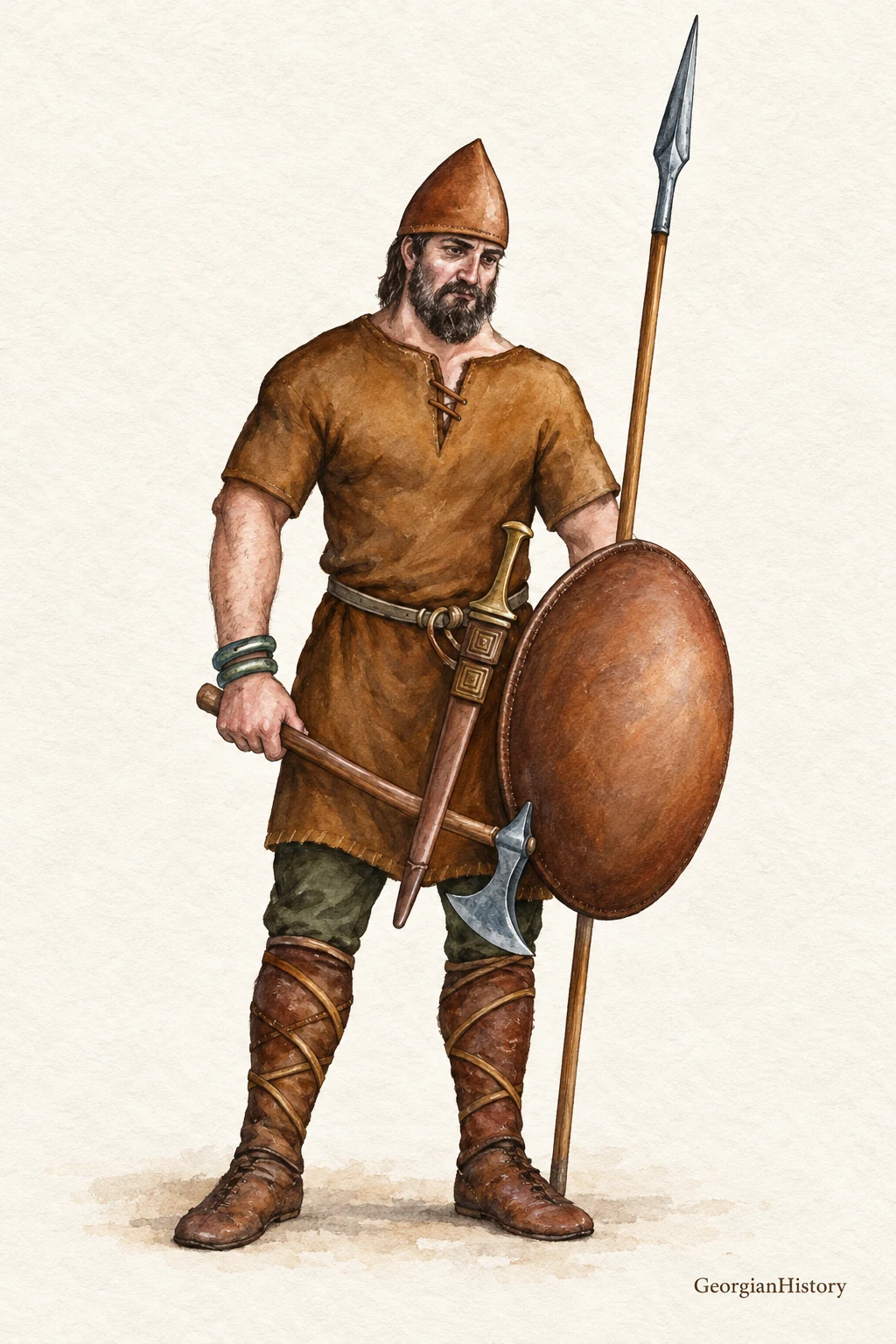
Burial no. 9 at Vani, dated to approximately 330–300 BCE, contained spearheads, arrowheads, daggers, an iron shield and bronze leg guards. The assemblage shows how much weapons mattered in the lives and burial rites of the nobility. It also shows that wealthy people had access to sophisticated protective equipment. [7]
Expensive objects had a social purpose. They made their owner's standing visible. A burial, however, preserves objects selected for the rite. The burial assemblage should be distinguished from the full equipment someone wore in a particular battle.
Horse and rider
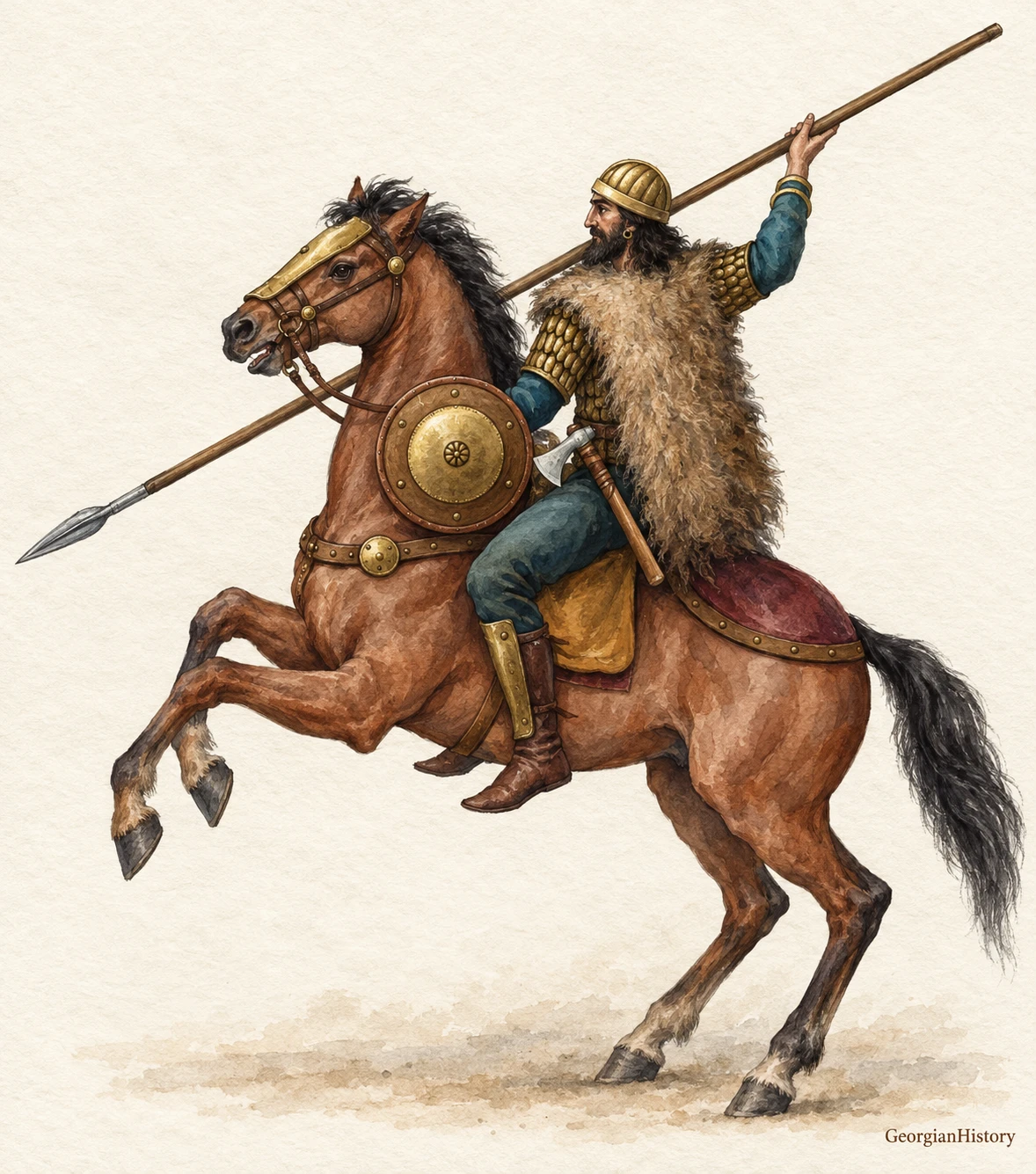
A horse gave a warrior mobility but required constant care, fodder and equipment. The history of mounted warriors is therefore tied to the economy that could support their service. Finds of harness components and depictions on works of art help us study cavalry in the ancient Caucasus. [4, 7]
Horsemen appear, for example, on ornaments from Vani. Such images show the place of the mounted figure in the culture of the local elite. Harness components trace ties with neighbouring regions where people exchanged goods and ways of working with horses. [4, 7]
The appearance of cavalry changed over the centuries. A reconstruction must match weapons, protective gear and saddles of the same period. It is especially important to keep medieval details out of a scene set in classical antiquity. A striking rider's silhouette does not guarantee historical accuracy.
The foot soldier's weapons
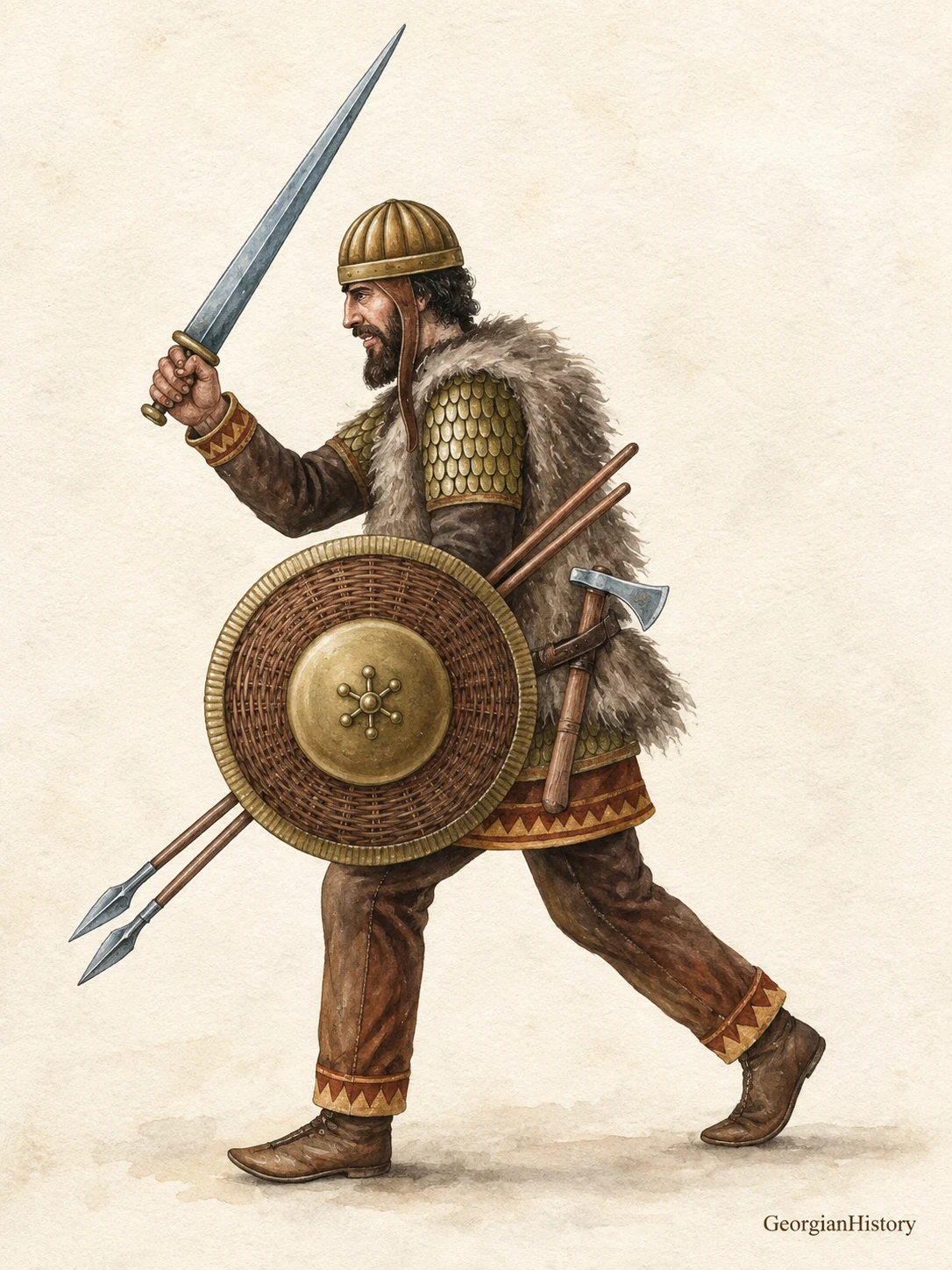
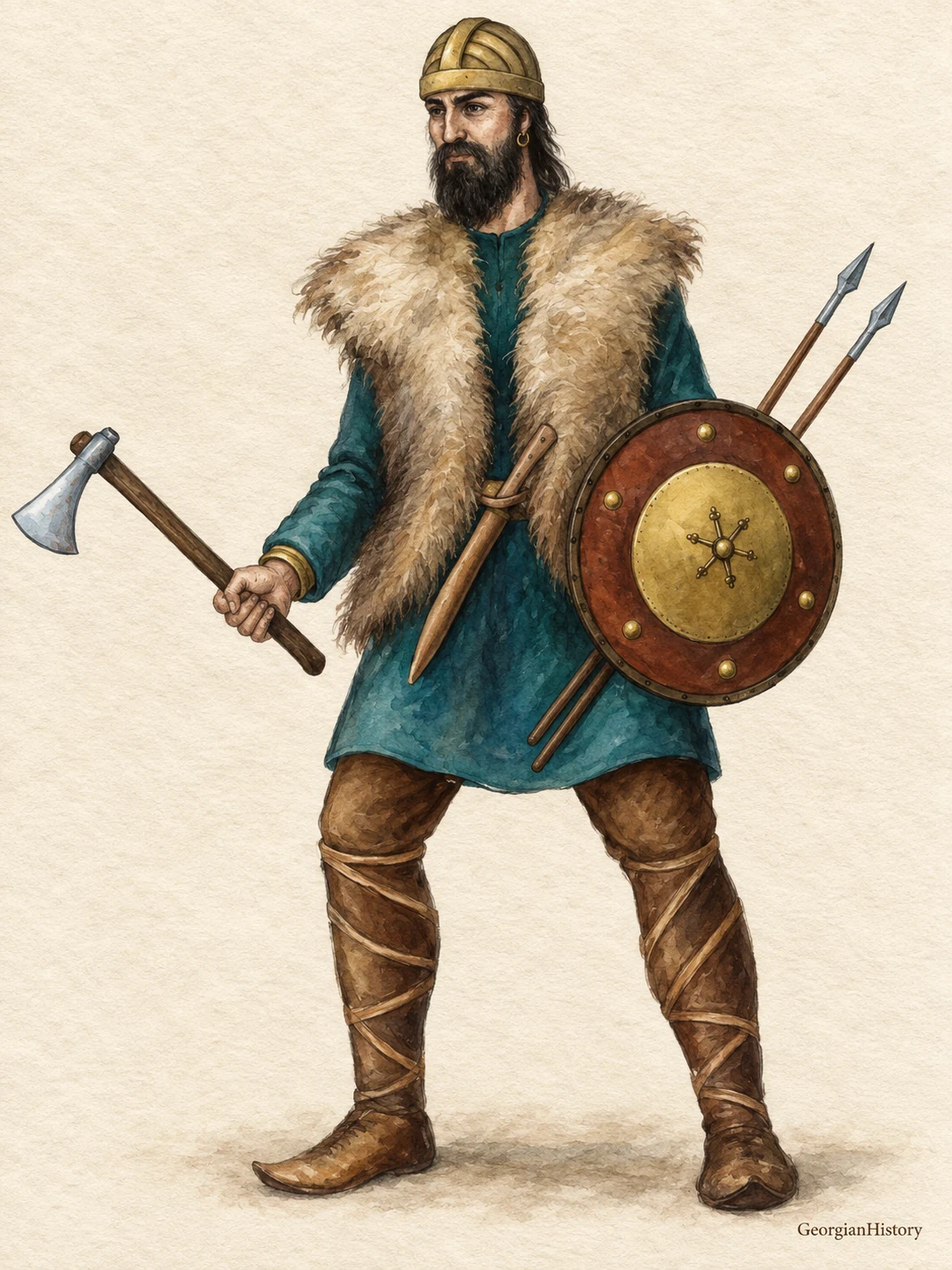
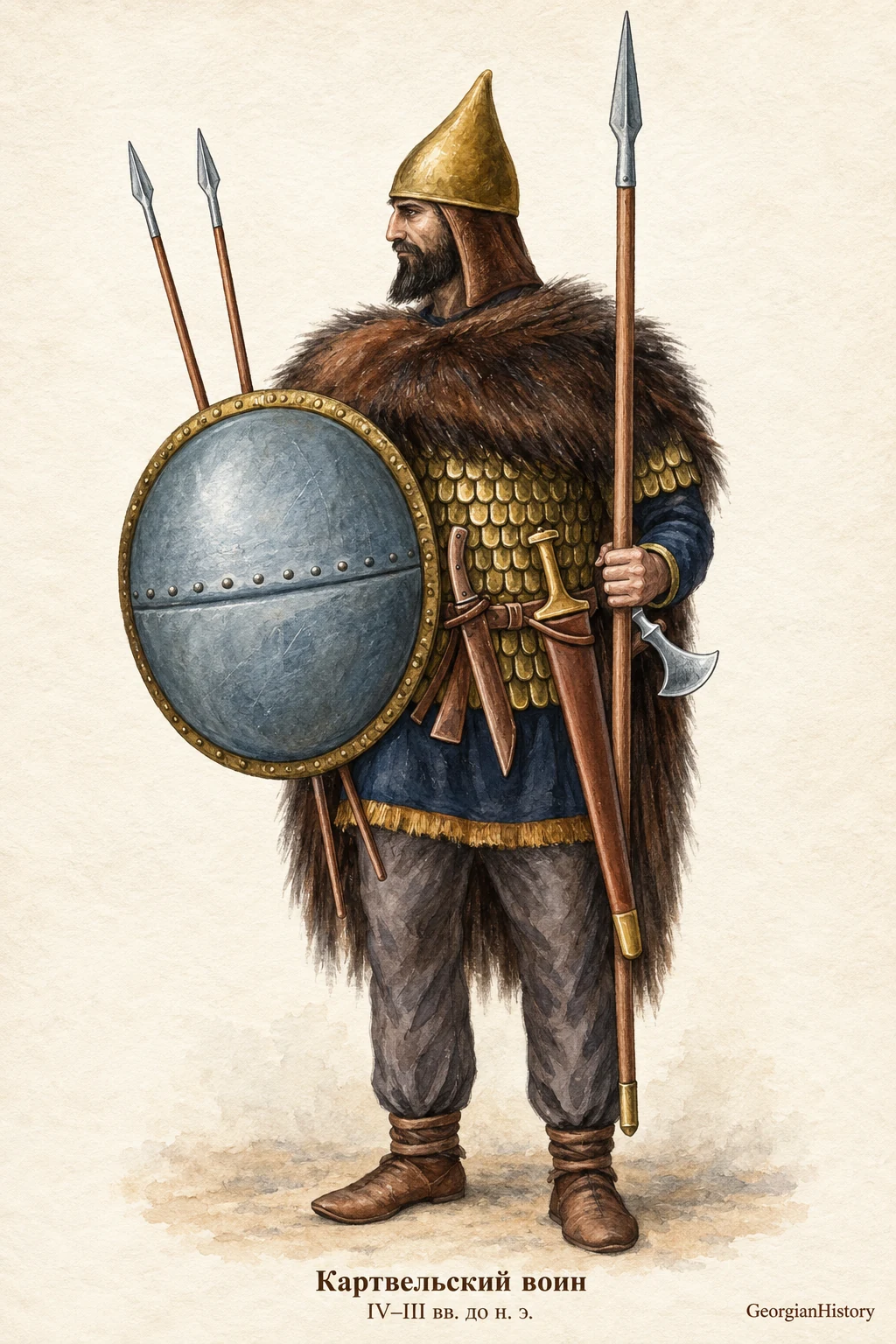
Spears, arrowheads, blades and axes make up an important part of the archaeological evidence for ancient Georgia. They help us study how weapons were made and how they changed across periods. The context of a find also matters when reconstructing warfare. An object from a burial, settlement or sanctuary could have served a different purpose in each. [4, 7]
Protective equipment survives unevenly. A metal fitting on a shield lasts longer than its wooden core and leather covering. Some elements of ancient arms are therefore known from the objects themselves, while others are reconstructed from images and comparable finds.
There is no single appearance that can be assigned to all Colchian and Iberian warriors. Wealth, place and period affected access to weapons and protection. This series represents those differences artistically. The illustrations help us picture people of the time, while archaeological evidence determines the date of individual objects.
Between great powers
Colchis and Iberia developed alongside major powers. Greek and Iranian influences are visible in works of art and luxury objects, though cultural ties did not always imply political subordination. Local societies selected and adapted examples from outside while retaining their own centres of power. [4]
In 65 BCE, during his eastern campaign, Pompey invaded Iberia and forced King Artoces to accept his terms. The episode brought the country into Rome's network of political relations. Iberia retained its monarchy under Roman supremacy and did not become a regular province. [6]
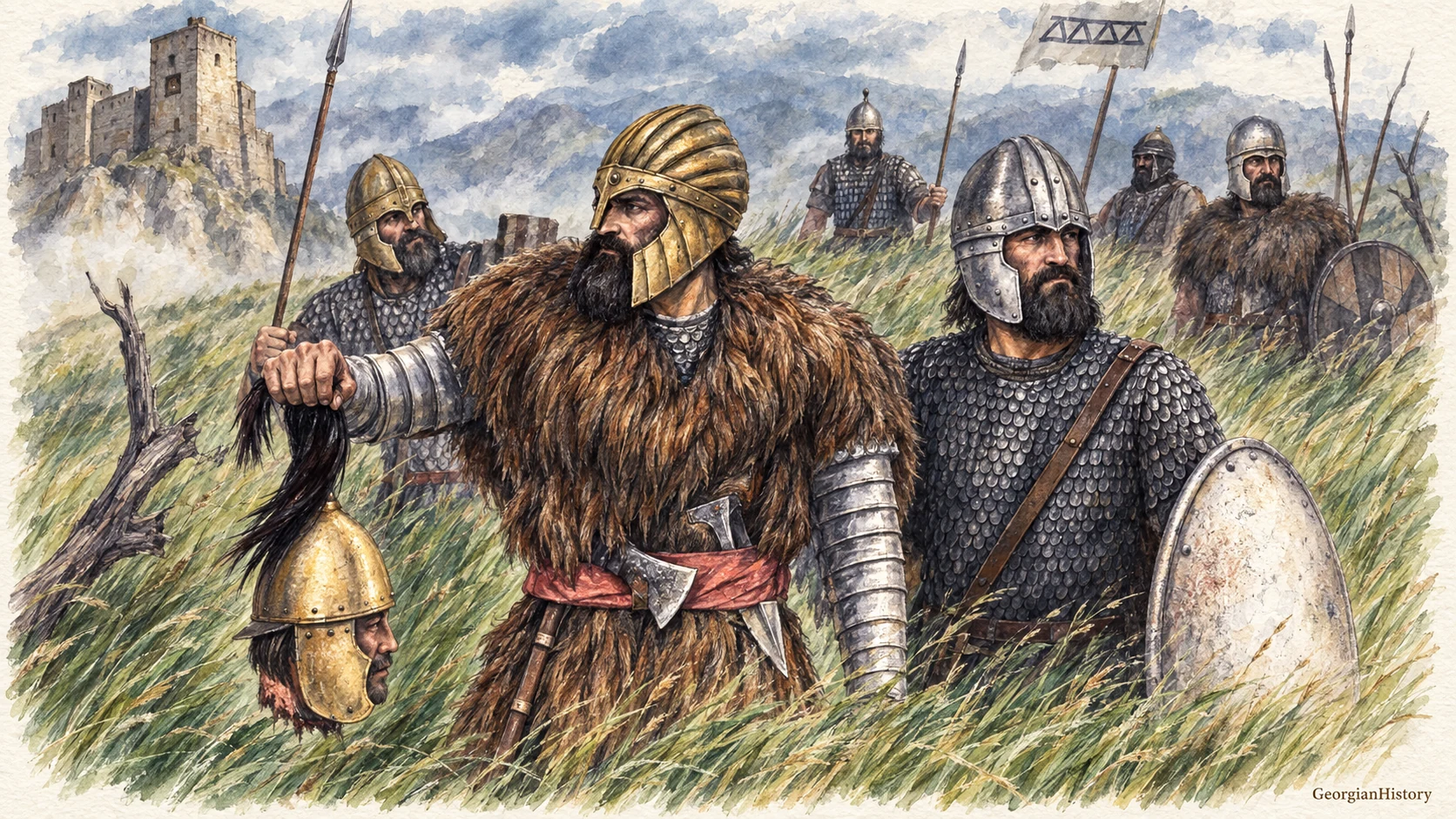
In the following centuries Kartli lay between the Roman and Iranian political worlds. Pressure from Sasanian Iran became particularly strong in Late Antiquity. The adoption of Christianity in the fourth century changed the country's religious and cultural life. In the sixth century the Sasanians abolished the Iberian monarchy. [3, 4]
The historical significance of Colchis and Iberia extends beyond the fortunes of particular dynasties. Urban centres, craft traditions and experience of government took shape there and informed later generations. Through the changes of antiquity and the early Middle Ages, these lands became part of the history of medieval Georgia.
Clothing and headwear
Weapons alone tell us little about an ancient person's overall appearance. Clothing, hats, hairstyles and ornaments fill out that picture and can reveal status and cultural connections. This selection of portraits based on reconstructions by Giorgi Tsiklauri brings together material from several periods. Each figure needs to be dated separately.
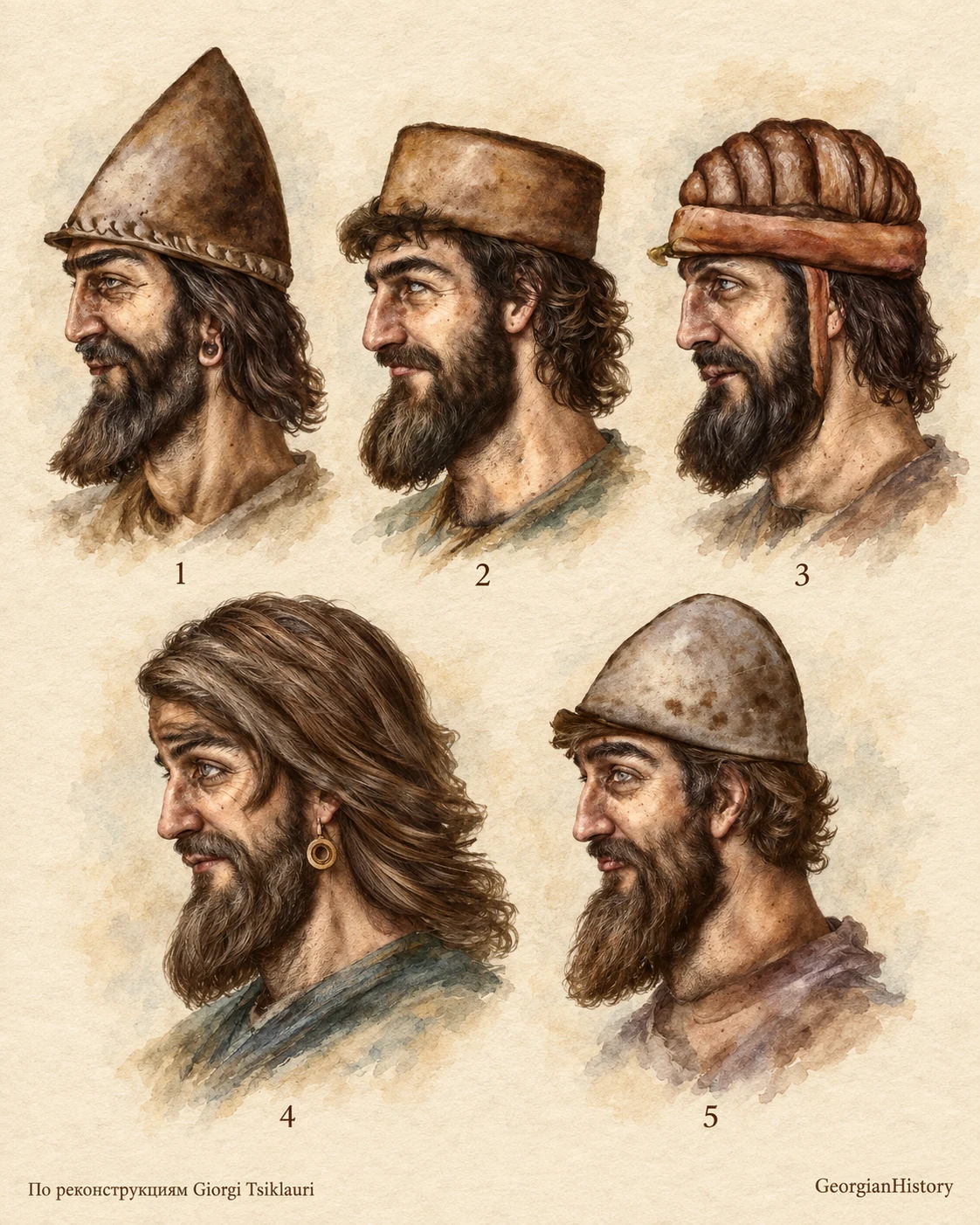
Headwear is reconstructed from sculpture, images on ancient vessels and archaeological finds. The outline is often reasonably clear, but the material and construction can require conjecture. The labels “felt hat” and “leather helmet” below describe the artist's interpretation.
The figure from Bedeni calls for particular care. It belongs to the Bronze Age and is much older than the Iberian kingdom. It appears here as part of the history of early dress in the territory of Georgia. It does not provide evidence for Iberian warriors of classical antiquity. [8]
Five figures from the ancient world
1 A hat based on an image from Vani
According to the reconstruction artist, the tall headwear derives from a sculpture from Vani. It is interpreted as a felt hat. The resemblance to later Georgian headwear is interesting as a comparison of shapes, but it does not establish that the tradition continued uninterrupted.
2 Headwear from Bedeni
The low cap is associated with material from a Bedeni burial. The Bedeni phase of the Early Kurgan period dates to approximately 2400–2000 BCE. This figure extends the story back into the Bronze Age. Its date rules out describing it as an established “Iberian hat”. [8]
3 A helmet based on an image on a cup from Gomi
According to the artist's explanation, the third figure is based on a depiction on a cup from Gomi. Identifying the headwear as a leather helmet remains a reconstruction. The parallels the artist proposes with bronze helmets from Varsimaantkari and Kamariskhevi need checking against publications on the specific finds.
4 Hairstyle and beard
The man with long hair and a beard presents one artistic reconstruction of how someone might have looked. Such a portrait brings the ancient period closer without assigning the same hairstyle to every inhabitant of Colchis and Iberia.
5 Possible Iberian headwear
The rounded shape of the fifth headpiece allows several interpretations. Without identifying the ancient model precisely, we cannot establish its material or protective function. The selection retains a neutral title.
About the illustrations
The watercolours are modern artistic reconstructions made with AI assistance from supplied materials. Several figures draw on reconstructions by Giorgi Tsiklauri. The new watercolours were prepared for GeorgianHistory and are not attributed to Tsiklauri.
Sources and further reading
- [1] Fitzwilliam Museum: The Search for the Golden Fleece
- [2] Kelsey Museum of Archaeology: the Vani excavations
- [3] George Sanikidze. Kartli, Encyclopaedia Iranica
- [4] Gocha R. Tsetskhladze. Georgian art and archaeology, Encyclopaedia Iranica
- [5] Strabo. Geography, XI.3
- [6] Study of the early kings of Iberia, Anabasis (2012)
- [7] Fitzwilliam Museum: the Vani burials
- [8] Bedianashvili et al. Textiles of the Bedeni period, Journal of Archaeological Science: Reports (2022)