Musical Instruments of Georgia. From Bone Flute to Svan Harp
Bronze Age bone flutes, musicians at Uplistsikhe and Vani, the ebani in medieval texts, and the string instruments of Georgian folk tradition.
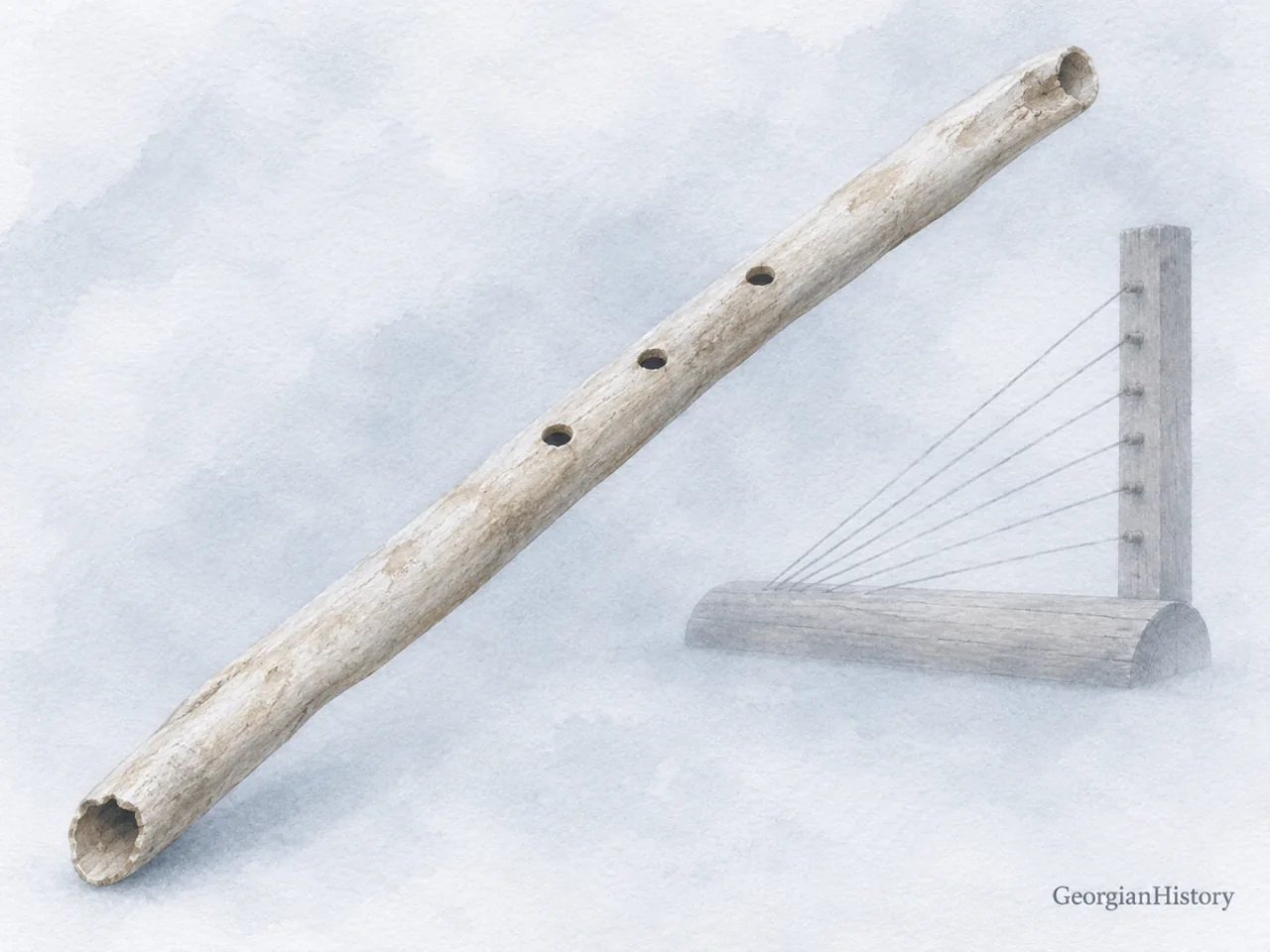
 In the Samtavro cemetery at Mtskheta, archaeologists found a small flute made from swan bone. It has three finger holes and measures about twenty centimetres. It lay in the grave of an adolescent. The historian Ivane Javakhishvili called it the “little shepherd’s salamuri”. The name stuck, although the adolescent’s occupation is unknown. The instrument is now in the Georgian National Museum. [1, 2]
Bone flutes of the Bronze Age
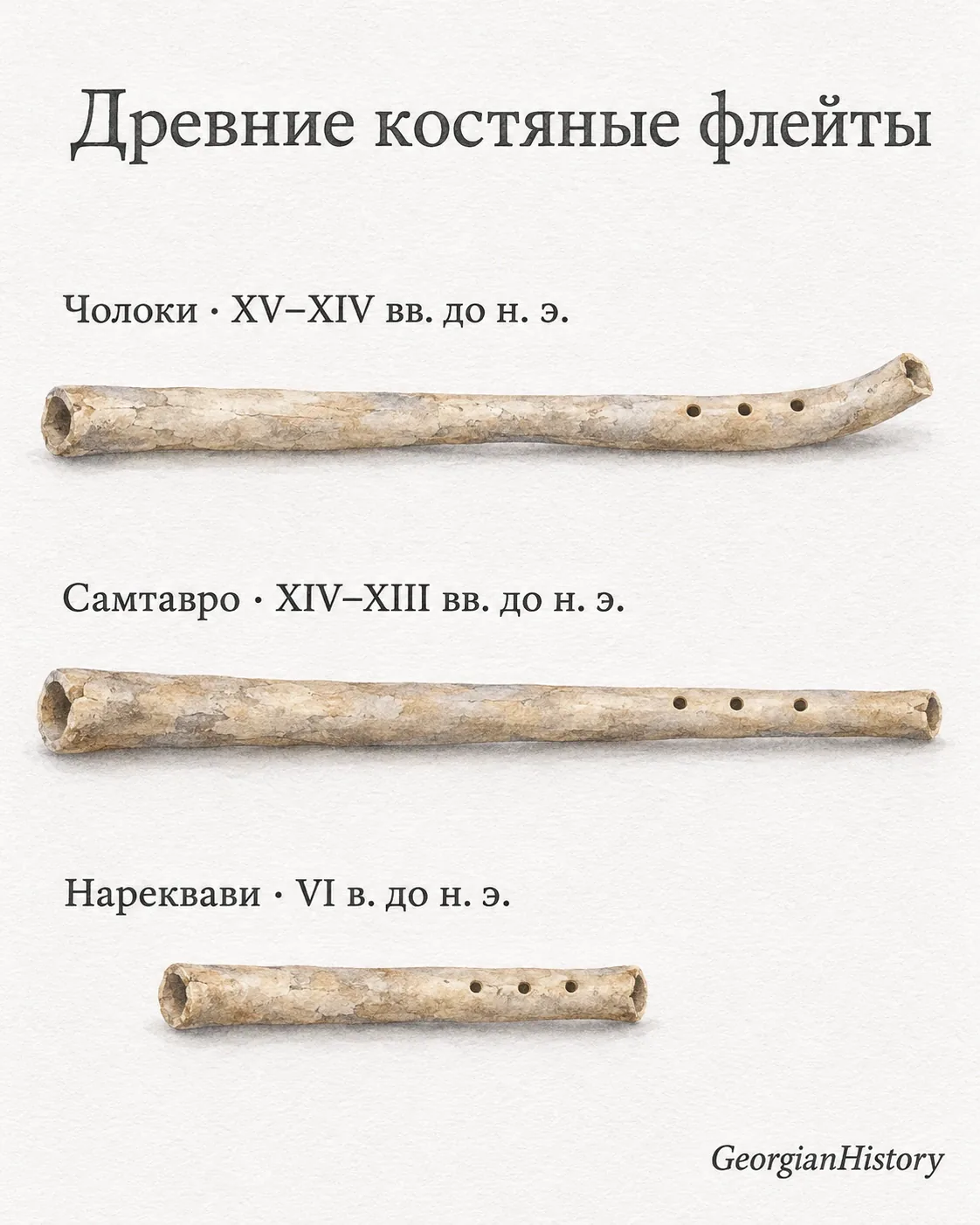
The Mtskheta find is part of a wider picture. At the Choloki settlement near Kobuleti, archaeologists discovered another bone flute of roughly the same length. Three finger holes were cut near its slightly curved end. The archaeologist Vera Chikhladze dates the Choloki flute to the 15th–14th centuries BCE and the Samtavro example to the 14th–13th centuries BCE. Ethnomusicologist Ketevan Baiashvili dates the Samtavro flute to the 15th–14th centuries BCE. [1, 2]
Bone pipes also occur in later contexts. A house at the Narekvavi settlement near Mtskheta yielded a sixth-century BCE flute with three holes. It is almost half as long as the finds from Choloki and Samtavro. Two types of salamuri survive in folk tradition, with and without a tongue. In 2000, the musician Sandro Nikoladze played the Samtavro flute at the museum. The experiment showed that the instrument can still sound. What people once played on it remains unknown. [1, 2]
Musicians in clay, bronze and mosaic
At Bambebi in Uplistsikhe, a layer dating to the seventh–sixth centuries BCE yielded a small clay figure of a seated musician. The figure holds a stringed instrument that scholars describe as a harp or a lyre. The figure gives an idea of its outline. Its tuning and construction are unknown. The same layer yielded a drummer figurine. [1]
At Vani, musicians appear on a bronze lamp of the late Hellenistic period. One small figure of Eros holds a three-stringed lute, while another holds an instrument that Chikhladze describes as a lyre. In the Roman period, a mosaic at Dzalisi depicted Pan holding a bundle of pipes. Archaeologists have also recovered actual percussion instruments, including pairs of bronze cymbals from the first centuries CE. [1, 3, 4]
What the medieval texts preserve
The word ebani appears in the writings of Shota Rustaveli and other Georgian authors. Ivane Javakhishvili associated the ebani with the changi and the lyre. That is one scholarly interpretation. A medieval name alone gives little indication of an instrument’s shape or sound. Ioane Petritsi offers a different kind of evidence. In discussing the Trinity, he draws on the example of three musical voices. In one case a name survives, in the other an idea of how voices sound together. [5, 6]
From Svaneti to eastern Georgia
The Svan changi is an open angular harp with six or seven strings. The Svan chuniri has three strings, a round body covered with skin, and a bow. In traditional performance, the two instruments can be heard together. [7, 8]
The panduri is widespread in eastern Georgia. The usual folk version has three strings, and a two-string version is known in Khevsureti. In western Georgia, musicians play the chonguri. Three long strings run along its neck. A shorter fourth string is fitted to a separate peg and provides a drone. The panpipe is called larchemi in Samegrelo and soinari in Guria. The museum collection in Tbilisi also holds the gudastviri, chiboni, doli, daira and diplipito. [7, 8]
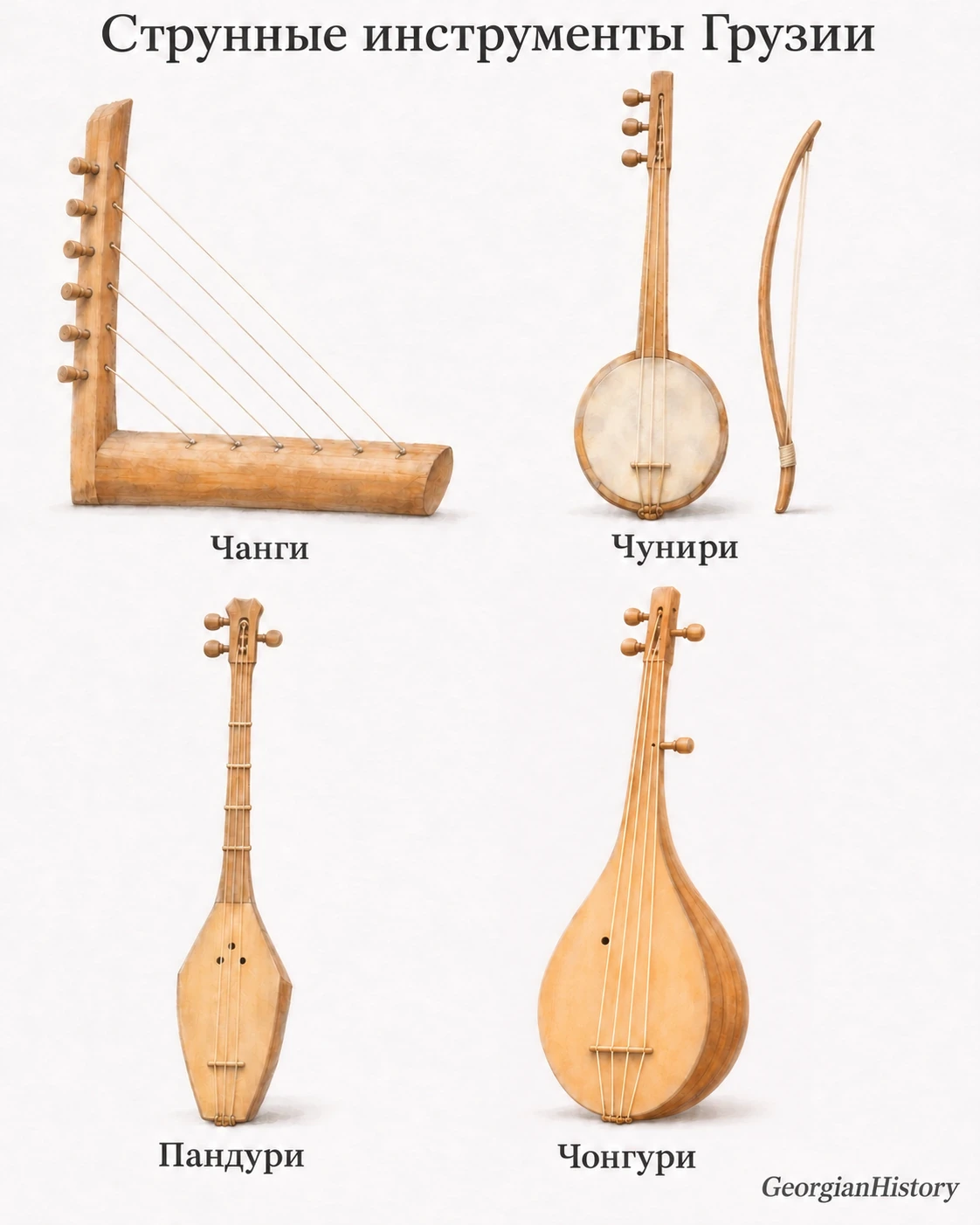
The short zili string runs between two long strings. Its upper end passes through the neck to the side peg. [9]
The bone pipe from Samtavro and the Svan harp are known through different kinds of evidence. Sometimes we can measure the object itself. Sometimes all we have is its image on a figurine or its name in a text. Where performance traditions have survived, we can hear the instrument alongside the human voice.
GeorgianHistory
Sources and further reading
- Vera Chikhladze · Musical Instruments Discovered in Georgia through Archaeological Excavations, pp. 162–167
- Ketevan Baiashvili · The Ancient History of the Shepherd-Boy’s Salamuri
- Getty · The Golden Graves of Ancient Vani
- Vera Chikhladze · Bronze cymbals from the first to fourth centuries CE
- Georgian Encyclopedia · Ebani
- Research Center for Traditional Polyphony · History of Folk Music
- Research Center for Traditional Polyphony · Musical Instruments
- Art Palace · Museum of Georgian Folk Songs and Instruments