A Royal Law for the Highlands: George V’s Dzeglisdeba
Mtiuleti, around 1334–1335. How George the Brilliant’s law code assigned responsibility for a ruined fortress, limited interest on debt, and asserted royal authority in mountain communities.
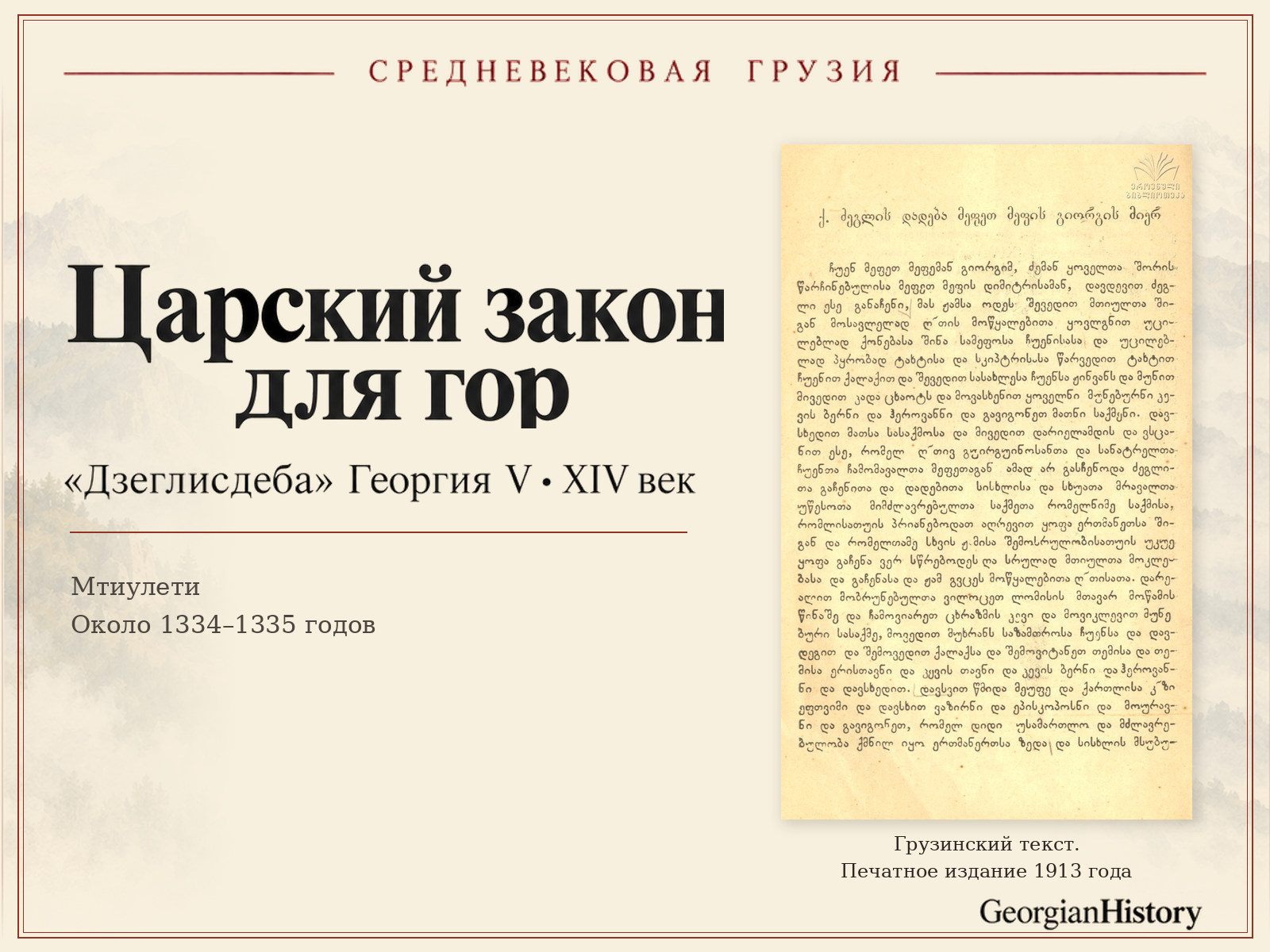
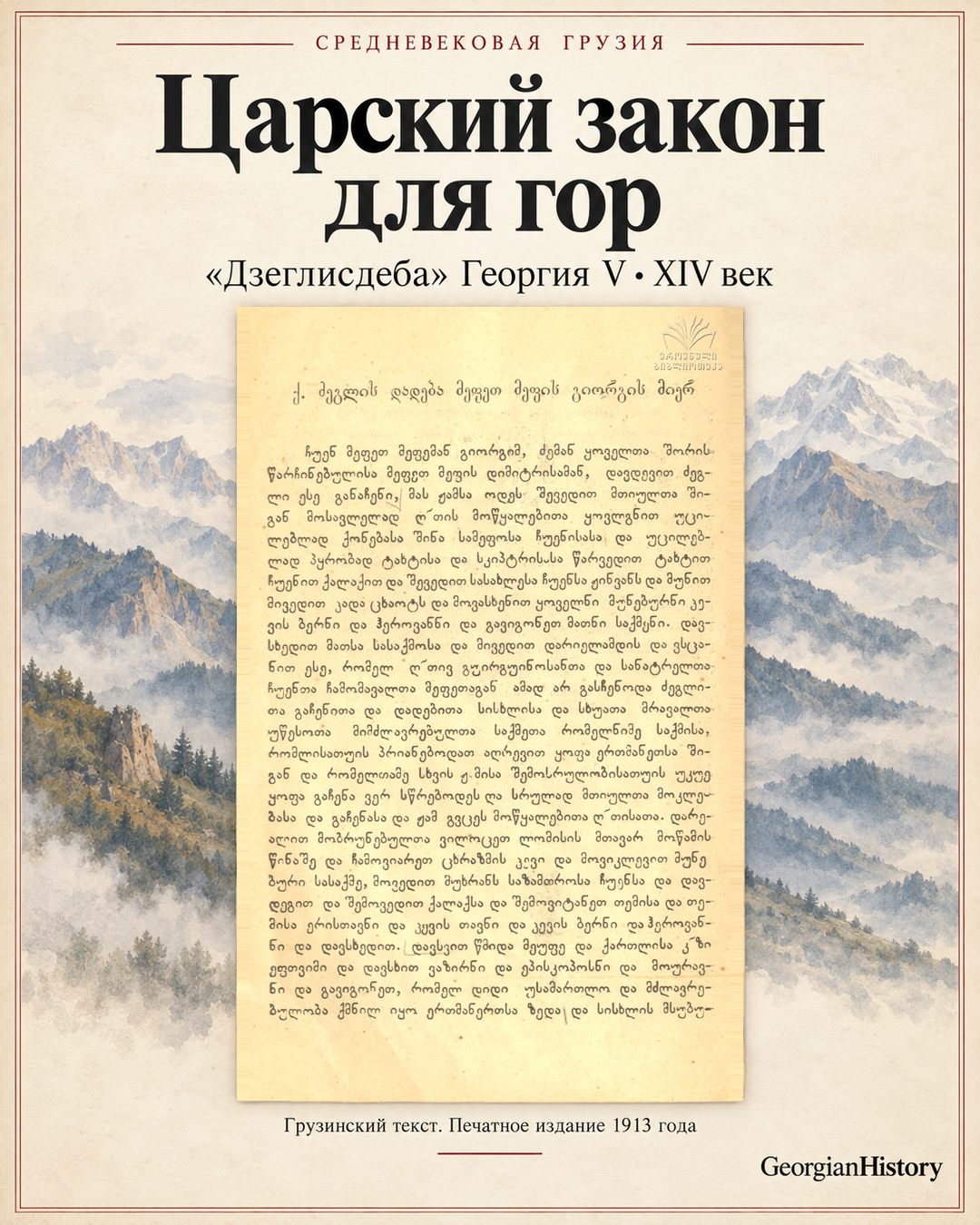
 A castle destroyed without authorisation had to be rebuilt. The offender also had to pay a penalty whose amount depended on the injured party’s standing. If the fortification was destroyed by order of the royal council, however, no liability arose. In this way, one provision of a medieval Georgian law code drew a line between private violence and the exercise of state authority. [1, 2]
The code is the Dzeglisdeba of George V the Brilliant, usually dated to 1334–1335. Its title is also rendered as Dzeglis Dadeba. The law was originally intended for the highlands of eastern Georgia, above all Mtiuleti. Its precise historical scope is still debated. The king’s inspection took him farther than the territory specified in the law itself. [3, 5]
Decades of upheaval preceded the document. Mongol rule weakened ties between royal authority and the highlands, while military operations in the Aragvi valley intensified local disputes. George V was restoring authority across the country. Putting the rules in writing was one means of doing so. The law set out who could judge disputes, how damages should be made good and which decisions required intervention by the royal council. [3]
The preamble relates how the ruler travelled from the capital into the mountains, visited Zhinvali and Khada-Tskhaoti, and reached Darial. He summoned local leaders, heard them out and investigated conditions in their lands. On returning, the king called a council attended by the catholicos, bishops, viziers and representatives of local government. This is how the document explains the origin of its rules. [1, 2]
The picture in the preamble is grim, with killings, ruined fortifications, attacks on property and breaches of family relations. The lawmaker nevertheless recognised that it was no longer possible to reopen every past conflict and secure fair compensation. The new rules therefore looked chiefly to the future. The proviso points to a practical aim: laying down a procedure for resolving the next disputes. [1, 2]
Royal authority relied on local government, protected its representatives and specified which matters had to be settled through the darbazi, or royal council. Church affairs retained a jurisdiction of their own. Customary rules operated alongside the sanctions of state authority, bringing the established relations of highland society into the order laid down by the king. [3]
Article 27, on the destruction of a castle, makes this aim particularly clear. Compensation extended beyond a monetary penalty. The offender had to restore the fortification in keeping with its owner’s standing. An order from the darbazi changed the legal status of the act. The law thus vested central authority with the power to authorise conduct for which a private individual would have been liable. [1, 2]
Debt was an everyday concern alongside violence and government. Article 46 condemned the charging of interest but set a limit for a lender who still demanded an addition: two units of silver for every ten. The lender could claim no more, however much time had passed. This was a cap on the total addition to the debt. It would be inaccurate to call it an annual interest rate of twenty per cent. [1, 2]
The vocabulary of the code also illuminates the organisation of authority. The legal term ganchineba could mean a judicial decision or the laying down of a binding rule. Judicial and lawmaking powers were closely connected. The code nevertheless retained distinctions of social standing and provided for harsh penalties, including forcible shearing of the hair. This law belongs to its period and must be read in historical context. [4, 5]
The value of the Dzeglisdeba lies in the specificity of its surviving provisions. They show how royal authority tried to define responsibility for violence, procedures of government and limits on property claims. The code itself cannot establish whether every rule was enforced. It does preserve George V’s aim of placing relations between highland communities and the state on a written, binding footing. [3]
Sources and further reading
- 1. Sargis Kakabadze (ed.). ‘ძეგლის დადება გიორგი ბრწყინვალის მიერ’. Tiflis, 1913. Georgian text of the preamble and the articles on the destruction of a fortification and on loans. The last article is on p. 16.
- 2. Oliver Wardrop. Laws of King George V, of Georgia, Surnamed “The Brilliant”. Journal of the Royal Asiatic Society, 46(3), 1914, pp. 607–626. Preamble on pp. 610–612, article 27 on pp. 620–621 and article 46 on p. 626.
- 3. David Purtseladze. The Law Code of George V, King of Kings. Tbilisi: Metsniereba, 1988. The introduction covers the historical context, the disputed scope of the law, local government and the darbazi.
- 4. Sulkhan Oniani. For the Meaning of the Term “Ganchineba” in Old Georgian Law. Journal of Law, no. 1, 2014, pp. 22–27, especially pp. 22–23. The term and the connection between judicial and legislative powers.
- 5. Sulkhan Oniani. On One Legal Formula Found in the Monuments of Georgian Law. Journal of Law, no. 1, 2025, pp. 5–21. Page 5 gives the date of 1334–1335 and lists shearing of the hair among the penalties.
- Supplement to source 3: complete 1988 Georgian–Russian edition at the National Parliamentary Library of Georgia. In Wardrop’s translation, article 27 is on p. 85 and article 46 on pp. 111–112.