Feudal Georgia in the Age of Queen Tamar
Behind the throne stood a country of farmers and aznauri, provincial governors and officials, clergy, artisans, and scribes. Their labour, rights, and duties shaped the kingdom.
 Its own legal vocabulary, patronqmoba relations, land rights and court institutions reveal a distinct historical tradition in medieval Georgia. It developed in the Caucasian world in interaction with neighbouring cultures. The account is organised around the relationship between land, service, power and knowledge.
The country behind the royal throne
The strength of the Georgian kingdom in Tamar's time took shape far beyond the royal palace. It depended on who owned the land, who worked it, who received the income and who could turn that income into armed force. A royal order passed through the hands of senior officials, provincial governors and local landholders. A grant to a monastery changed the lives of people who had never been present when it was discussed. The work of an urban workshop met the needs of the court, the army and the village, while a charter drawn up by a scribe could determine a family's position for longer than a human lifetime.
We call this society feudal. The term encompasses a whole range of relationships: a landholder's authority over dependants, a noble's service to his patron, the hereditary advantages of aristocratic houses, and the provision of land to support public office. In Georgia these relationships had their own terminology, historical development and legal practice. Understanding them means looking at the kingdom, the province, the estate and the individual household together.
Tamar's reign allows us to examine the system during a period of considerable political and cultural growth. Her independent reign began in 1184. Her co-rule with George III, which preceded it, is usually dated to 1178, although some scholars give 1179. Our subject is considerably broader than this dynastic event. It is the organisation of the country Tamar had to govern: social strata, land rights, obligations, institutions, ways of making decisions and the material foundations of culture.[1–3]
The evidence for this world varies in kind. A chronicler records appointments and conflicts in detail but pays much less attention to daily labour. A charter reveals particular rights and obligations without describing society as a whole. A later palace ordinance sheds light on the organisation of court services while preserving rules from different periods. Some details therefore require chronological qualifications. It is important to distinguish Tamar's Georgia from the legacy of the previous century and from arrangements that only took their final form later.
1. Land as the basis of the economy and power
For a medieval landholder, land was a source of regularly renewed wealth. Arable fields yielded crops, vineyards produced grapes and wine, and pasture sustained livestock. An estate, however, amounted to more than a list of parcels. Its value depended on people who knew how to farm, access to water, the condition of the roads, the ability to store the produce and the means to obtain the share due. The study of feudalism therefore calls for questions about both the extent of the land and the rights attached to holding it.
One of the most important Georgian terms was mamuli (მამული). The word retained its connection with paternal inheritance. It could refer to property received from one's ancestors, to land or even to one's homeland. In the history of landownership its meaning as an inherited estate is especially important. Mamuli gradually came to denote the hereditary character of property regardless of how it was first acquired.[7]
Such a right linked several generations. The holder controlled a resource on which his heirs depended and sought to protect it against outside claims. Family memory acquired practical economic content: who received the land, on what grounds and who confirmed the grant. A preserved charter, evidence of purchase or the memory of royal favour could become an argument in a future dispute. For a family, losing an estate meant having fewer means to maintain a household, support its service and preserve its accustomed standing.
Alongside hereditary estates there was provision in return for service. This is associated with the term sakargavi (საკარგავი), whose holder was called a mosakargave (მოსაკარგავე). In studies of the eleventh to thirteenth centuries the term refers to land and income provided in connection with the performance of duties. The recipient gained the material means to serve, while the authority providing the resource expected the assigned duties to be carried out.[8; 41]
The difference between hereditary property and provision for service had political consequences. The sovereign needed to retain the ability to appoint someone else and give that person the resources required for the office. The holder sought to make his own position secure and provide for his children. This produced a lasting tension: a grant needed for government might eventually strengthen a house that had come to consider the grant its own property.
An estate should not, however, be imagined as a single parcel with a single origin. A large holding could combine inheritance, purchases, grants and other acquisitions. Different parts of the property might be held on different grounds. The question ‘whose land is this?’ therefore prompted further questions: was it inherited or attached to an office, which obligations remained in force, who confirmed the right, and what exactly could the next holder pass on?
The kingdom distinguished between land under state administration, estates directly supporting the royal house, and lands held by lay and ecclesiastical owners. Historians associate the administration of state provinces with the eristavi, while the royal domain had its own stewards. These distinctions help explain why a provincial governor's official powers cannot automatically be equated with his personal wealth in land.[9]
The royal domain gave the throne an economic base of its own. Resources at the sovereign's disposal through royal servants could maintain the court, support particular armed forces and sustain grants. Where those resources were insufficient, dependence on the agreement of large landholders increased. Land policy thus directly affected the royal authority's capacity to act independently.
For an ecclesiastical institution, an estate allowed it to continue its work. Income supported worship, the maintenance of the brethren, construction and the production of books. For a lay household it made it possible to maintain armed men and take part in politics. In both cases the right to income reached beyond private consumption: it determined the owner's social weight.
The landholder's income and the royal treasury
Payments that looked alike could rest on different rights. A dependent household gave a share of its produce to the landholder who administered its obligations. The crown received funds from its own estates and through institutions responsible for revenue. Understanding the economy therefore depends on knowing to whom the income was due and on what grounds it was demanded.[14;42]
On a rural estate, the revenue linked the producer's household to the maintenance of a lord's house or an ecclesiastical institution. In town, trade dues and customs duties administered by the royal financial offices were added to this. Crops, money and service reached their recipients by different routes. The recipients could then use those resources to maintain the court, provide for armed forces or support a monastery.[14;42]
A revealing example survives in Tamar's charter to Gelati, which the National Archives dates to 1187. Twelve monks without means of support were assigned a share of the revenue from the village of Chorvila. The order concerned a specific income intended to provide for them on an ongoing basis.[49]
Such an assignment could turn a royal grant into a long-term supply. The recipient had to preserve the right to the revenue, and it had to continue to be provided locally. Transferring the revenue affected the village economy even if its inhabitants took no part in the decision. A grant of part of the revenue does not in itself describe a transfer of all the land and all the rights over its population.
Exempting people or institutions from demands changed how resources were distributed. In a charter it matters which levies were lifted, who lost the right to impose them and which duties remained in force. Grants to the Church, immunities and peasant obligations therefore need to be read together: a single document could both provide for a monastery and define the duties of several households.[39;45]
Here one of the principal features of the feudal order comes into view. Economic advantage could become the power to direct people and participate in government. Yet land rights did not give every owner the same degree of authority. A small aznauri and a powerful lineage might both belong to the privileged stratum while commanding resources on altogether different scales. The size of an estate, the legal basis of its holding and the powers attached to it need to be distinguished throughout the account.
2. Patronqmoba and different forms of dependence
In Georgian historical usage, relationships of protection, subordination and service are expressed by the term patronqmoba (პატრონყმობა). It brings together the patroni and the qma. Depending on a person's position, qma could refer either to a noble bound by service or to a dependent producer. It therefore cannot be rendered by the same Russian word in every context.[6; 41]
A noble bound to a patron retained the advantages of his social position. He might be expected to serve in war, carry out assignments and remain politically loyal. Patronage offered support, access to grants and the possibility of protection. For a peasant, dependence chiefly affected the household economy, obligations and scope for personal action. A shared vocabulary did not make these relationships equivalent.
This is where the familiar feudal ladder needs explanation. Its upper part generally shows ties among privileged people, while its lower part shows the position of those whose labour sustained landholding society. A substantial legal and social difference lay between them. A holder who owed military service and a family that handed over a share of its produce had different relationships to their lord, even if both depended on the same house.
A nobleman could have a patron of his own. His position did not necessarily rest on a direct tie to the king. The nobility had its own relationships of seniority and subordination. Social organisation is therefore best understood as several intersecting ties. Some grew out of landholding, others out of service, and still others out of family and political relationships. Together they determined whose support a person could count on and whose demands he had to take into account.
Hereditary advantages did not remove the need for protection. The more that depended on the land and the family's position, the more important it became to defend them in a dispute. An association with a stronger house could make a practical difference to a small landholder. For a powerful patron, dependants who served him made it possible to act beyond his immediate circle.
Loyalty had concrete consequences. When a conflict arose between the king and a powerful lineage, it involved people, offices, fortresses and income. Publicly acknowledging authority meant having to support it in practice. Breaking a tie could mean losing a grant or an office. The personal dimension of medieval politics therefore cannot be explained simply by the personalities involved. Personal ties organised a considerable part of government.
The system also allowed people to rise. The sovereign could rely on someone whose influence initially depended on royal service and give him the means to perform important duties. What happened next to such a house was not predetermined. Once it had land, office and connections, a newly established service family acquired interests of its own. Simply replacing old royal favourites with new ones could not eliminate that possibility.
The term batonqmoba (ბატონყმობა) also requires historical care. Scholarship has interpreted the relationship between batonqmoba and patronqmoba in different ways, and the meanings of the words themselves changed. It would be inaccurate to reduce all Georgian feudalism to a later popular understanding of serfdom. Behind the general concept of dependence we must therefore distinguish the specific parties: a noble in service, a peasant, an ecclesiastical institution or a landholder wielding political power.[6]
The structure of patronage explains both the kingdom's resilience and its vulnerability. It bound people through reciprocal expectations, sustained service and made it possible to distribute resources. When several powerful patrons came into conflict, these same ties became lines of political division. The crown had to keep them operating within a common political order.
3. Aznauri and didebuli
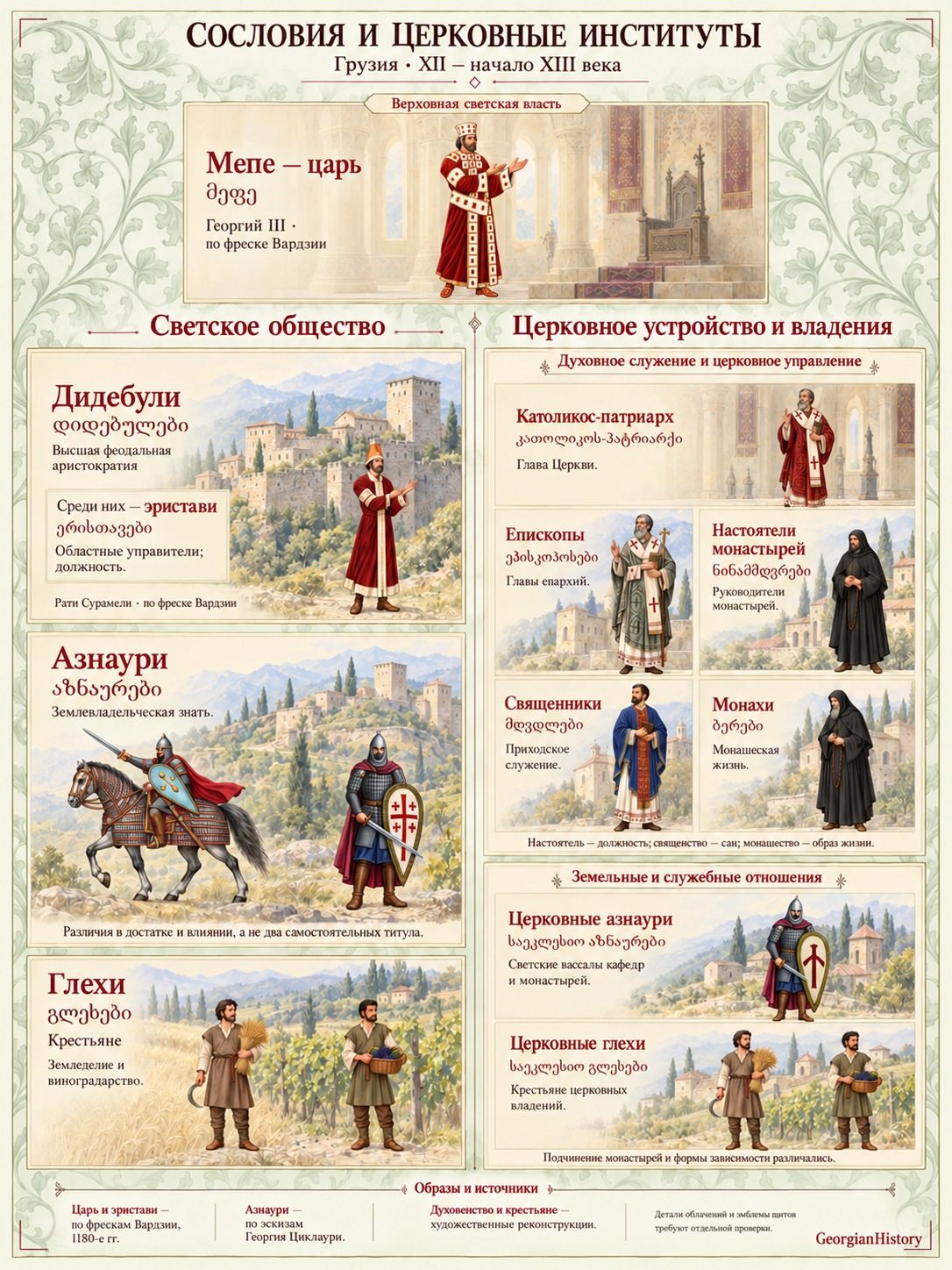
The word aznauri (აზნაური) designated the privileged landholding stratum. Historians describe wide differences within it in the tenth to thirteenth centuries. Some landholders had extensive lands, dependants, a fortress of their own and a family monastery. Others had considerably more modest means. A shared noble standing did not imply equality in wealth, influence or closeness to the court.[4]
The didebuli (დიდებული) formed the upper tier of this stratum. Large estates, high social standing and senior offices were associated with their position. Historians debate how conferred rank, official powers and pre-existing wealth related to one another. For Tamar's period, what matters is their conjunction: a leading court official could also be the head of a powerful landholding house.[5]

Role in society
A member of the privileged nobility. His standing depended on birth, landholding and service. The shield design is conjectural.

Role in society
Horse equipment showed what its owner could afford. “Mounted aznauri” was not a separate title.
Figures based on sketches by Giorgi Tsiklauri. Differences in wealth and arms do not represent two separate titles. The shield designs are conjectural.
This distinction also matters when depicting the social estates. A wealthy aznauri and one of modest means, shown side by side, belong to the same broad privileged stratum without being socially equal. More expensive arms may reflect greater economic resources, while a position at court may reflect connections and acknowledged service. The appearance of armour alone, however, cannot establish its owner's exact legal rank.
Hereditary standing allowed a family to preserve its advantages after an individual's death. Someone born into a recognised noble house acquired a social position that another person had to earn through exceptional service. Descent therefore had value in its own right. It gave people grounds to expect honour and to challenge the elevation of those whom rivals considered insufficiently well-born.
Sources for the beginning of Tamar's reign show how acute the issue could be. Discontent with George III's favourites found expression in demands that houses distinguished by lineage and service be restored to their proper place. Ideas of honour mattered in this contest, but behind them lay concrete powers and resources. Losing a place near the throne put access to decisions, grants and royal backing at risk.[15; 38]
The well-born never acted as a single united faction. Houses competed, maintained their own connections and assessed the benefits of royal policy differently. A senior officeholder might support the throne to protect his position, while his rival called for change. It would therefore be too crude to explain every conflict as the same confrontation between the king and ‘the entire nobility’.
Social rank must be distinguished from office. The eristavi (ერისთავი) was defined primarily by the powers of provincial government. The amirspasalari (ამირსპასალარი) headed military administration. A member of the highest nobility could hold such offices, but the terms answer a different question: what authority did the person exercise? A diagram depicting didebuli, eristavi and amirspasalari as three mutually exclusive estates hides the possibility of their combination in one person.[9; 11]
Nor can the later hierarchy of tavadi and aznauri simply be projected back into the twelfth century. The history of the word tavadi and the emergence of the tavadi as a distinct social estate were part of a long development. Historians associate the differentiation of that estate with later centuries. For Tamar's time, it is safer to speak of a varied aznauri stratum, its upper tier, powerful lineages and particular offices.[4]
Noble society combined hereditary continuity with the possibility of mobility. Service could open a path upwards without cancelling the advantages of old houses. Wealth strengthened a family's position, although using it politically required recognition and connections. This combination makes social history more revealing than a table of titles. It explains why people of the same origin could carry different weight and why people of different origins could find themselves working alongside one another in government.
4. Glekhi and the economy of a dependent household

Role in society
Agricultural labour sustained the household, provided income for the landowner and supported the material foundations of the kingdom.

Role in society
Tending vines and making wine were part of the country's economic life.
Composite depictions of rural inhabitants. Artistic reconstruction.
At the base of the landholding order was the glekhi (გლეხი), the peasant. Georgian historiography associates this category with a dependent farming population whose position took shape over the preceding centuries. By the time of the developed monarchy, the rural producer was already part of relationships that limited economic and personal independence.[28]
The word ‘peasants’, however, covers a wide range of circumstances. A family's means, its terms of land use, how its dependence arose and what it owed all mattered. One household might have more reliable means of production, while another faced a constant shortage of resources. Dependence does not tell us that all rural inhabitants lived alike.
The farming household's first concern was to keep its economy going. Its produce had to feed the family, provide seed for the next sowing, maintain its livestock and meet its obligations. Part of its income or labour went to the landholder. The household's ability to get through another season depended on how much it retained and how securely its terms of tenure held.
This order had a rhythm of its own. A vineyard needed years of care, a field had to be worked at the right time, and livestock needed feed. Losing a draught animal could not be offset by one extra spell of work without consequences. A failed harvest threatened both the family's subsistence and its ability to meet the landholder's demands. Farming meant living with economic risks and obligations that did not automatically lapse when a harvest went badly.
Rural neighbours and shared work
A household's economy depended on relations with its neighbours. Water use, access to land and carrying out work could bring several households together. Such relationships existed alongside obligations to the landholder. Understanding rural life means distinguishing the individual household, the organisation of neighbours and rights to land.
In historical usage, daba (დაბა) is associated with a rural community of neighbours. It gradually gave way to the word sopeli (სოფელი). The history of the settlement retained traces of collective organisation even after individual holdings developed. Living as neighbours and working together, however, do not in themselves mean that all the land remained the inhabitants' common property.[50]
The word temi (თემი), attested in written sources from the twelfth century, could denote both a territory and the community living there. Its scale varied from a single locality to a province and to a larger whole. Its meaning must therefore be established from the context in each instance. The term alone cannot reconstruct the organisation of local government.[51]
The division of labour is especially clear in Tamar's charter on maintaining the water supply from Skhaltba to Shio-Mgvime. At the request of Anton Chkondideli, two royal peasant households of the Kosaisdze family were assigned to the monastery to care for the installation on an ongoing basis. The monastery added two more households. If the damage was considerable, additional workers from Skhaltba and other villages were to be called in.[54]
Several levels of organisation are visible: a royal order, an official's initiative, the monastery's decision and the labour of the households assigned to the task. Routine maintenance differed from major restoration work, which required more people. The example shows one particular allocation of duties. It cannot automatically be taken as the rule for all rural water use.
Obligations and the household's position
Obligations took different forms. They might involve deliveries of produce, payments or labour. Begara (ბეგარა) is an important term in Georgian usage. The narrow rendering ‘corvée’ does not capture its full scope in Georgian history, where the word could cover several obligations tied to landholding. Their content depended on the particular terms and the organisation of the local economy.[42]
No single percentage of the harvest, standard number of workdays or uniform amount of peasant payment can therefore honestly be given for all of Tamar's Georgia. Rules varied, and surviving documents reflect only part of the practice. Detailed categories of dependent households and norms from later inventories cannot simply be turned into a kingdom-wide table for the twelfth century.
Understanding these relationships depends more on who made the demand, whom its fulfilment benefited and how it was established. A delivery in kind supplied the recipient with a particular product. A labour obligation ensured that a specific job was done. A cash payment presupposed the ability to obtain or dispose of money. Each form linked the producer's household to the landholder's needs in a different way.
Rural labour supported far more than a landholder's personal consumption. Maintaining an armed man meant fodder, provisions, the processing of materials and the ability to draw people away from farming. Monastic life needed regular supplies. A palace needed resources to be collected and distributed. This does not mean that each item was taken directly from a single peasant household. It shows why agricultural production remained an essential foundation for society as a whole.
Dependent households could have different owners: the royal house, a lay landholder, an episcopal see or a monastery. The expression ‘church peasants’ describes this affiliation. It does not make a farmer a monk or turn his labour into a freely chosen act of religious obedience. The family's actual position still has to be established from its obligations and documents, rather than merely from the owner's general designation.
A gift of land or income could change the beneficiary of an obligation. An act of piety described from the donor's perspective thus had another side: it concerned the labour and position of the people who supplied the gift. For a historian, both perspectives matter. The monastery obtained the means to conduct worship and produce books, while dependent households continued to fulfil their established duties.
A change in material circumstances did not always mean a change in personal status. A more prosperous dependent household retained its obligations, while a noble of modest means retained the advantages of birth. Economic and legal inequality intersected without fully coinciding. This is one reason why feudal society cannot be explained merely by dividing it into rich and poor.
Finally, rural life left fewer personal names in the sources than life at court. This inequality in historical memory should not dictate how much attention we give each. Sustained rural labour, the continuity of households, care for the means of farming and the fulfilment of obligations shaped the kingdom's stability as directly as appointments at the top of government. The Golden Age took place within a society of unequal rights and opportunities. Cultural growth did not remove that foundation.
5. Mepe and the foundations of royal power
The sovereign's highest rank was expressed by the word mepe (მეფე). Tamar went down in history as Tamar Mepe, a ruler in her own right. The content of royal power is seen above all in the crown's relationship with the other participants in the political order. The sovereign confirmed rights, granted estates, appointed senior officials, directed military policy and helped uphold justice. Hereditary rank gave a claim to supreme authority. Exercising it meant dealing with people who had their own resources and recognised standing.

Role in society
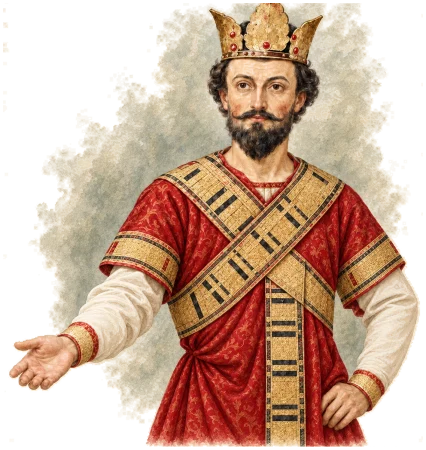
An artistic portrayal of the king. The robes draw on the Vardzia frescoes.
George III. Reconstruction of his appearance and royal clothing.
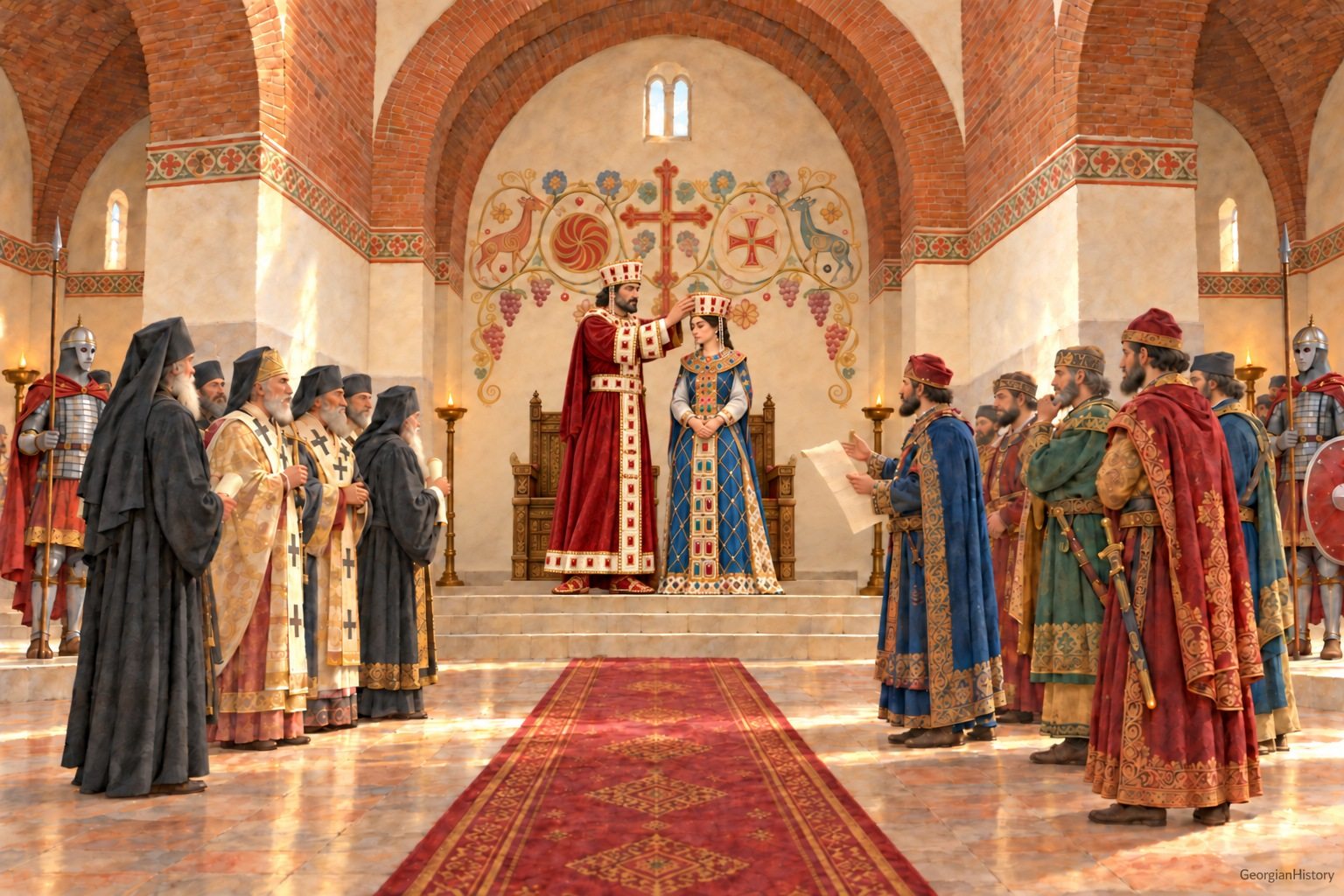
Tamar's transition to independent rule in 1184 shows the distinction especially clearly. George III had made his daughter co-ruler in advance and secured her a recognised place beside the throne. After his death, the question of royal rank became linked to who would receive the major offices and which houses would influence decisions. The continuity of the monarchy did not remove the need for political negotiation.[1–3]
The throne drew strength from several sources. The royal house had resources of its own. Service created a circle of people tied to the ruler by assignments and grants. Military leadership made it possible to muster forces from different provinces. Recognition by the Church placed royal authority within a Christian understanding of social order. Dynastic tradition made the crown a dignity that outlasted any one ruler.
These sources of strength reinforced one another, but could also pull in different directions. Land given to a loyal man supported his service while increasing his house's ability to act independently. High ecclesiastical rank strengthened an official's authority without making him a mere instrument of royal will. A military commander was indispensable to the sovereign precisely because he controlled considerable force. A strong monarchy therefore needed a durable way to organise relationships as well as a decisive ruler.
Coins provide visible evidence of royal power beyond the palace. Numismatic material from Tamar's time bears Georgian and Arabic inscriptions, royal names and formulas of rank. Copper coinage belonged to a monetary practice connected with wider circulation in the Near East. These objects brought economic life together with a public expression of the reign.[36]
The right to make grants was especially significant in feudal society. It allowed authority to recognise service and build support. A grant, however, had lasting consequences. Later holders tried to retain what they had received, heirs invoked their ancestors' rights, and ecclesiastical institutions safeguarded the documents confirming those rights. Each new order became part of an existing memory of landholding and obligations.
The stature of the kingdom in Tamar's time should therefore be understood through the throne's capacity to bring different social forces together. Military success required people to fulfil their service. Income required a functioning economy and administration. Decisions needed recognition and implementation on the ground. Royal power was supreme, yet its practical effect depended on how the entire country was organised.
6. The province and the ruling house
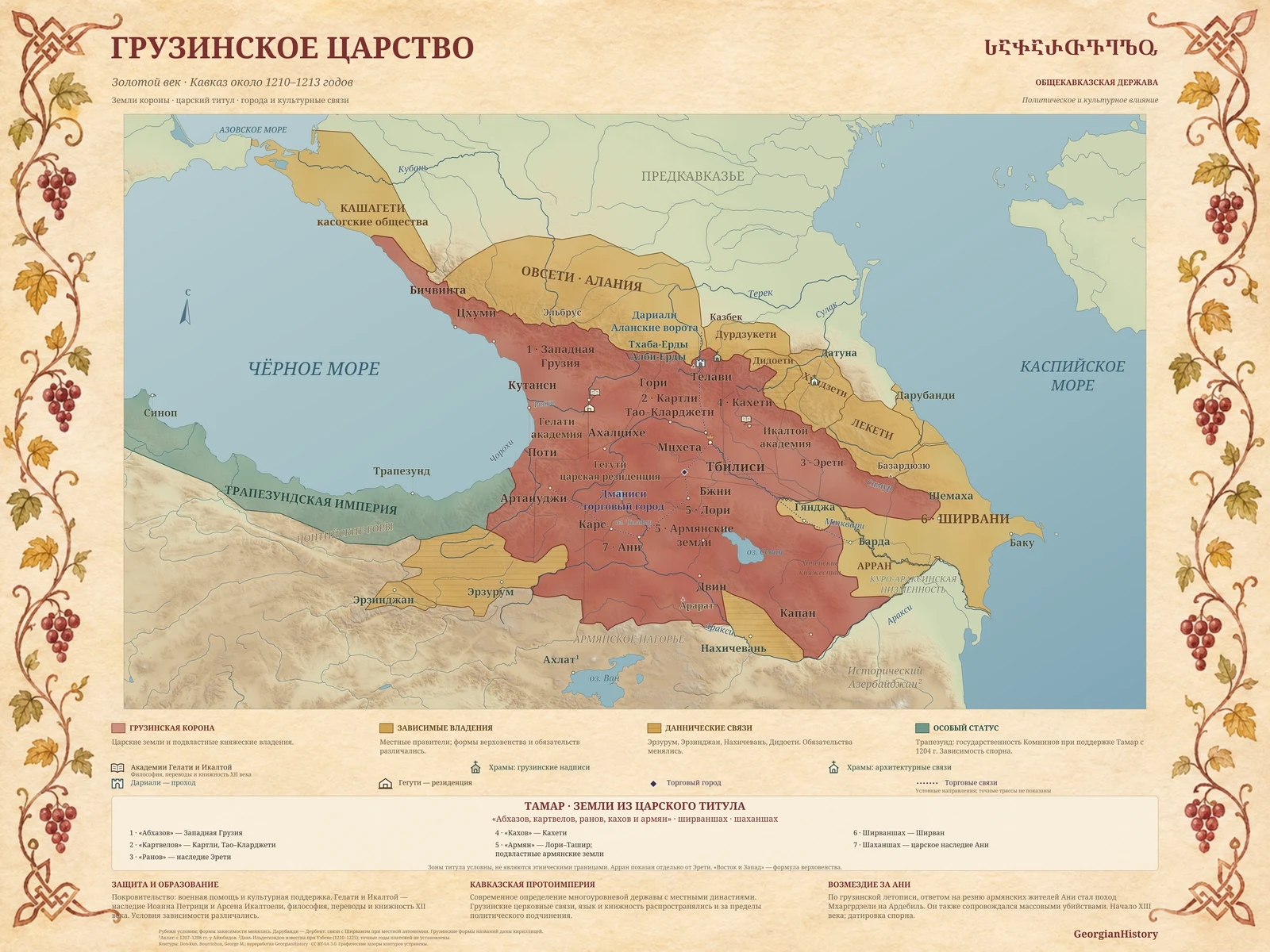
The outer line marks the extent of the illustration. Internal boundaries are approximate. Flags, animals and other emblems are artistic motifs.
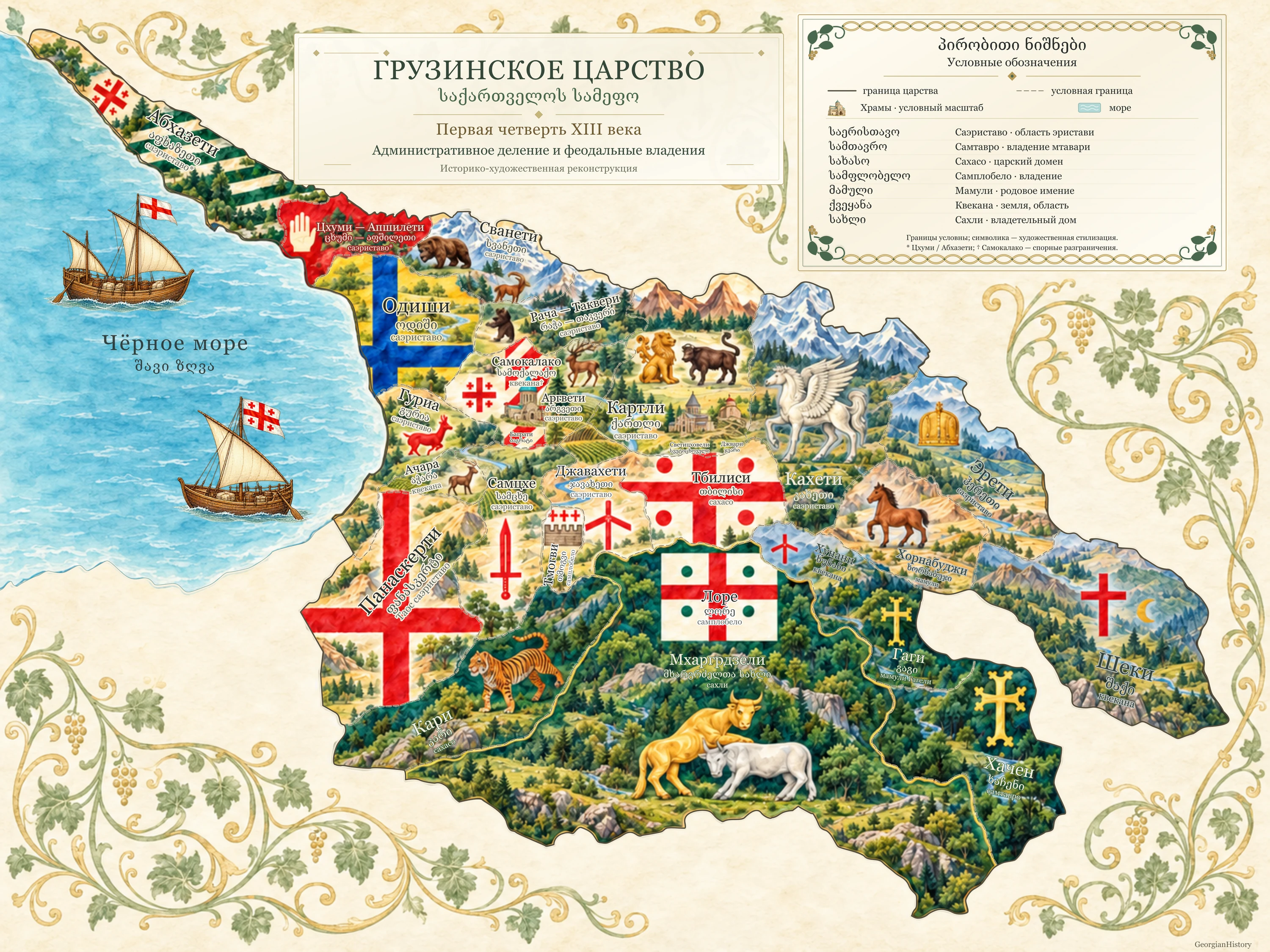
The artwork contains Russian and Georgian labels. The accompanying caption and legend are available in English, Georgian and Russian.
Map with legend and notes
Provincial governors linked the court to the territory it governed. An eristavi headed an administrative province, a saeristavo (საერისთავო). In the unified kingdom this power belonged to the system of royal government. In practice, it could remain with a particular lineage for a long time and become combined with its own wealth and military influence.[9]

Role in society
Governor of a region. The authority attached to his office should be distinguished from his family's own estates.
It is especially important here to distinguish a province from a private estate. A governor could own land in the province without the whole territory entrusted to him becoming his hereditary property on that account. Likewise, a family could retain an office for several generations while continuing to receive it within a system that recognised royal authority. The gap between a family's practical continuity in office and the legal basis of its powers left room for political dispute.
Several tasks came together at the local level. Orders had to be put into effect, revenues due had to be collected, order maintained and military forces brought into the field. That required knowledge of people and territory. A governor who could rely on his house and connections commanded means that a written appointment alone could not confer. The royal centre therefore needed local power while seeking to prevent it from becoming entirely independent.
The high dignity of eristavteristavi (ერისთავთერისთავი) cannot be explained by its literal rendering, ‘eristavi of eristavis’, alone. In the unified monarchy the holder remained a royal official. Having several other eristavis under him was not a necessary feature of the title. Its actual content is established from the position of the particular holder, rather than by trying to match it to a precise grade of European titulature.[10]
Combining local and court offices was one way of linking a province to the centre. An influential house could then participate in governing its own territory and act at the throne. The combination gave the sovereign an experienced official with his own base of support. For the official, it opened access to decisions that might strengthen his position locally.
Frontier lands required special attention. After the capture of Kari, now Kars, in the early thirteenth century, Tamar entrusted the territory to Ivane Akhaltsikheli. The appointment entailed frontier duties and high honours. The case shows how military expansion became a problem of organising power: holding the fortress, providing for the administration of nearby lands and bringing a new resource into royal service.[47]
A map of the provinces should therefore not resemble a fixed grid of identical duchies. The historical origins of a territory, its relationship to the royal domain, the strength of a local lineage and the military situation all mattered. Its name, boundaries and the substance of its governing powers could change. The administrative history of Tamar's era requires Georgian concepts and attention to the particular relationship between centre and province.
The lands of the kingdom and the peoples of the Caucasus
Political boundaries and cultural areas are shown approximately. Map notes and sources.
7. Senior officials and government from the royal court

Role in society
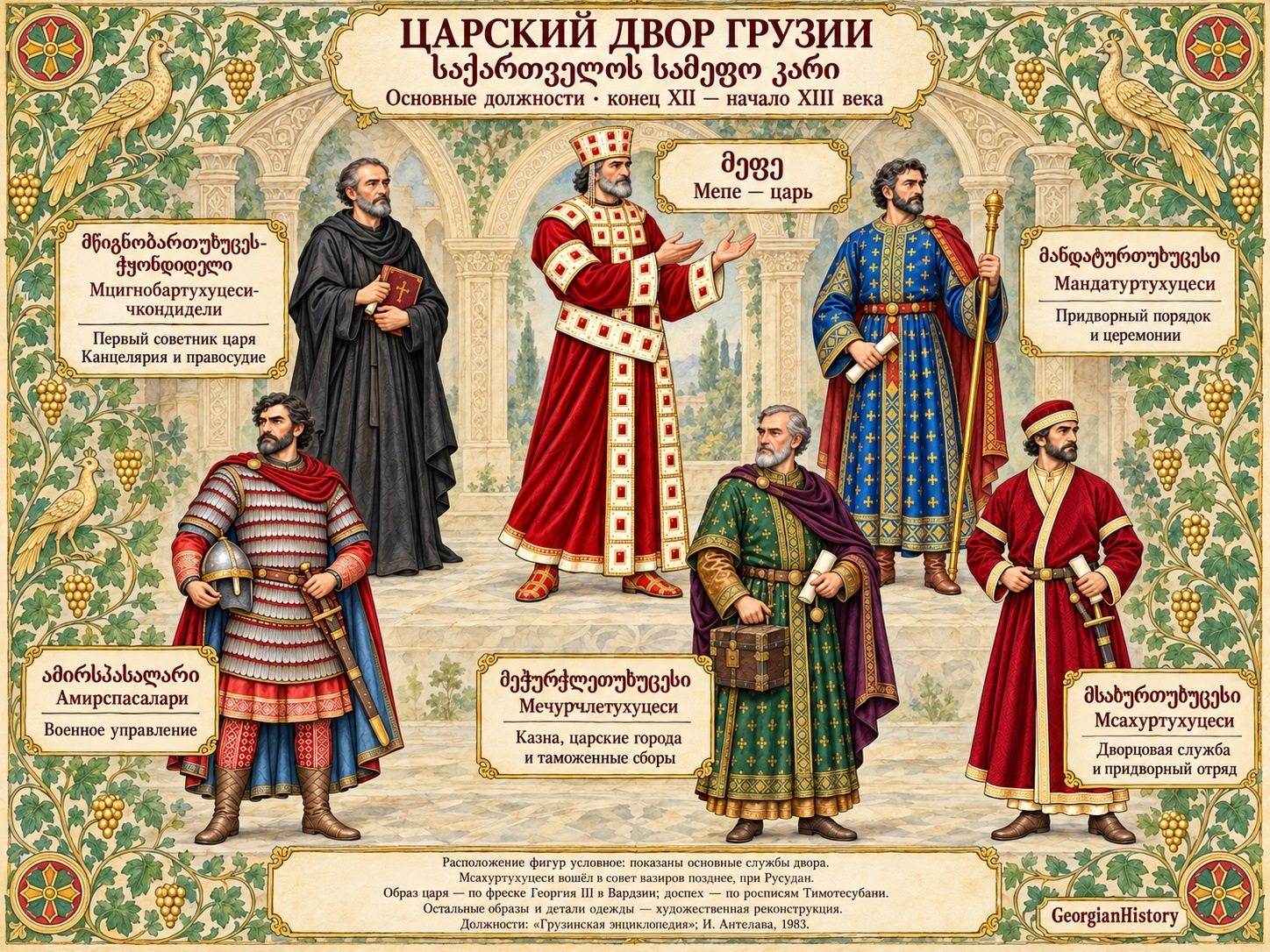
A high office combining responsibility for written administration with a role in central government.

Role in society
The highest military officer, responsible for organising the army and for military administration.

Role in society
Head of the mandaturis. His office was concerned with court order and ceremony.

Role in society
A dignitary who oversaw the treasury and related institutions.
Individual depictions of the highest offices. The text discusses how offices could be held together and how their standing changed over time. The faces and clothing are reconstructed.
The royal court was both the sovereign’s everyday home and the centre of government. It received reports, prepared documents, discussed appointments and assigned tasks. Orders issued at court affected provinces, estates and towns. A modern distinction between household and affairs of state therefore often proves hard to draw.
The court also had its own divisions of work. Military organisation required one kind of expertise, the writing office another, and management of valuables and revenue a third. High offices combined a distinct set of duties with the social standing of their holders. An official’s importance depended on the business entrusted to him, the sovereign’s confidence and the means at the official’s own disposal.
Mtsignobartukhutsesi-Chqondideli
The mtsignobartukhutsesi-chqondideli, მწიგნობართუხუცესი-ჭყონდიდელი, combined leadership of the royal writing office with the bishopric of Chqondidi. This arrangement took shape under David IV. Its first known holder, Giorgi Chqondideli, took part in the most important affairs of government and in carrying out royal policy. The office retained particular weight in Tamar’s time.[12]
Combining the two posts served a clear practical purpose. An educated churchman could prepare written decisions and wielded spiritual authority. Access to documents and participation in discussions brought him close to the making of royal policy. The ecclesiastical side of his office also bound him to a circle of institutions, people and interests of its own.
In 1184, Catholicos-Patriarch Mikel IV also received the office of mtsignobartukhutsesi-chqondideli. His holding of both posts was an important feature of the political history of the beginning of Tamar’s independent reign. Scholars differ in their assessment of Mikel himself. For the history of government, there is clear significance in the fact that several sources of high authority could be concentrated in a single person.[35]
Amirspasalari
The amirspasalari, ამირსპასალარი, headed the military administration. His position arose from the need to coordinate forces drawn from different parts of the kingdom. On campaign the army needed unified command, while in peacetime it still needed to be kept ready and supplied. Appointment to the office affected the balance between the throne and the leading military houses.[11]
The amirspasalari’s role extended beyond battlefield command. The officer who organised the army also helped direct the resources needed for service. His influence depended in part on the lands and connections supporting his position. Ivane Orbeli’s revolt of 1177–1178 showed how dangerous a conflict between the king and the holder of the highest military authority could become.[1]
Mandaturtukhutsesi
The mandaturtukhutsesi, მანდატურთუხუცესი, oversaw order at court and the performance of several administrative duties. The office was associated with arranging assemblies, regulating movement and admission, and exercising oversight. A golden staff was its known insignia. It could be combined with the post of amirspasalari, giving one person both sets of powers.[13]
This arrangement shows that ceremony formed part of government. Summoning the right person, escorting an envoy, announcing someone’s place in an assembly and seeing that established procedure was followed all affected how public business proceeded. Protocol indicated who had a right to be heard, who could approach the sovereign and whose standing the others recognised.
Mandaturs were lower-ranking officers. The term is attested from the eleventh century, and these officers are associated with guard, escort and administrative duties. The distinction between the head of the service and an individual mandatur mattered. Service in the same office did not confer equal authority or social standing.[48]
Mechurchletukhutsesi
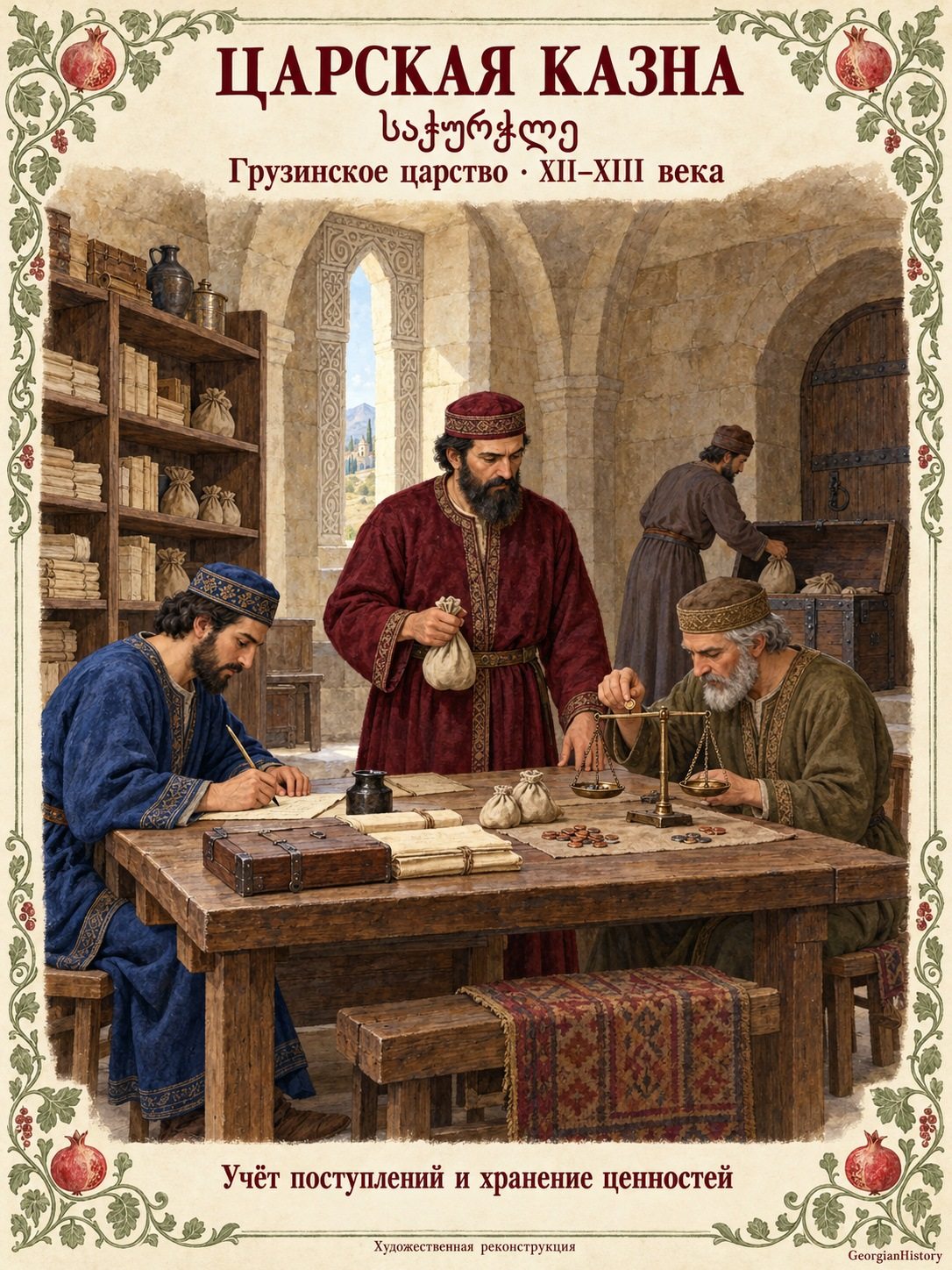
The mechurchletukhutsesi, მეჭურჭლეთუხუცესი, headed the treasury administration. His office was associated with royal towns, merchants, town administrators and customs dues. The position thus played a particularly important role in connecting landed wealth with revenue from urban life and trade.[14]
The treasury turned receipts into action by maintaining personnel, supplying the court, making grants and buying necessities. The financial side of government was therefore bound up with politics. A decision to spend meant choosing whose needs would be met and which undertakings the sovereign could support materially.
Msakhurtukhutsesi and the changing composition of central government
The msakhurtukhutsesi, მსახურთუხუცესი, was associated with personal service to the sovereign, palace institutions and the armed force of the royal domain. His position illustrates changes in court organisation particularly well. The office rose in standing under Tamar. Scholars associate its holder’s inclusion among the viziers with Rusudan’s reign.[15]
This points to an important rule for reading the sources. The arrangement of several viziers known from a later description cannot simply be projected back in its entirety onto 1178 or 1184. The standing of individual offices changed, as did the relations between them. Historians still debate when the administrative structure took its final shape and when certain designations came into use.[11; 46]
At the beginning of the thirteenth century, the office of atabagi, ათაბაგი, acquired particular importance. It was associated with the upbringing of the heir and extensive powers in government. Ivane Mkhargrdzeli was among its holders. The history of the office shows how proximity to the royal house could be combined with military leadership. Its later role in Samtskhe cannot automatically be assigned to the entire preceding period.[44]
Central government consisted of interacting spheres of responsibility. It evolved, tied institutions to personal trust and allowed one person to hold several offices. To reconstruct it historically, the important questions are what an official did and when his position is attested. A uniform list of “ministers” for every year would obscure those differences.
8. The people who kept the royal court running
Behind the senior officials were many staff and heads of specialist services. Their work shows how provision, security and social order were connected. The king needed documents, arms, horses, supplies and arrangements for receiving guests. Each task required people with the right skills and a defined place in the organisation of the court.
The Regulations of the Royal Court provides the most detailed description of many services. Its surviving recension is generally assigned to the fourteenth century, though it has also been dated to the late thirteenth. The text survives in a damaged later manuscript. It preserves important historical material and cannot be treated as a list of court posts drawn up in Tamar’s accession year. The discussion below therefore distinguishes the existence of particular kinds of court work from the detailed organisation described at a later date.[46]
The writing office and custody of the seal
Putting a decision into writing required literate staff. A scribe had to produce a text the parties could use after negotiations ended. Accuracy in recording the name, the list of property, the exemptions and the obligations had direct consequences. An error could become a subject of dispute, and a preserved record could substantiate a right.
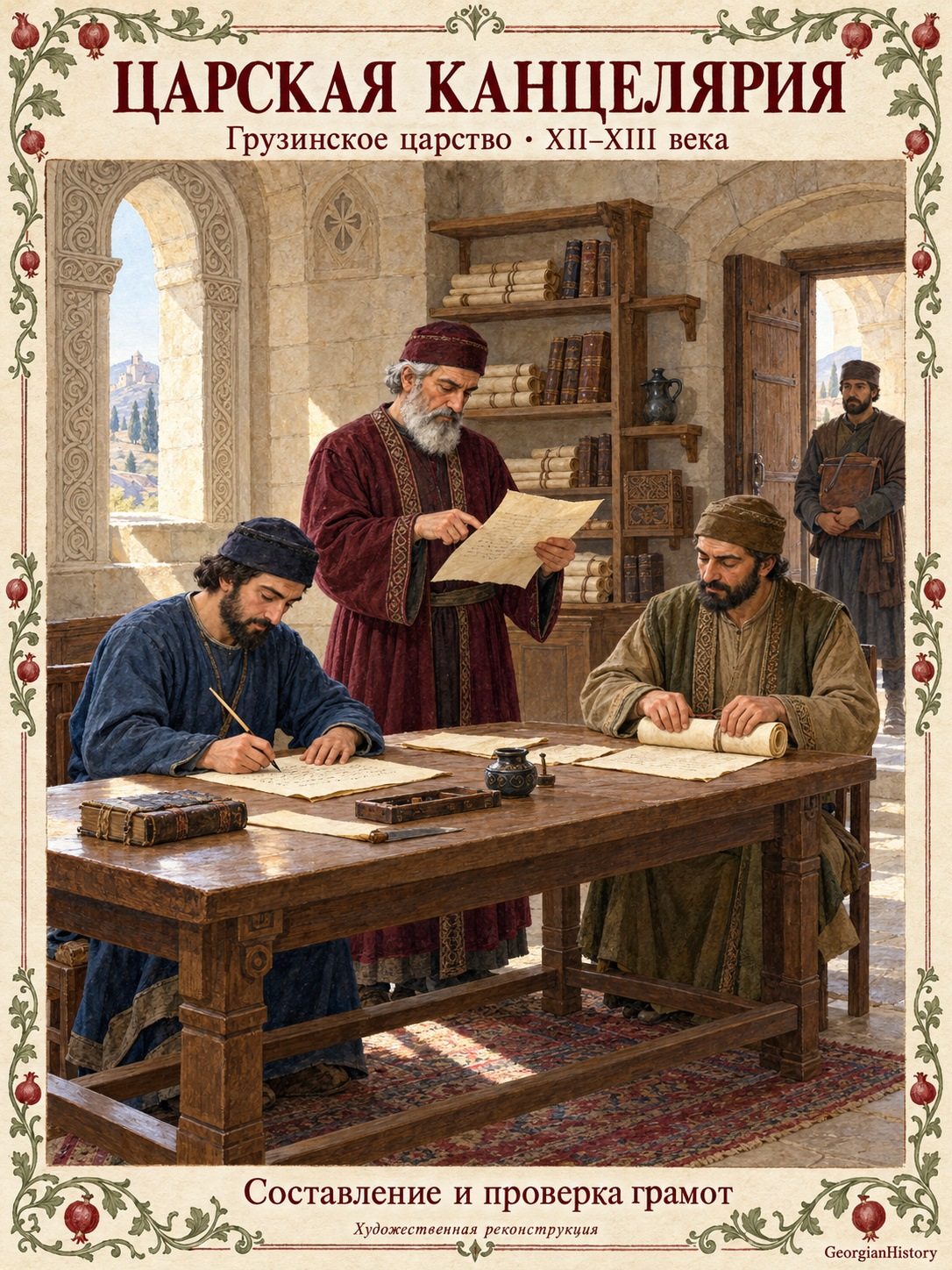
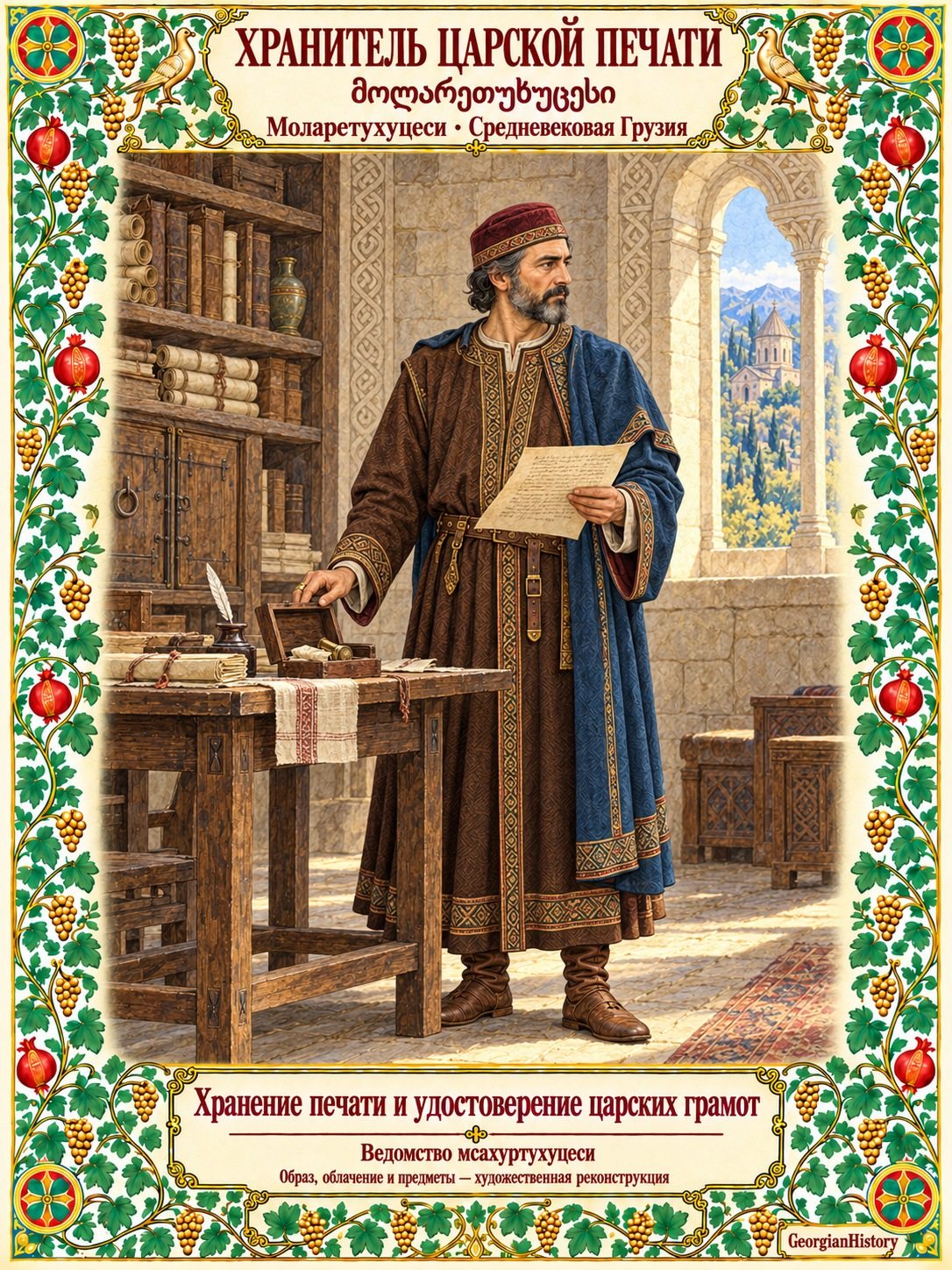
The molaretukhutsesi, მოლარეთუხუცესი, was associated with authenticating charters and keeping valuables. In the description of the service, the great state seal was kept in the salaro, where documents were brought to be sealed. The office combined a role in written business with custody of especially important property. Detailed later lists of its revenues and subordinates belong to the periods in which they were compiled.[16]
These duties belonged together at a court where a document’s value depended both on its contents and on a recognised form of authentication. The seal gave an order the prescribed form of a royal act. Keeping it was therefore a position of trust that helped safeguard legal decisions.
The sovereign’s guard and rules of access
The internal guard of the royal apartments was associated with the mesatsole, მესაწოლე, and its head, the mesatsoletukhutsesi. In this context, satsoli means more than a bedchamber. It refers to the royal apartments and the space the sovereign inhabited in everyday life. A later description distinguishes the guards within from those controlling entry from outside, including the satsolis mekare, საწოლის მეკარე.[17]
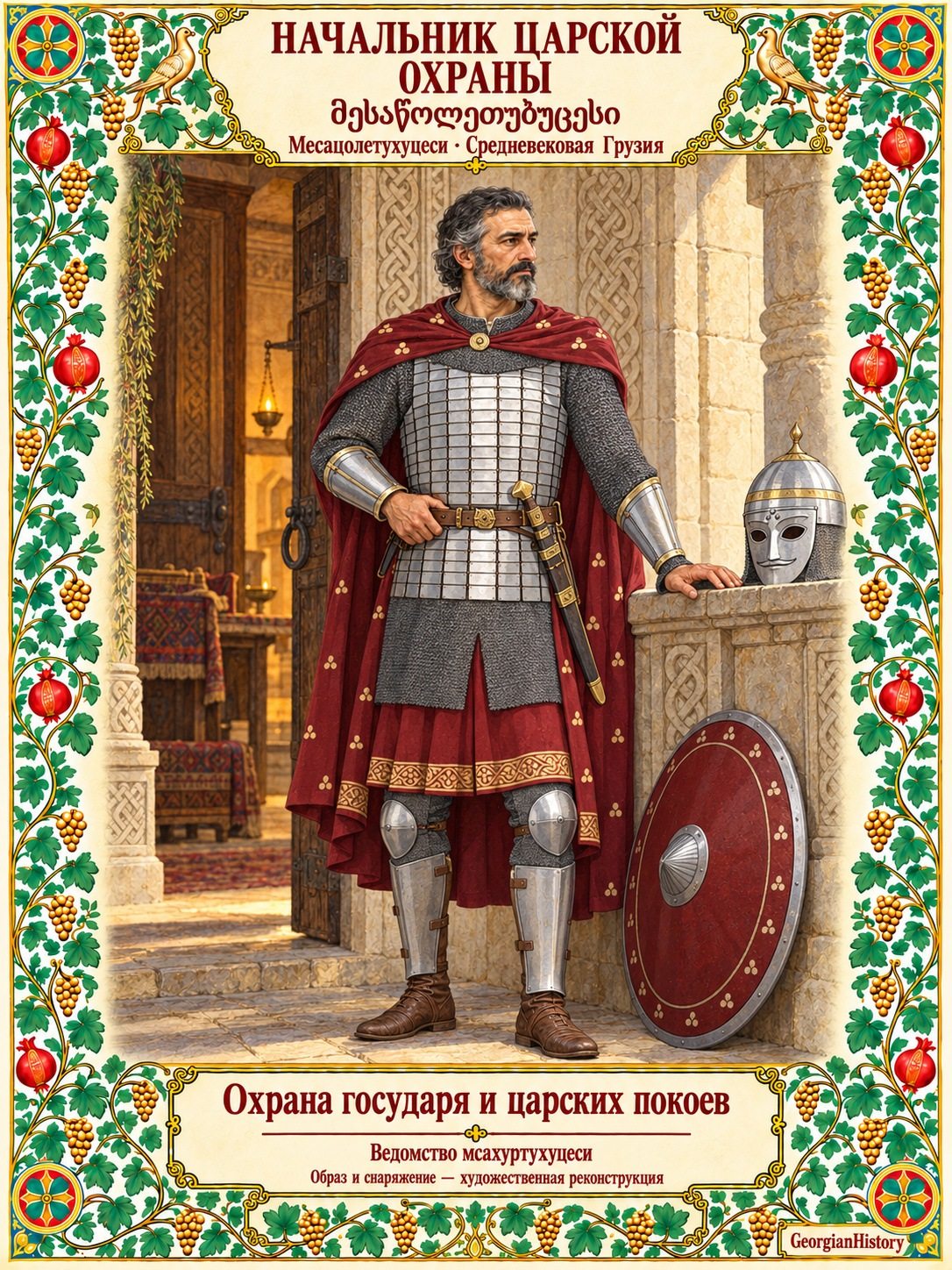
Guarding the entrance meant controlling access. The sovereign had to be protected while remaining accessible for necessary reports and instructions. Guards had to recognise those allowed in and maintain the order in which they appeared. The head of the palace guard and the commander-in-chief therefore held distinct posts. Security in the royal apartments and leadership of the entire military administration operated on different scales.
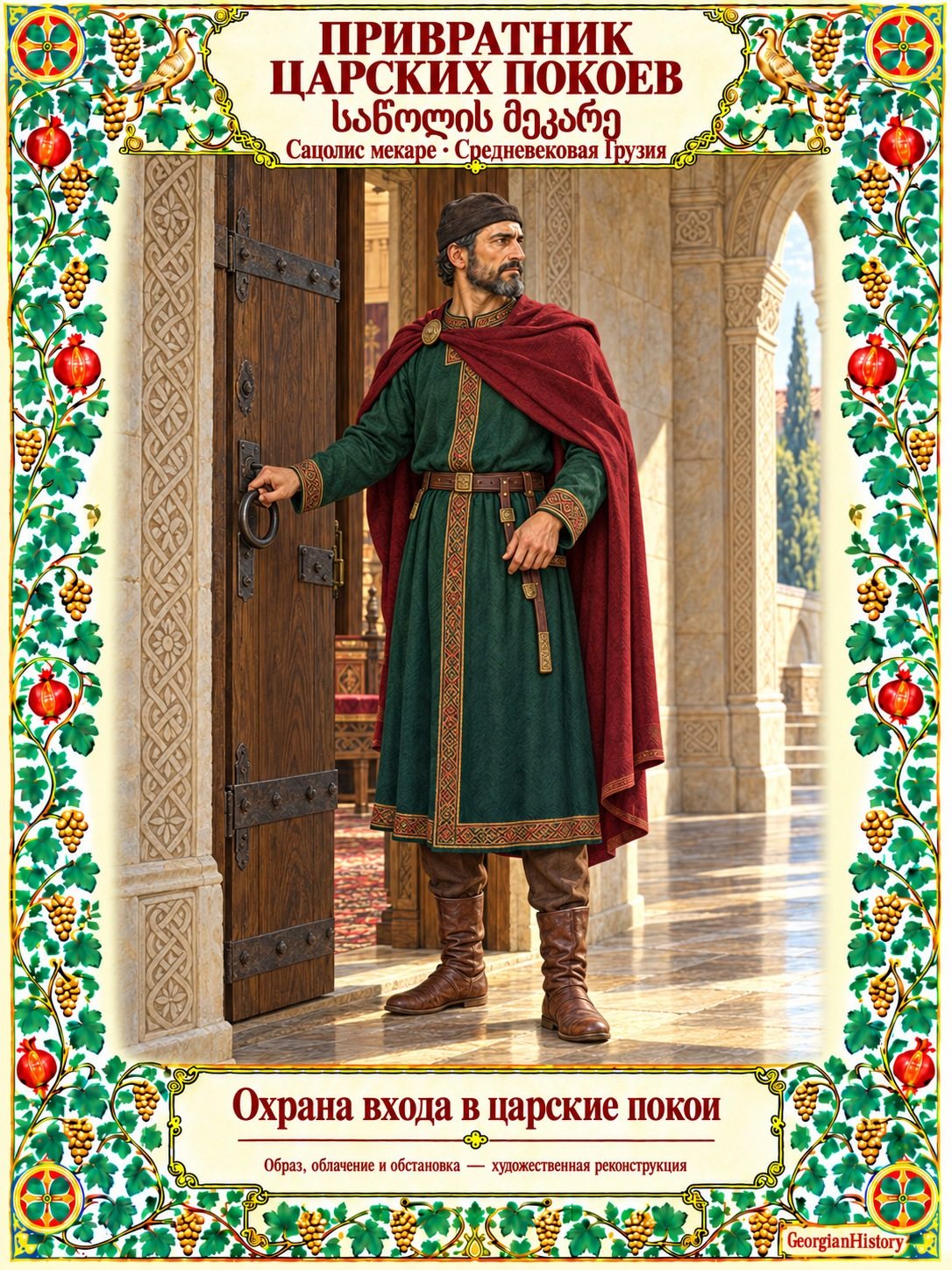
Service close to the sovereign carried political weight of its own. A court servant might gain access to the person who controlled appointments and grants while holding a comparatively limited position in the administration. Proximity to the monarch, formal authority and social origins therefore need to be considered separately.

Role in society
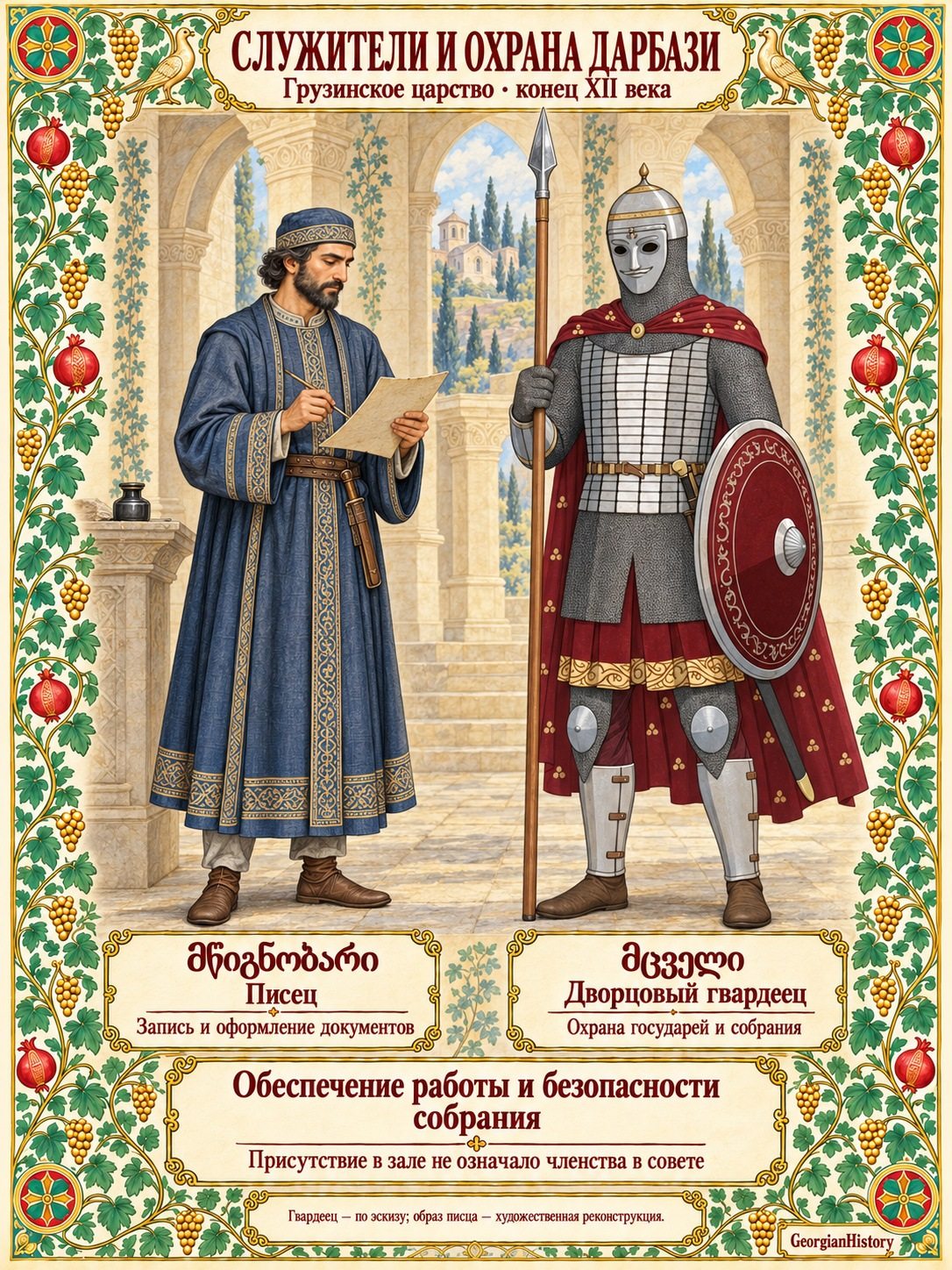
Guard duty and control of access to the ruler required a standing service. The figure's appearance is conjectural.
Mstovari and information for the sovereign
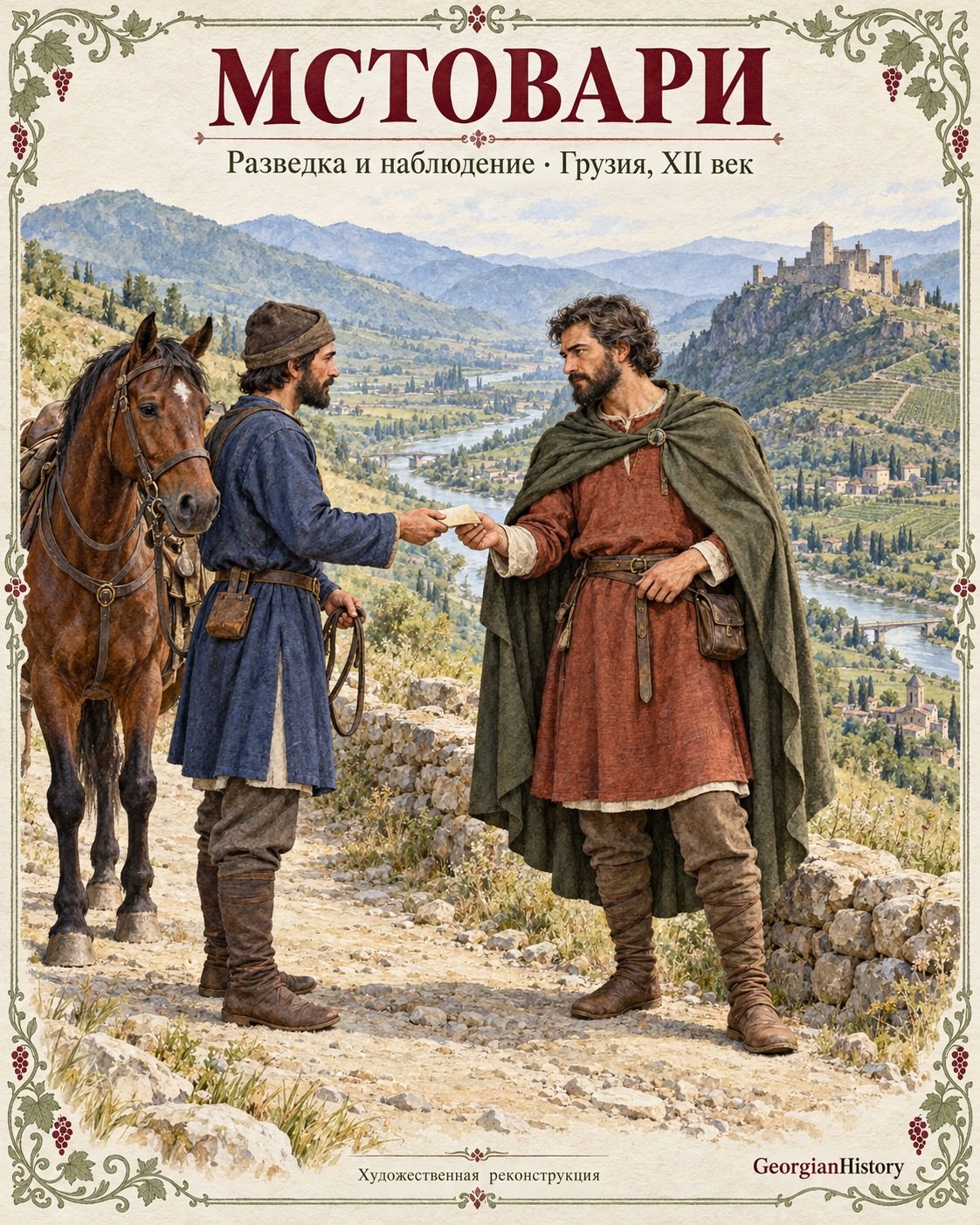
The sovereign needed reports on the conduct of officials, the disposition of influential houses and the enemy’s movements. This information helped him act before disobedience turned into open revolt. Being well informed was one way to retain authority over men who had lands and armed forces of their own.
A mstovari, მსტოვარი, was a scout or spy. The Georgian Encyclopedia connects the organisation of a special network of these agents to David IV’s reforms in the early twelfth century. Its tasks included military intelligence and surveillance of officeholders, feudal lords and the higher clergy. David’s chronicler stresses that reports of what people of different stations did and said reached the king. His eulogistic account conveys the idea of an exceptionally well-informed ruler.[59]
According to the same encyclopedia, the mstovari network began to weaken under Tamar. Its organisation under David IV and the ways information reached the late twelfth-century court should therefore be considered separately. The surviving evidence supports the existence of surveillance and reporting. It does not establish an unchanging staff or chain of command throughout the period.[59]
Tamar’s historian describes a specific reporting channel in her reign. Frontier commanders reported on the enemy or a proposed campaign. The queen considered the matter and decided whether to muster the army. This illustrates the link between local knowledge and a central decision. Gathering information, delivering it and ordering a response were distinct stages of government.[40]
Horses and arms
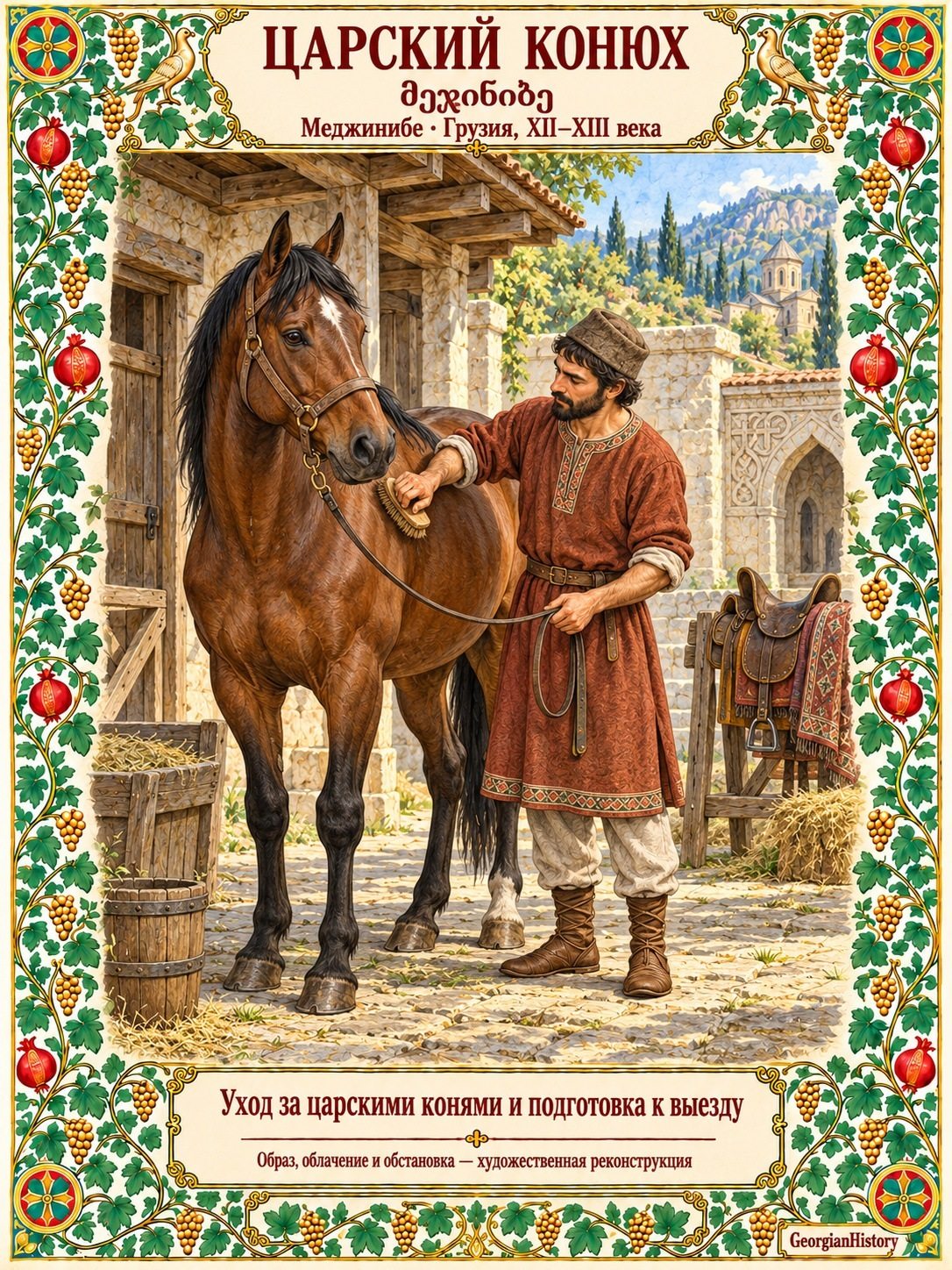
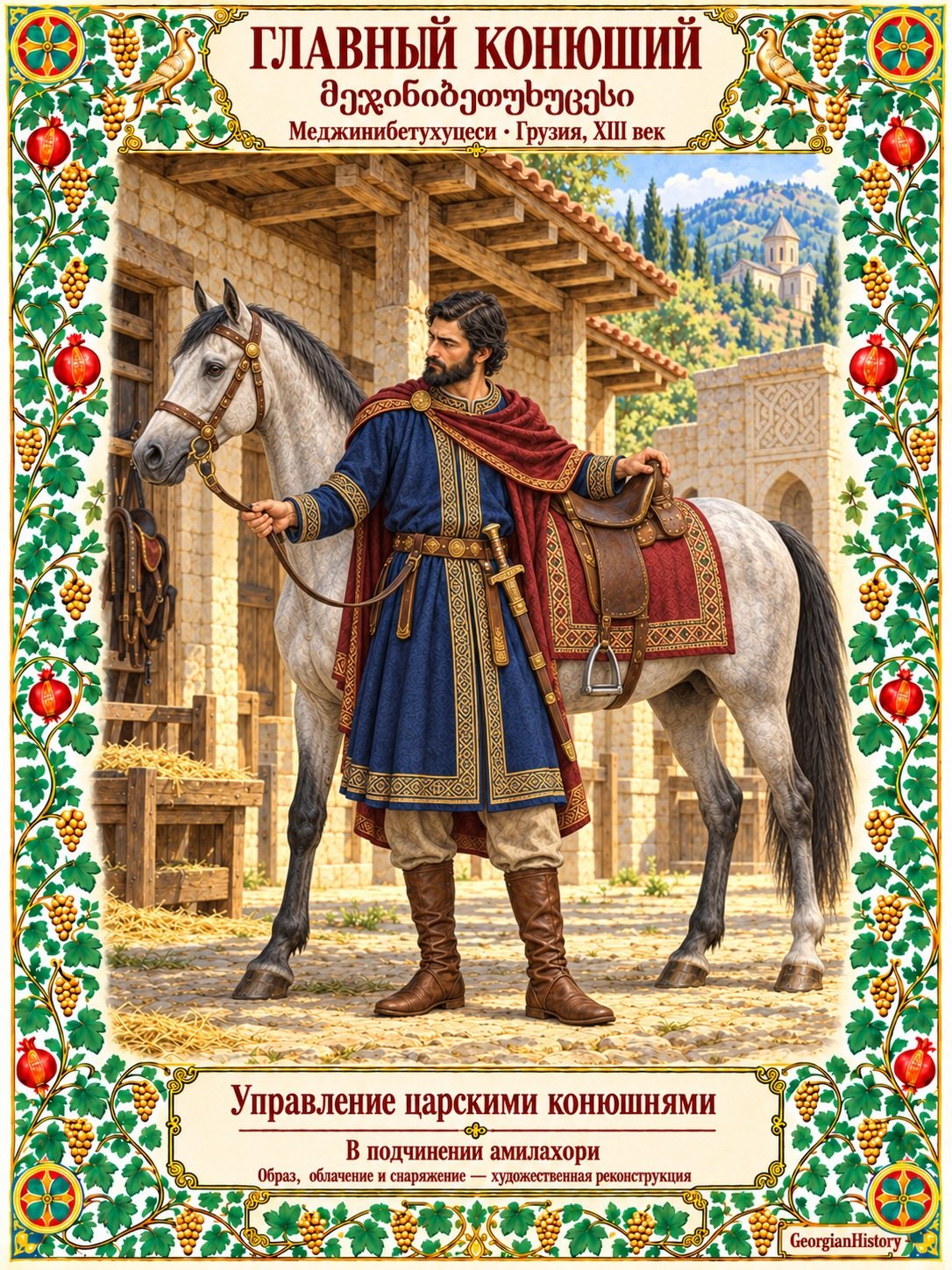
The stable service kept the horses needed by the court and its military men in good condition. The mejinibe, მეჯინიბე, tended the horses, and the mejinibetukhutsesi, მეჯინიბეთუხუცესი, headed the staff. The office is attested in a thirteenth-century royal coronation text and formed part of the military supply organisation.[19]
The armourers and their head, the meabjretukhutsesi, მეაბჯრეთუხუცესი, similarly took care of arms. The senior armourer is known from the same body of ceremonial evidence. The links between these services and the amilakhori show that military leadership required ongoing logistical work. Carrying a weapon in ceremony was a different duty from supplying the whole administration day to day.[18; 20]
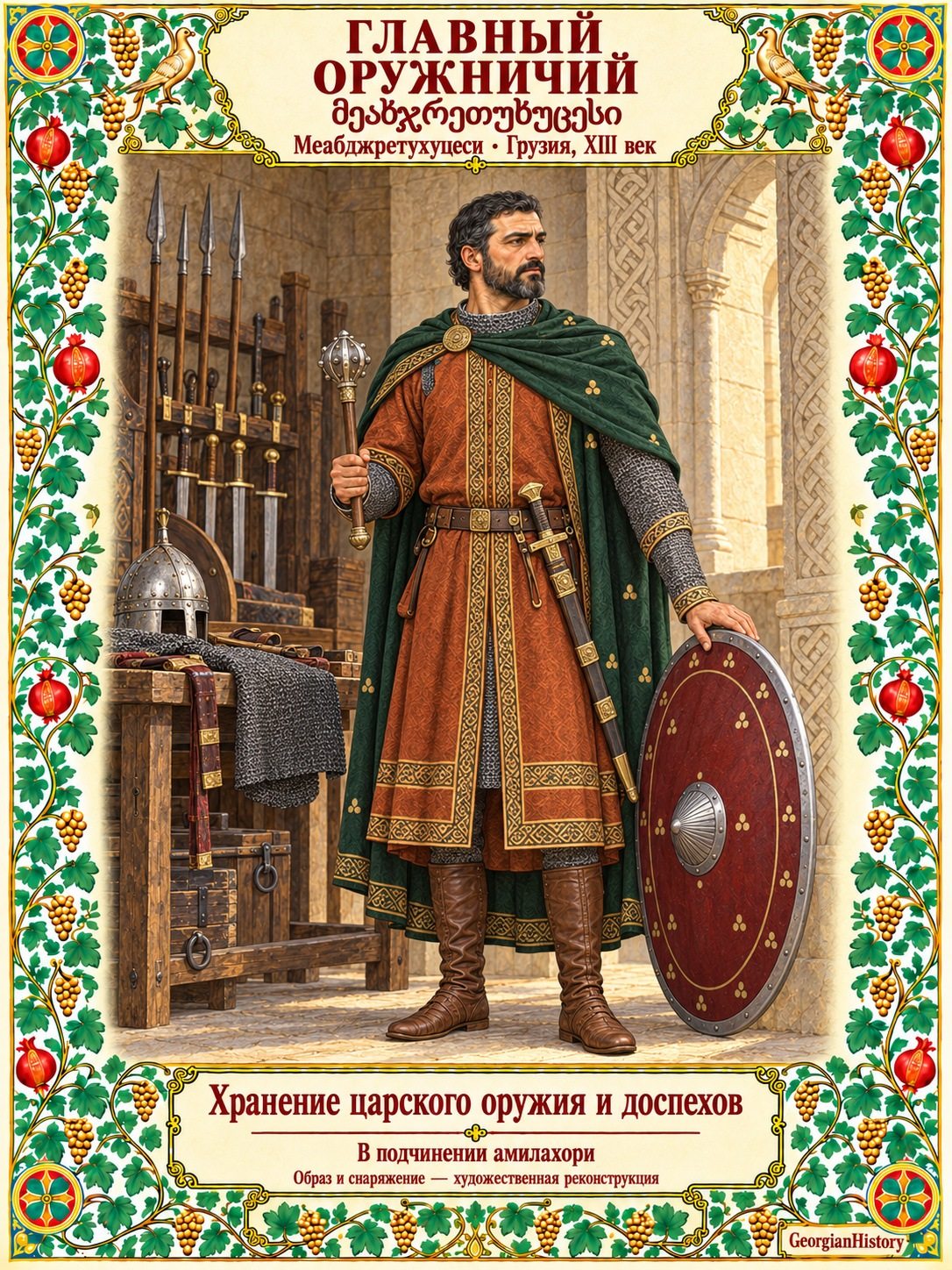
For the economic history of the court, what matters here is the regularity of the work. Horses needed daily care, arms had to be stored and kept serviceable, and journeys required advance preparation. Military service depended on the labour of people a chronicler might never name. Their presence made an order to march or travel possible to carry out.
Receiving guests and envoys
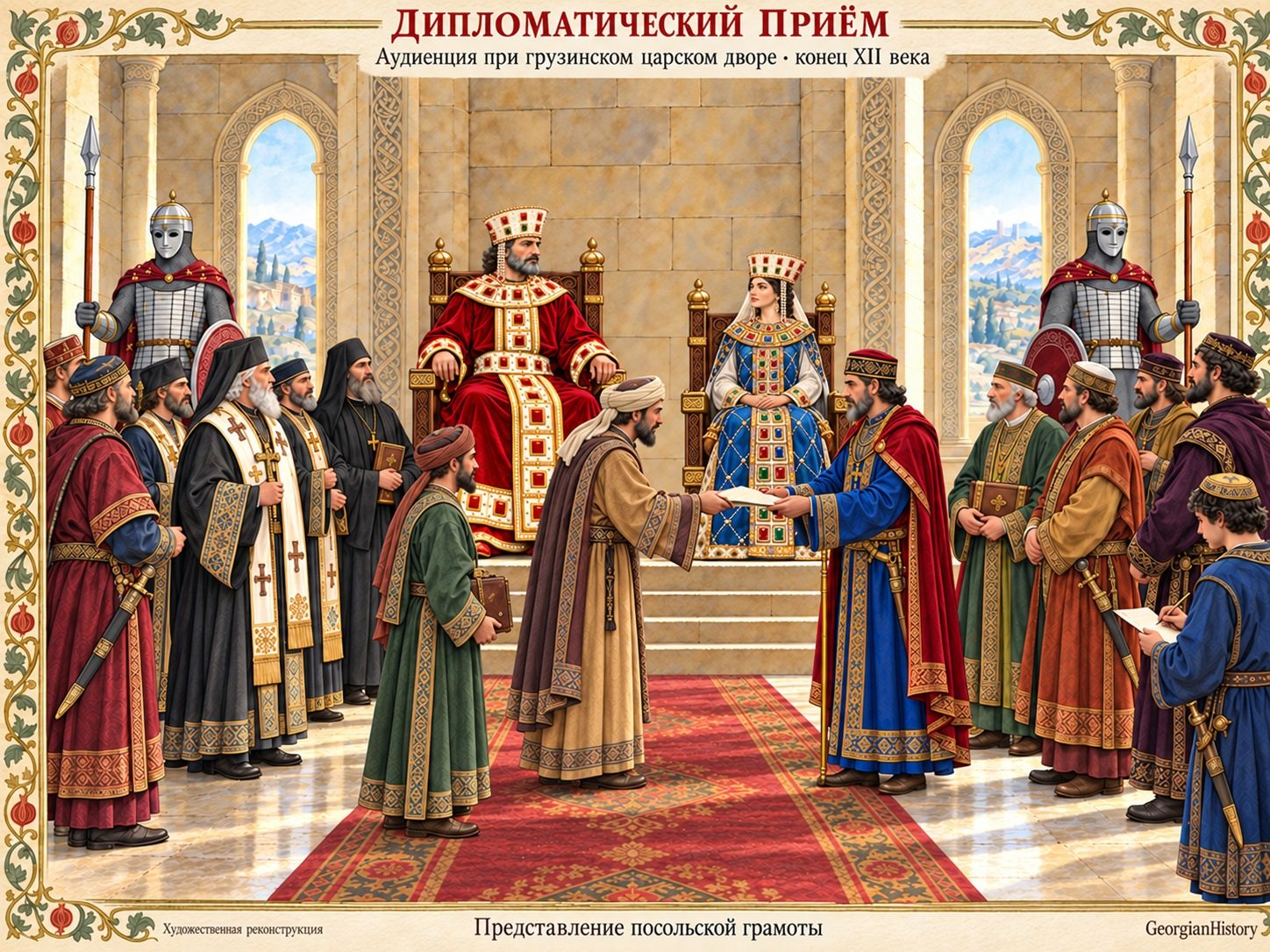
The mestumre, მესტუმრე, prepared to receive arriving guests, messengers and gift-bearers. They were led by the mestumretukhutsesi, მესტუმრეთუხუცესი. In the description of the united monarchy’s organisation, this service was associated with the mandaturtukhutsesi’s department.[22]
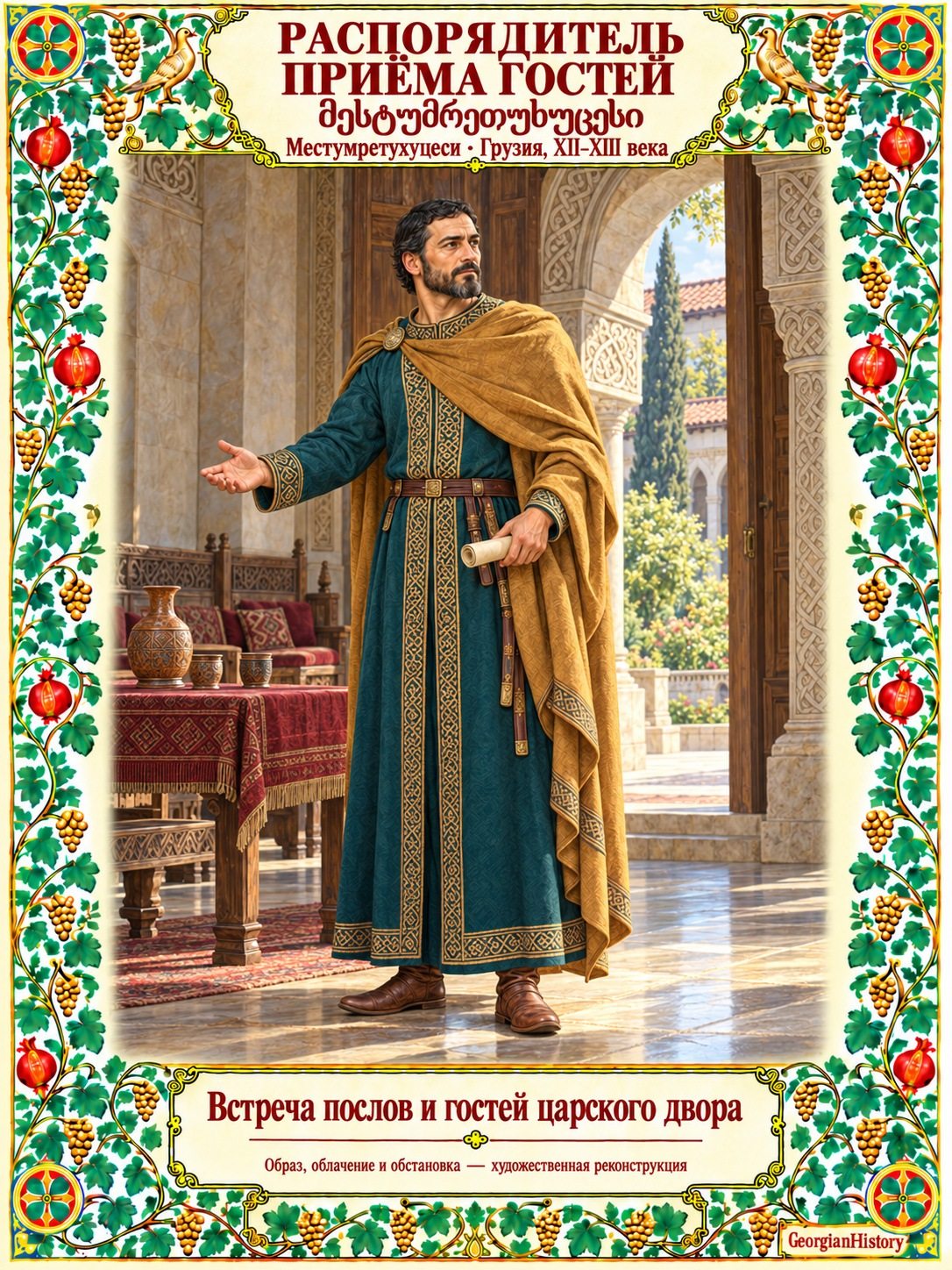
Hospitality at court was a matter of state. An arrival had to be assigned a place in the established order, formally received and taken to those who could hear the business at hand. The reception acknowledged the guest’s standing and expressed that of the sovereign receiving them. Court servants therefore had to know the procedure and work in concert with their colleagues.
The wine service and the cupbearer
The meghvinetukhutsesi, მეღვინეთუხუცესი, head of the wine service, is mentioned from the twelfth century. A later account associates his department with royal vineyards, receiving and storing wine, and serving gatherings at court. It shows in practical terms how a resource from the land supported palace life.[23]
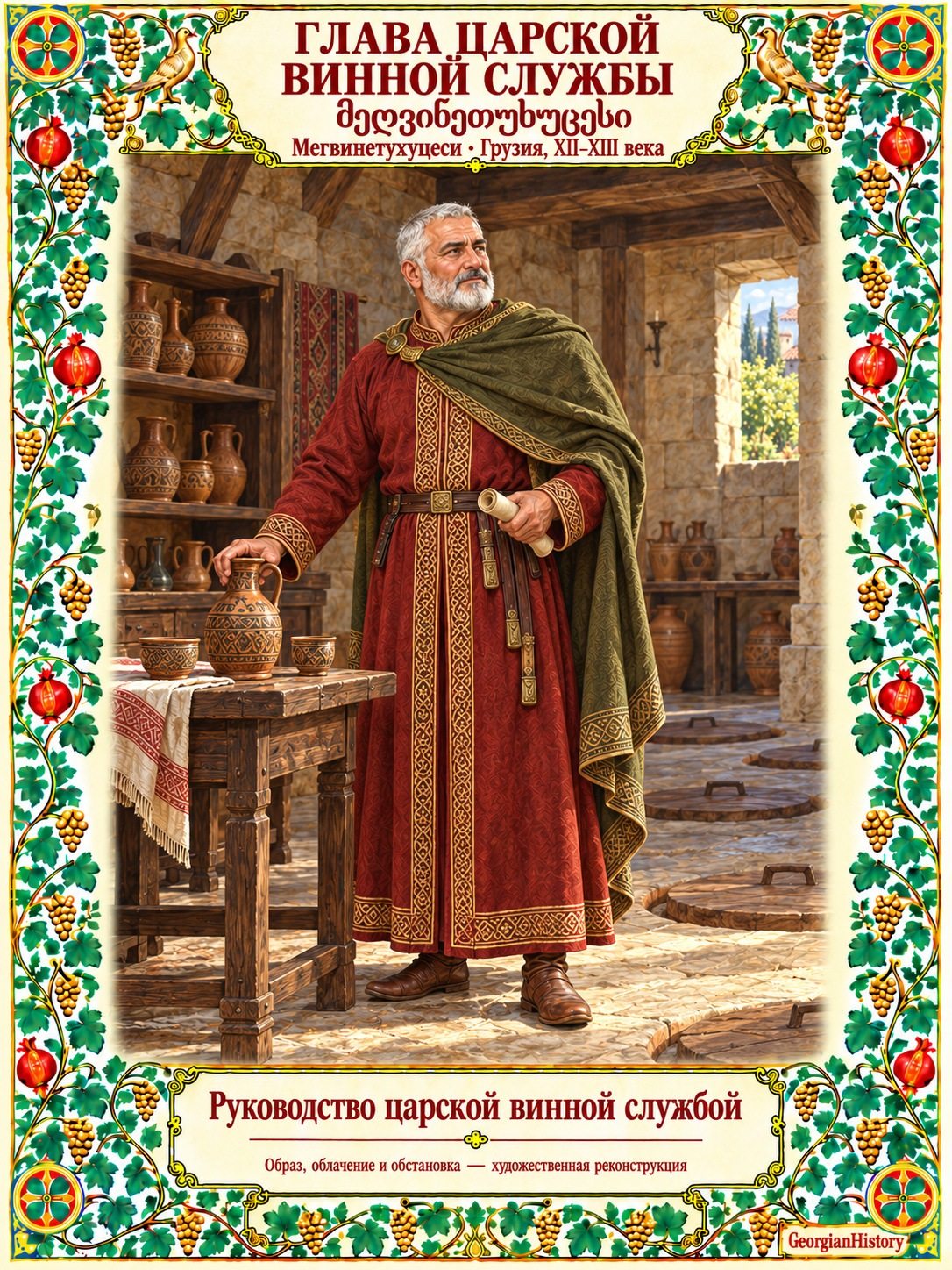
The personal cupbearer, piris mtsde, პირის მწდე, performed a particular service in the sovereign’s presence. He should be distinguished from the head of the whole department and from the others who delivered, stored and served the wine. One servant’s proximity to the king does not mean he controlled all the resources behind the service.[24]
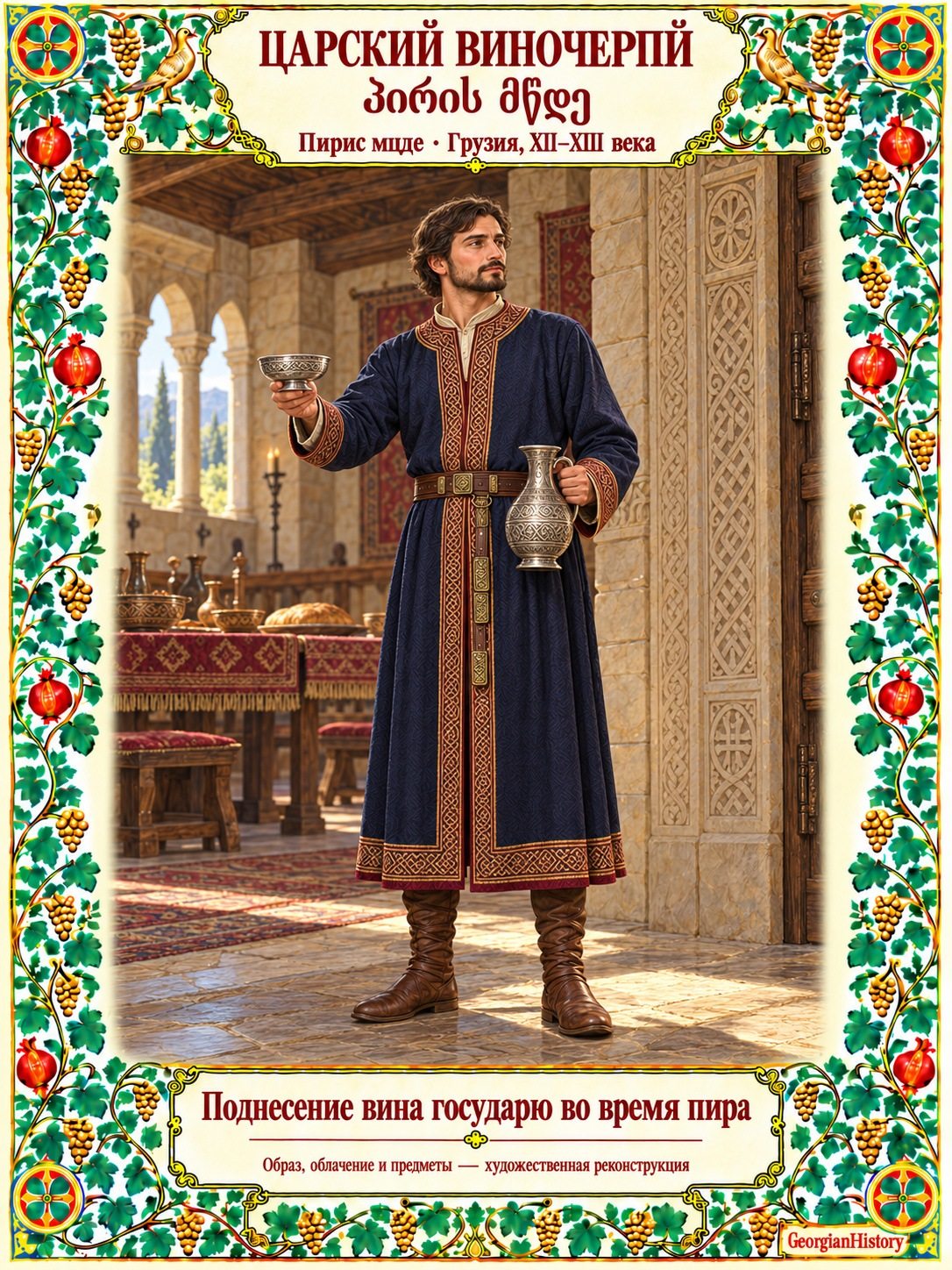
Hunting and specialist work
Royal hunting also needed organisation. The monadiretukhutsesi, მონადირეთუხუცესი, was associated with hunting grounds, staff and preparations for expeditions. A later description of the court presents hunting as part of public service and military exercise. The bazieri, ბაზიერი, or falconer, had specialised skill in handling a bird of prey. Working with and training dogs required a different kind of labour.[21]
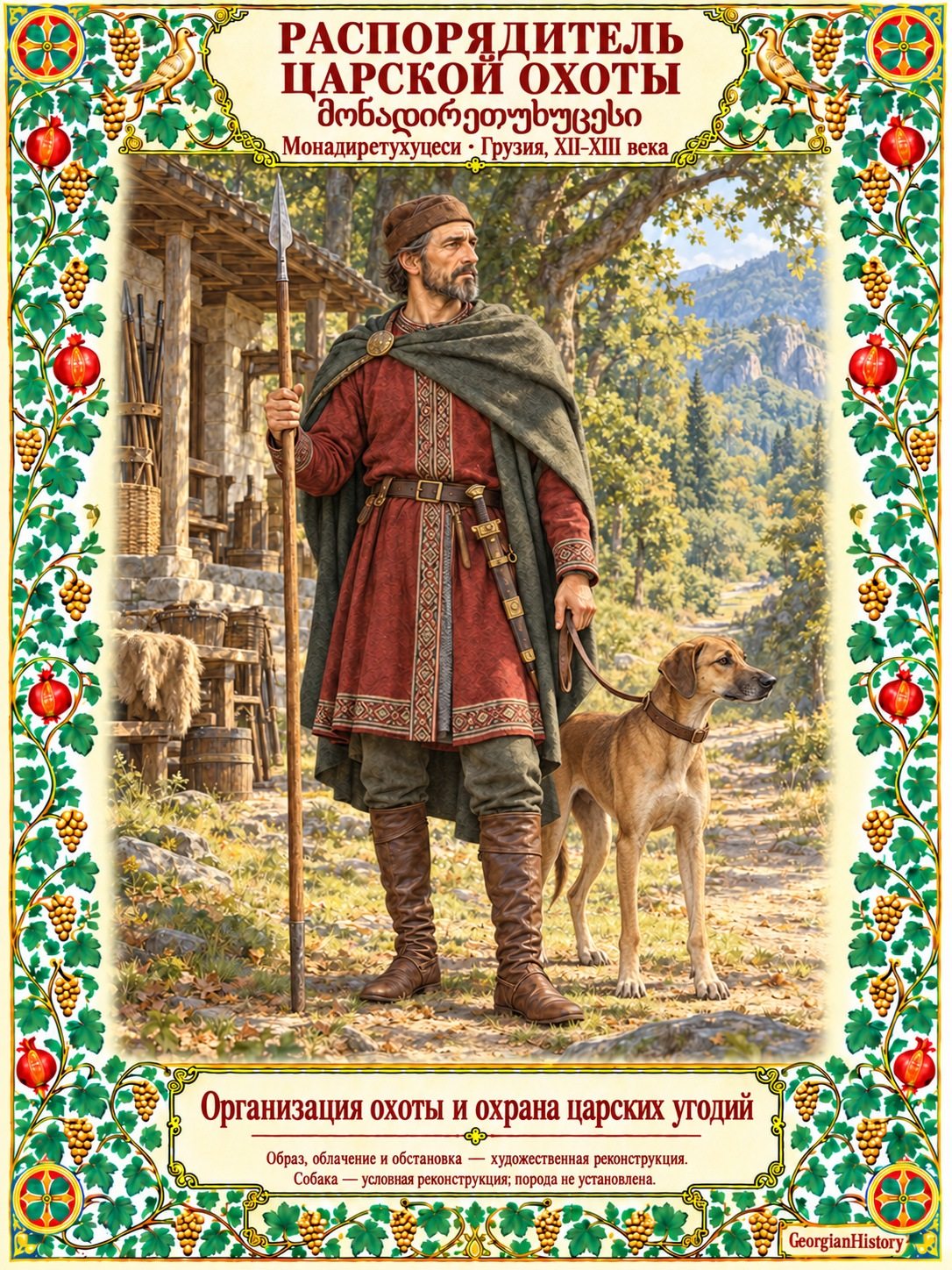
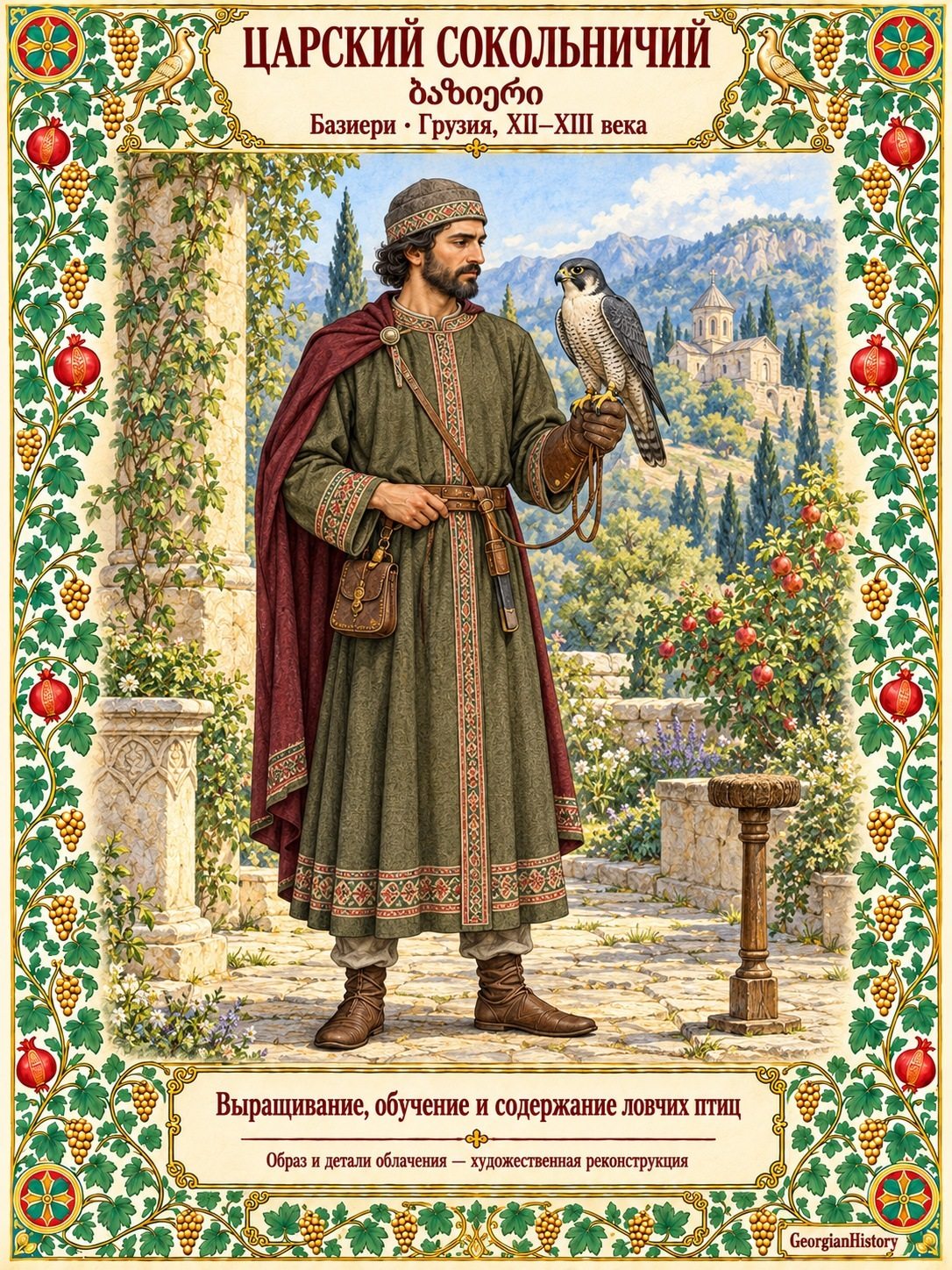
Healing, preparing food, caring for possessions and supplying the court were other parts of its day-to-day provision. Their necessity is obvious, though it does not justify inventing an equally high official rank for each kind of work. The word mkurnali, მკურნალი, means a healer, for example. The word alone does not establish a single, distinct office with a fixed place in the hierarchy of the court.
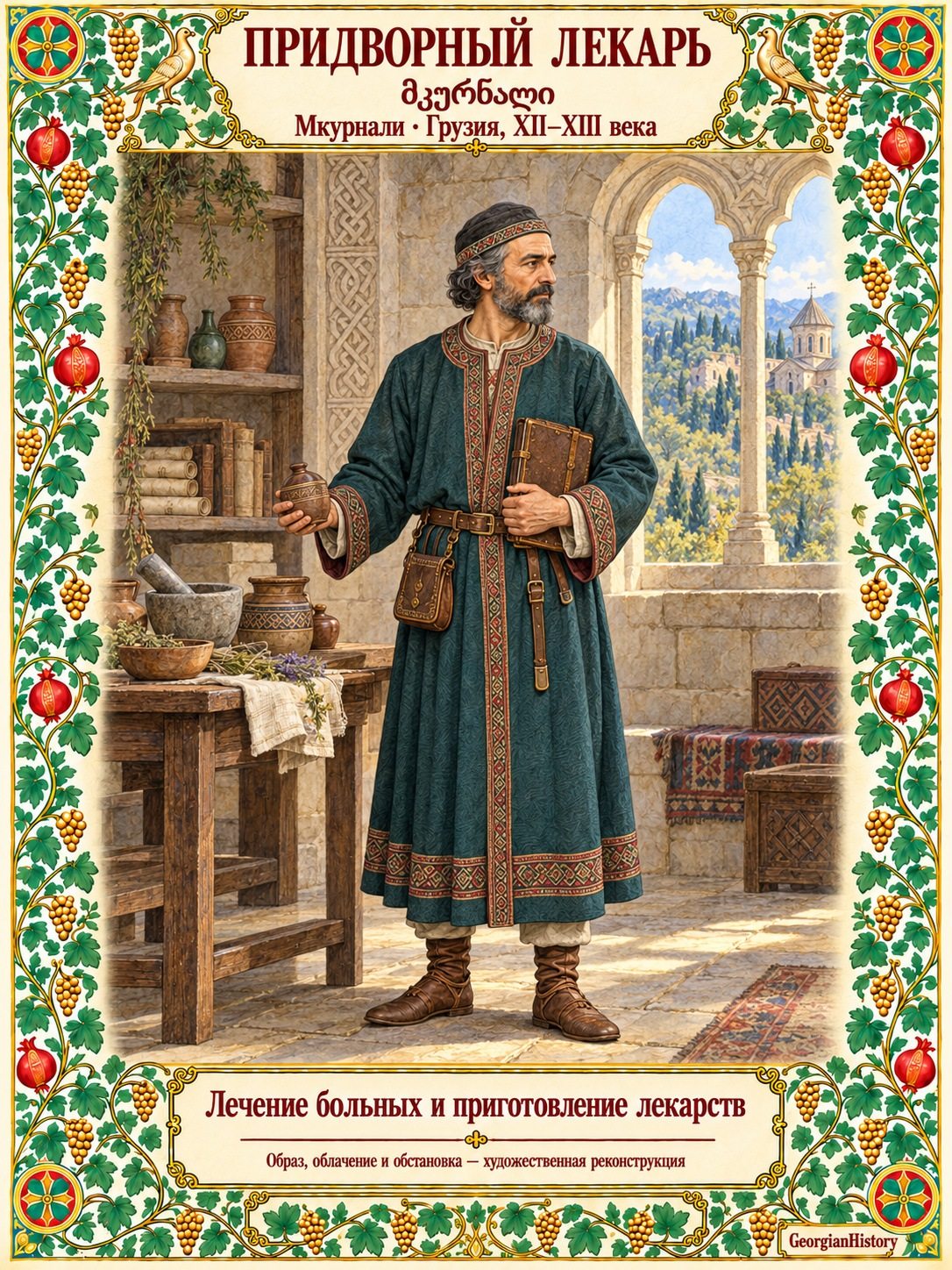
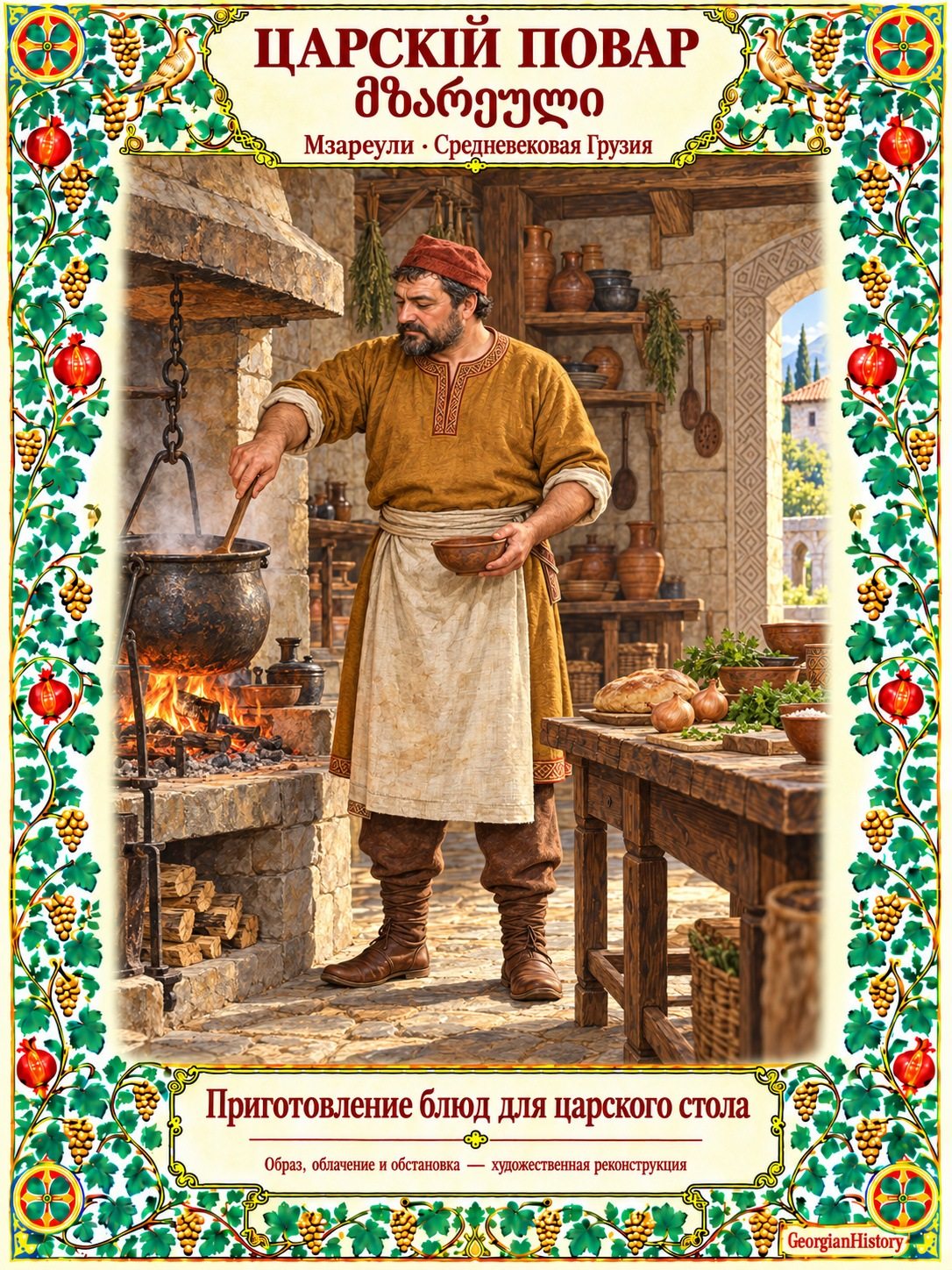
Court service brought together people of different standing. A head of department might hold a dignity and have staff of his own, while an individual servant might have a particular skill and a limited assignment. An account of the court should preserve that distinction. Otherwise many different relationships are reduced to an artificial succession of equivalent “ranks”.
9. The darbazi and the nobility’s participation in politics
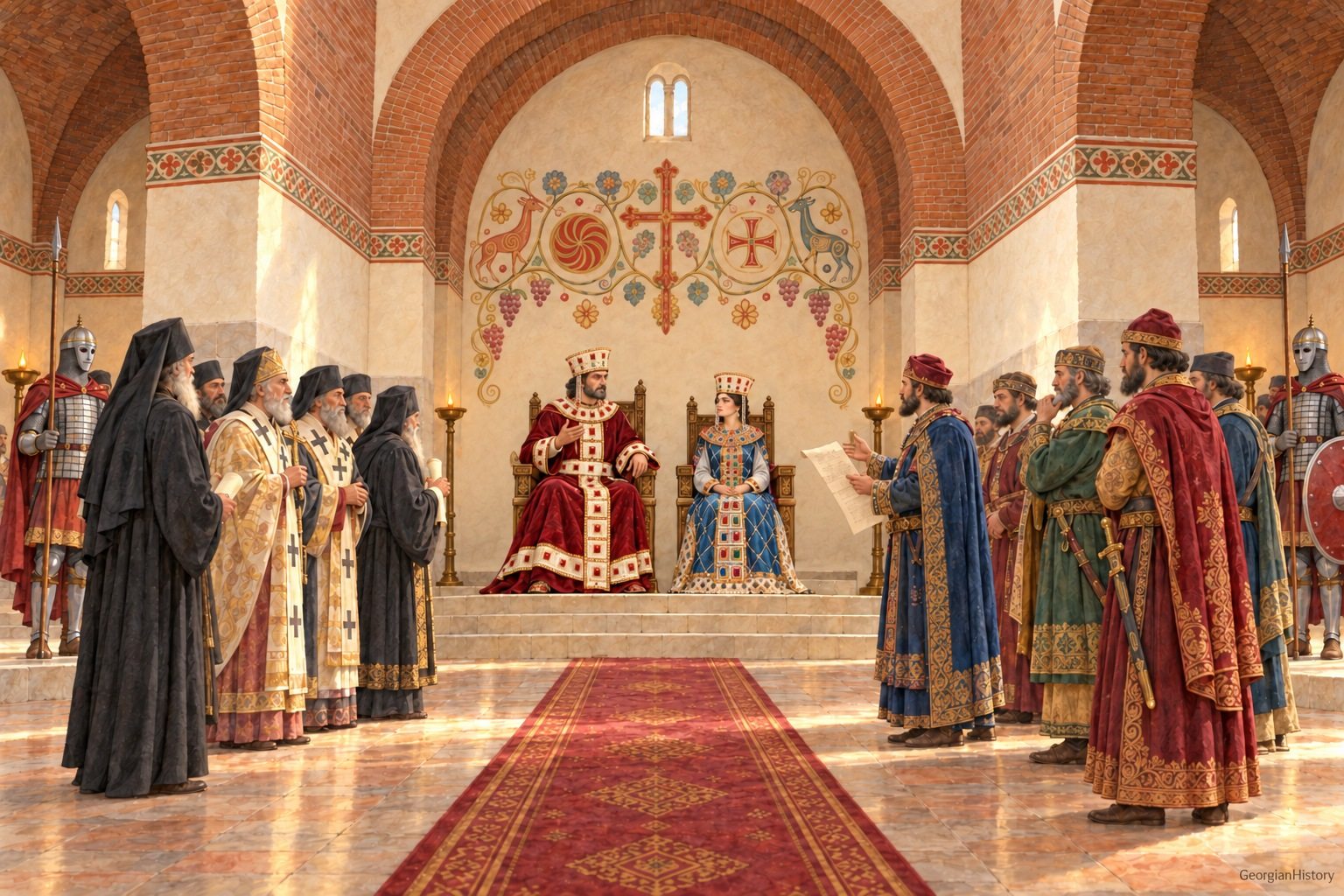
The darbazi, დარბაზი, is one of the central concepts in the history of government in Georgia. It is associated with the spaces of the royal palace, assemblies and the discussion of affairs of state. Historians explain the institutional meaning of the term in different ways, from a royal council to a broader designation for the court and its associated institutions. We cannot accurately assign the darbazi an unchanged membership across several centuries.[25]
It is particularly important to distinguish a discussion of business from a large ceremonial assembly. They differed in scale, purpose and attendance. The palace housed people who took part in the decision as well as those needed for ceremony, security or recording. Presence near the throne by itself does not establish equal political participation.[46]
The participation of clergy, officials and influential houses gave the assembly weight because each brought a network of social ties. Alongside them were the people responsible for recording the proceedings, maintaining order and ensuring safety. The political role of someone who spoke with the sovereign and the service role of a scribe or guard remained distinct even when they shared the same room.
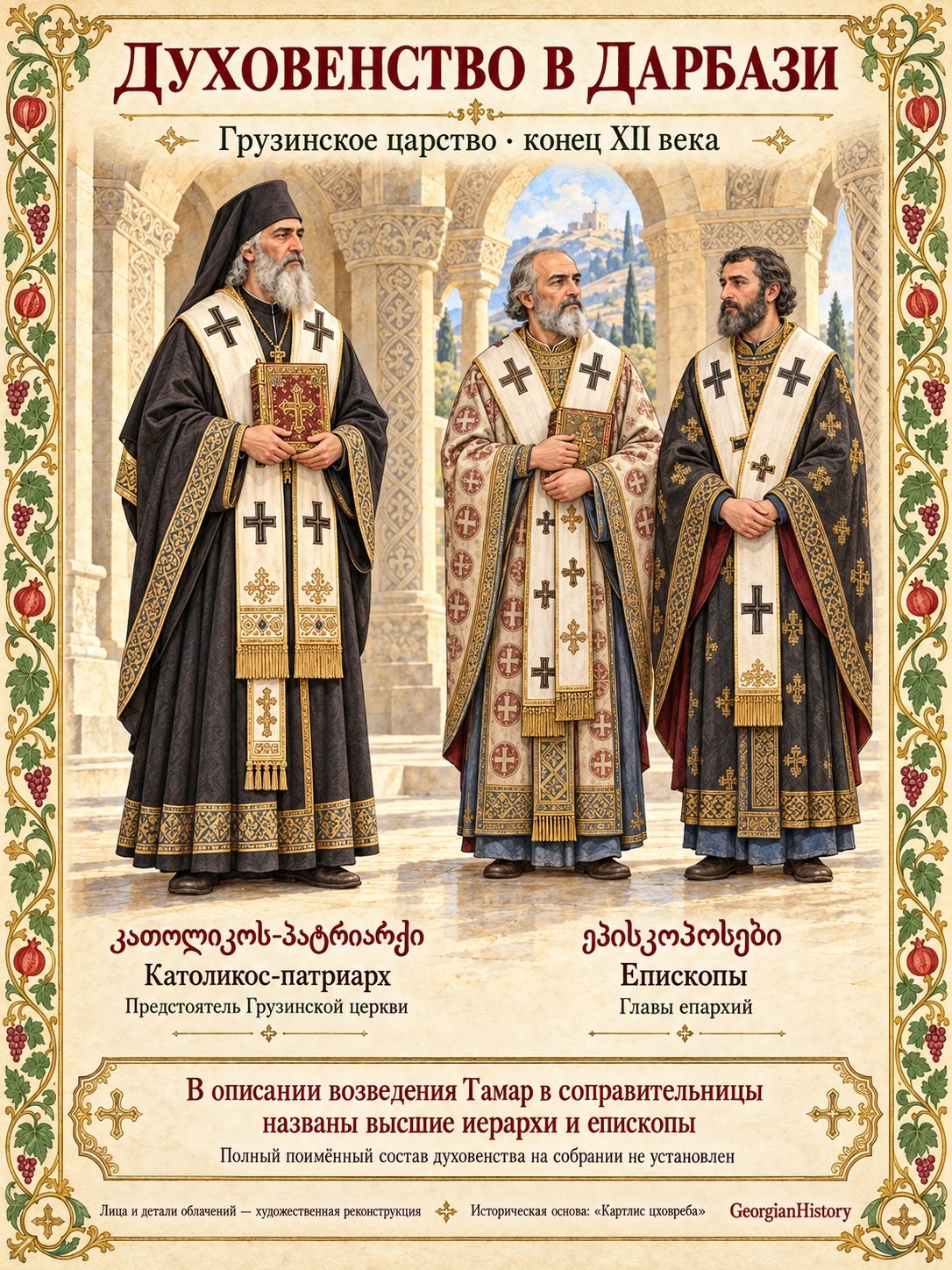
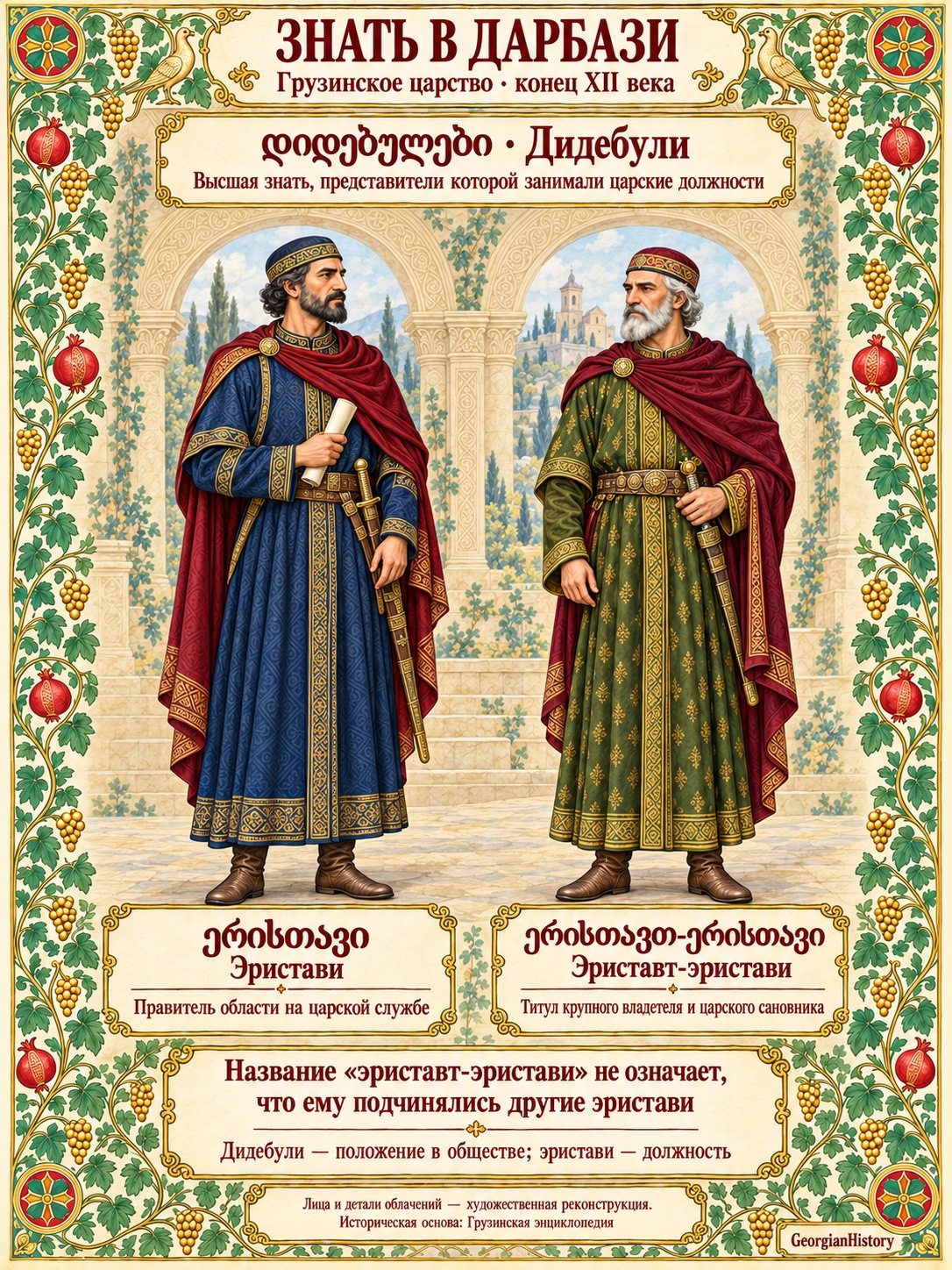
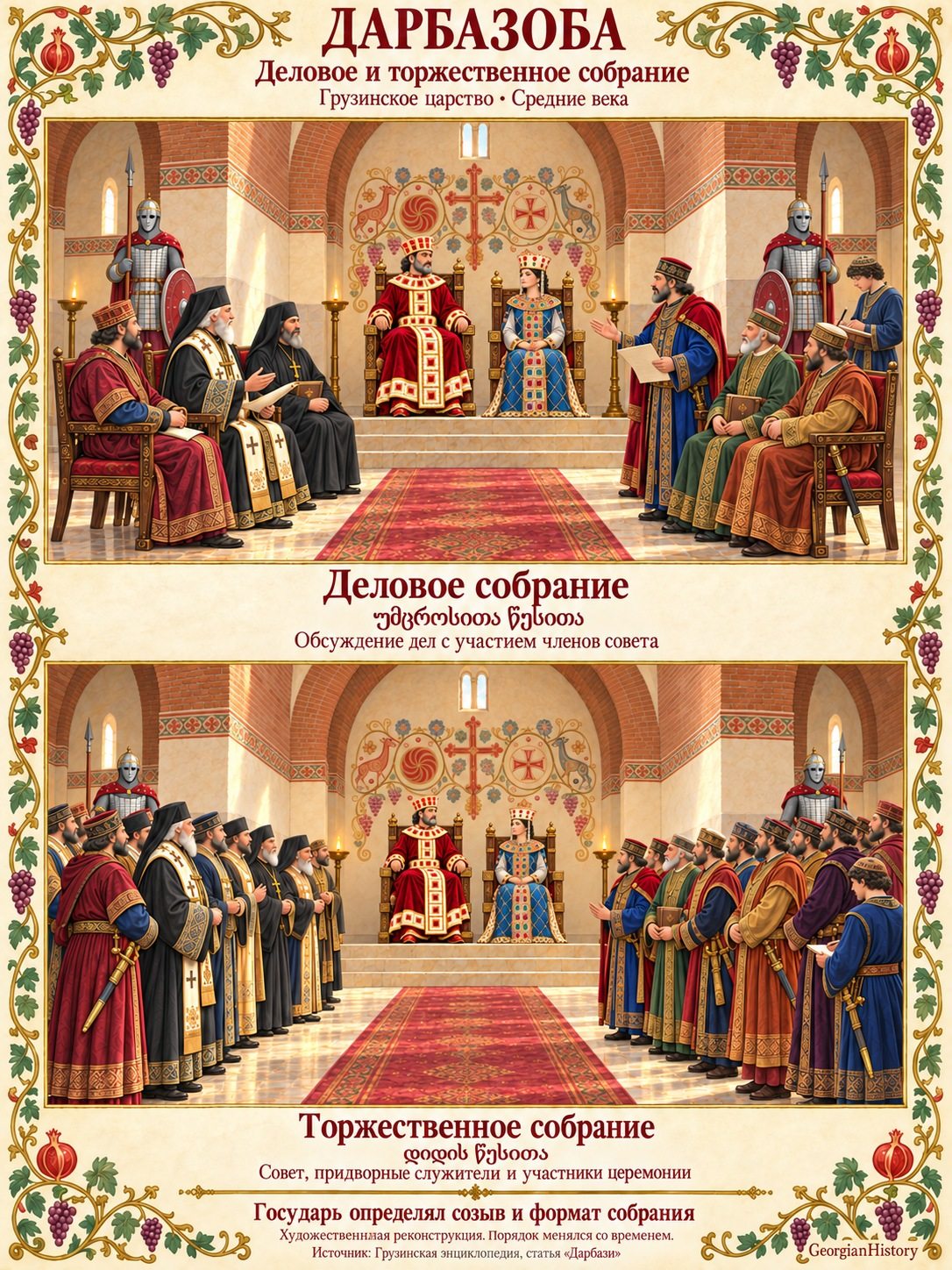
Seating arrangements expressed recognised standing. The sources and their scholarly interpretation draw attention to distance from the throne, the type of seat and whether there was a carpet or cushion. A privilege that may look like an outward detail to a modern reader was a public mark of rank. Disputes over honour could thus also be disputes over the right to take part in government.[25]
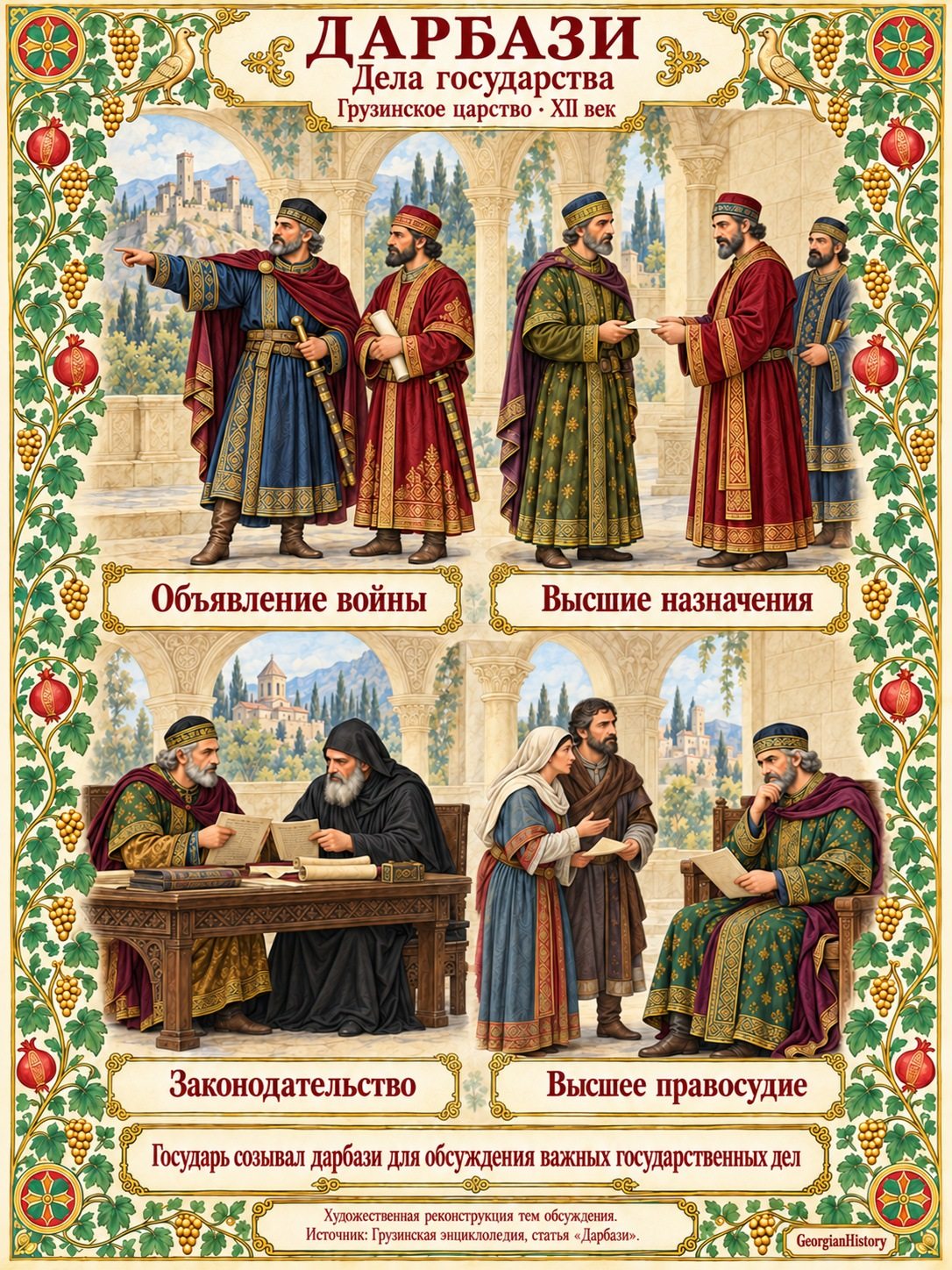
A political conflict early in Tamar’s reign illustrates this aspect of feudal order. Qutlu-Arslan proposed a separate institution, the karavi, that would have an independent role in making important decisions. His initiative concerned the distribution of powers between the sovereign and a group of influential subjects. Scholars differ in their assessment of the group’s precise social composition and of the consequences of the agreement.[26]
Calling the karavi a fully formed modern parliament would be misleading. Such a claim would require evidence about representation, membership and procedure. A broad resemblance to the idea of limiting royal authority cannot supply that evidence. A more revealing historical question is who was to decide matters of grants, punishment and government, and how independently the throne could act.
In the chronicle’s account, the confrontation required negotiation. Tamar entrusted the mediation to Kravai Jaqeli and Khvashak Tsoqali, and the settlement brought obligations on both sides. The episode shows the political weight of noblewomen’s authority. These women acted in a specific capacity as mediators. Their participation cannot by itself establish a uniform institution or right for all women.[27; 38]
The debate over the darbazi therefore concerns the structure of feudal society itself. Major landholders participated in government because they possessed power, resources and recognised standing. The king depended on their action and sought to retain the ability to direct common affairs. A seat on the council, court office and personal negotiation offered different ways to accommodate those interests.
The development of central offices did not diminish the importance of lineages and provincial governors. It created new ways to direct their work from the centre. The same official could link a personal estate, provincial authority and service at court. The history of institutions in Tamar’s Georgia is therefore also a history of social relations.
10. The Church as a spiritual institution and a landholder

Role in society
The highest spiritual leadership. Ecclesiastical rank could also bring political influence.

Role in society
A prelate who led a diocese. Spiritual duties went hand in hand with managing church estates.

Role in society
Parish ministry and participation in the community's daily religious life.

Role in society
Monastic life included worship, labour and, in some centres, work with books.
Spiritual leadership, the ordained ministry, and monastic life. Representative figures with reconstructed vestments.

Role in society
Participation in worship. The vestments and appearance are reconstructions.
A deacon with a censer. Artistic reconstruction.
Church life was embedded in every major part of medieval society. Worship, education and legal tradition shaped ideas of order and proper conduct. Through landholding and dependants, the Church participated in the economy. Through senior prelates and educated officials, it took part in government. These aspects cannot be separated completely, though the distinction between them matters.
The ecclesiastical order had a structure of its own. The Catholicos-Patriarch held the highest place in the Church’s leadership. A bishop headed a diocese and a superior governed a monastery. Priests and deacons belonged to the ordained ministry, while monasticism denoted a particular form of religious life. Being a superior was an office. Ordained rank, monastic status and that office do not form a single straightforward hierarchy.
A bishop and a monastic superior therefore cannot be represented by one stock figure, and a monk does not invariably occupy a rung below a priest. Their relations were shaped by differences of function as well as seniority. The episcopal see should likewise be distinguished from the monastery. Both could own land and support a culture of books, though they held different places in Church government.
Church estates needed to be managed. Revenues had to be recorded, dues collected and records of property preserved. A donation became part of the institution’s long-term work. Its preservation could determine whether the community could maintain worship, support people and continue its work on books.
Nobles who served ecclesiastical institutions were also part of this arrangement. The expression “Church aznauri” describes dependence on an episcopal see or a monastery. These men remained laypeople and held a social position of their own. Their service differed both from monastic obedience and from the labour of peasants on Church land. Historical vocabulary might express such relationships as belonging to the institution’s “house” or as being in a position of “sonship” to it.[41]

Role in society
A layman in the service of a church estate. This position did not make him a monk.
After a sketch by Giorgi Tsiklauri. Belonging to an ecclesiastical estate did not imply monastic status.
Exemptions and privileges attached to an estate were particularly important. Sheuvaloba, შეუვალობა, or immunity, meant limiting specified demands or interference from outside. The document determines the scope of each exemption. Relief from one demand does not establish a complete withdrawal from the royal order. There is no basis for treating every Church property as equally free of all obligations.
The preceding period left an important legacy. David IV’s testament to the Shiomghvime monastery, dated to 1123–1124, confirmed the monastery’s grants and special standing. A study of the document notes the restoration of its immunities and the connection with royal patronage. Religious privilege could therefore coincide with the monastery’s closer incorporation into the sphere of royal protection.[45]
Under Giorgi III, the demand to restore ecclesiastical immunity also had political significance. Even victory over the rebel houses did not relieve the king of the need to reach agreements with Church institutions. They had rights and expectations of their own, which the throne had to take into account.[1]
The chronicle’s account of Tamar’s address to a Church council conveys an ideal of mutual responsibility. “Begin with me”, in the historian’s rendering, stresses that royal dignity brings an obligation to observe religious standards. The passage is evidence of the idea of rulership conveyed by the source. It is not an independently preserved verbatim record of the speech.[40]
Aid to the poor and royal charity
Helping people in need formed part of the Christian understanding of a ruler’s duties. It linked the use of wealth to care for those without sufficient means of their own or support from their families.
The published Life of Tamar, Queen of Queens reports that a tenth of state revenue was set aside for the poor and that overseers were appointed to look after them. This detail belongs to a eulogistic account of the reign and expresses an ideal of royal care. It does not allow actual receipts and expenditure to be reconstructed year by year.[40]
The same account links donations to monasteries with support for the destitute and the ransom of captives. Transferring funds required trusted people to deliver and distribute them. Charity thus had a practical economic side and created ties of patronage beyond the royal court.[40]
The Church was an independent participant in feudal order, with considerable spiritual and material weight. It could support the throne, demand confirmation of rights and enter disputes over offices. Its wealth allowed cultural centres to endure, while remaining embedded in relations of ownership, service and dependence.
11. The town in the feudal kingdom
The town brought together production, exchange and government. Farm produce met the needs of buyers, craft labour met commissions and imported goods met local demand. The court and Church institutions, major landholders, merchants and many people working in shops or providing transport took part in urban life. Towns were therefore part of the feudal order.
The town was more than a copy of a rural estate. A wealthy merchant might command means and connections unlike a rural landholder’s resources. A craftsperson depended on specialist skills, tools and the opportunity to secure a commission. Money and a commercial reputation offered their own routes to influence, although differences of social standing and dependence on recognised authority still mattered.
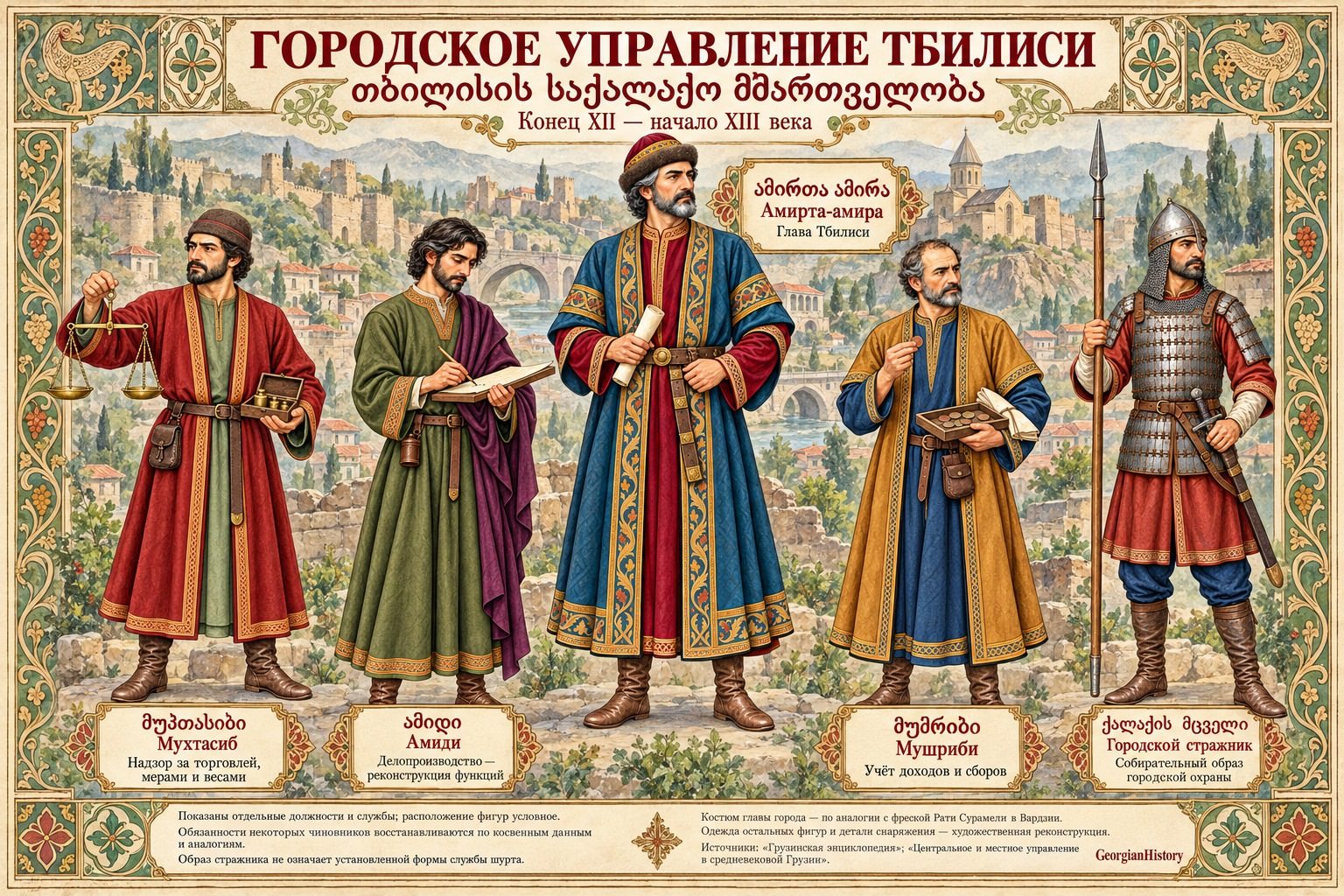
In Tbilisi, the amirta-amira, ამირთა ამირა, or head of the town, became an important office. The Georgian Encyclopedia associates its establishment with the late twelfth century and notes that the officeholder answered to the mechurchletukhutsesi. Duties included care of the town, judging its inhabitants and handling the affairs of its surroundings. The office linked urban government to the royal financial administration.[43]

Role in society
Head of the city. The article discusses the office's powers and its ties to royal financial administration.

Role in society
Supervision of measures, weights and market order. Artistic reconstruction.

Role in society
Accounting for merchandise and customs duties. The duties are known from the later Regulations of the Royal Court. The figure's appearance is reconstructed.
Amirta-amira, muhtasib, and mushribi. Reconstructions of distinct urban functions, attested at different dates. Details of the mushribi’s service are known from later sources.
The link had practical foundations. To the authorities the town was a source of revenue and a place of exchange and concentrated population. Trade depended on the ability to deliver goods, established rules for collecting dues and a means of settling disputes. Treasury, government and urban justice therefore constantly intersected.
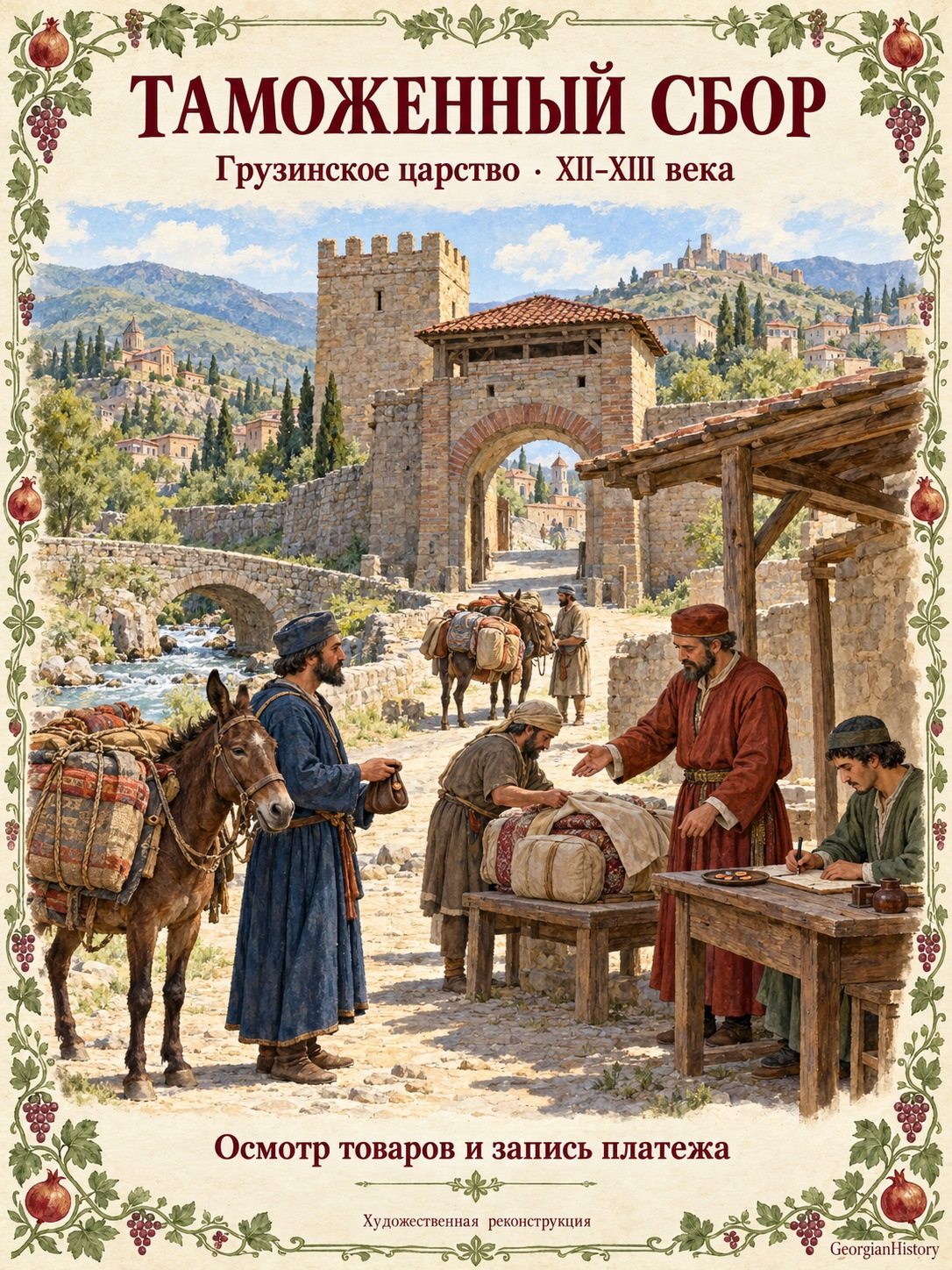
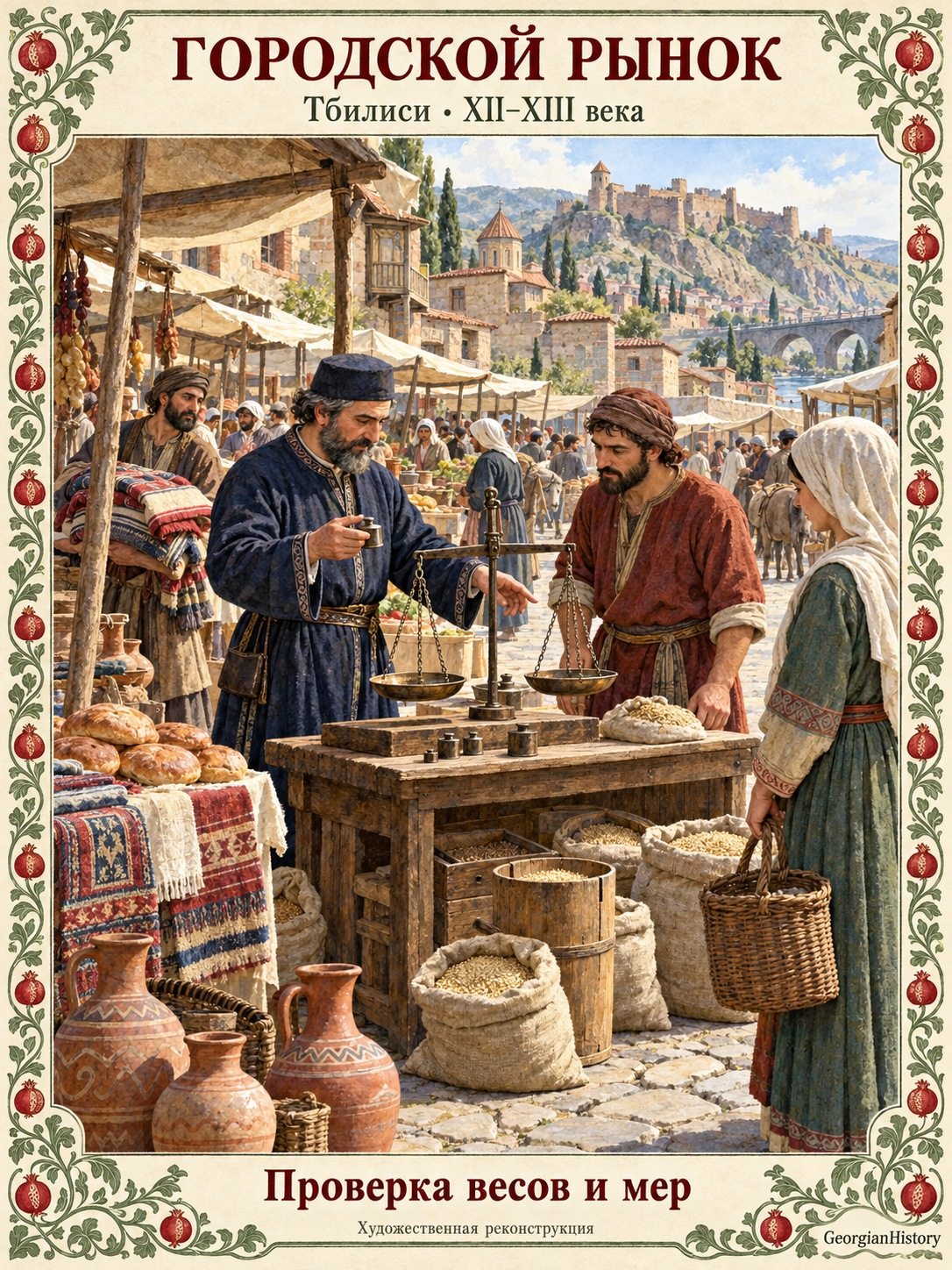
The vocabulary of urban office retained titles of Arabic origin, including amidi and mukhtasib. The mushribi was associated with recording merchandise and customs duties and transferring collections to the office of the mechurchletukhutsesi. The later Regulations of the Royal Court describes his work in detail. These illustrations depict individual functions on the evidence of different dates. They cannot reconstruct all Tbilisi’s officials in the year Tamar came to the throne.[12;46]
Craft production supplied the material means of society. Smiths made and repaired necessities, stoneworkers contributed to construction, potters supplied vessels, and weavers and tailors produced cloth and clothing. Goldsmithing combined valuable materials with a high level of skill and could serve secular patrons as well as ecclesiastical needs.
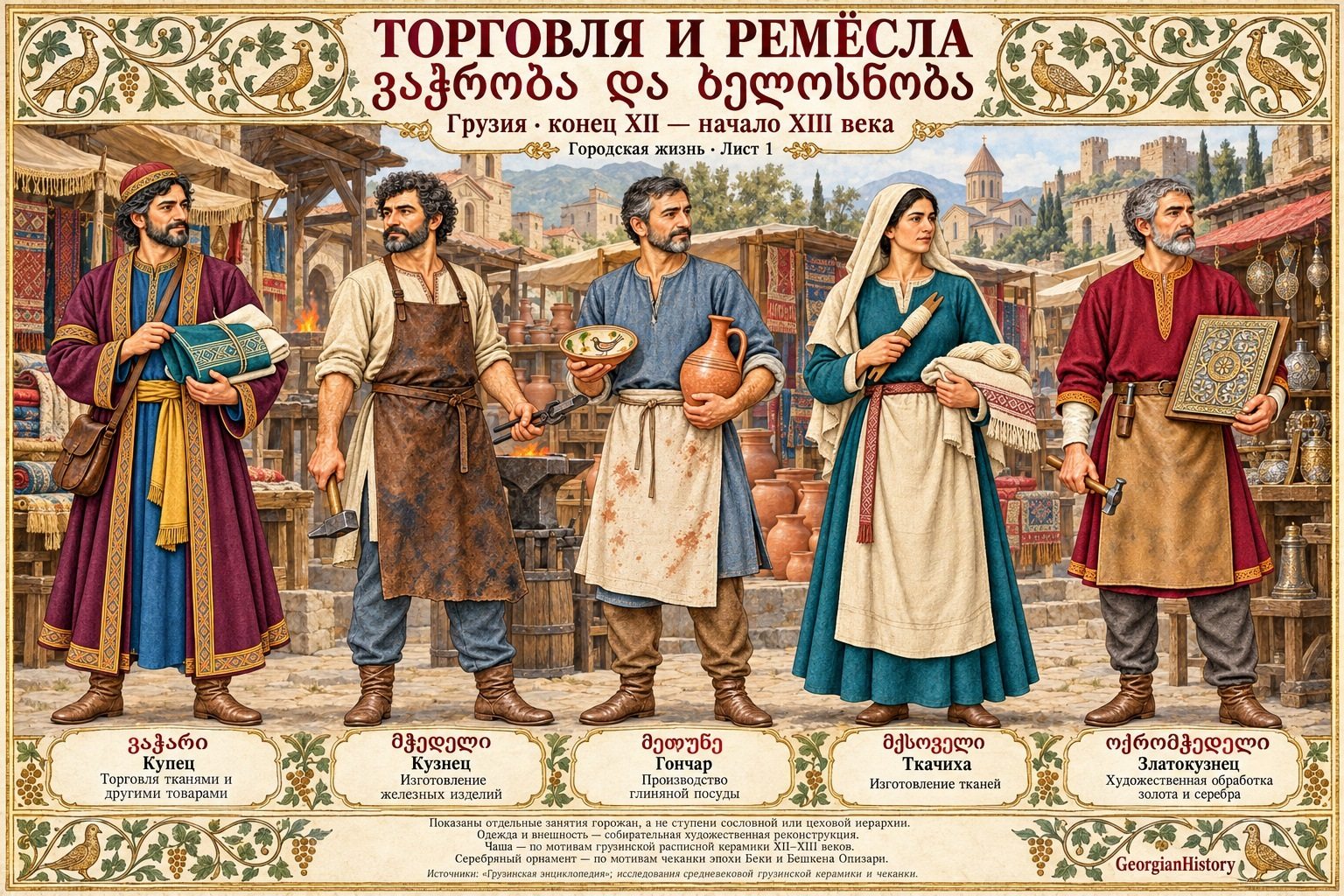

Role in society
Made and repaired metal objects. The craft connected the army, town and countryside.

Role in society
Made ceramic dishes and vessels for household use.

Role in society
Making textiles formed part of the material support of society.

Role in society
Working stone for construction and decorative finishing.
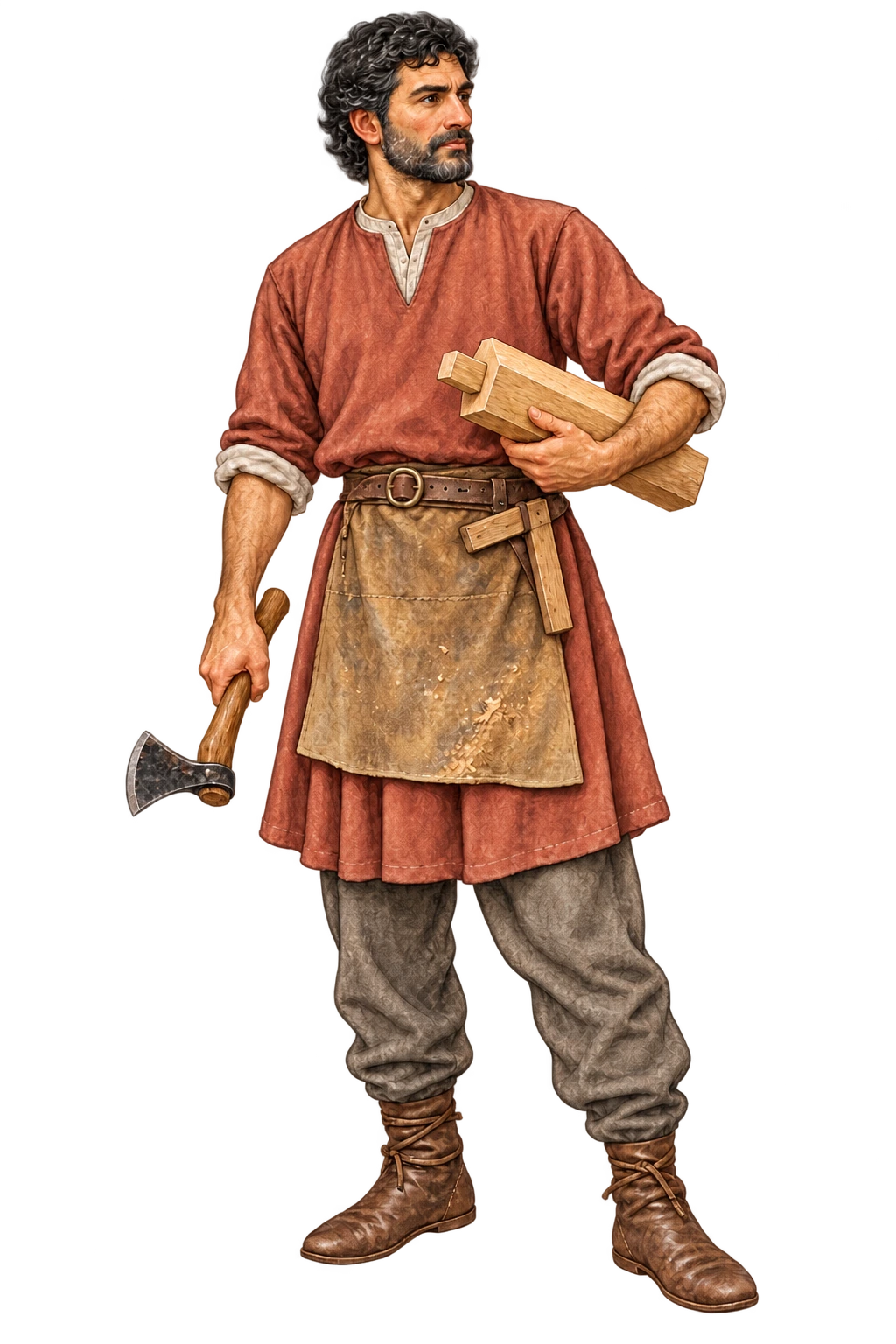
Role in society
Working wood and making items for household use.

Role in society
Baking bread for the town's inhabitants.
Reconstructed figures of urban artisans.
Each craft had its own sequence of learning. Watching an experienced master, repeating operations, learning the material and gradually acquiring independence took time. A craft apprentice is therefore an important figure in social history. The apprentice shows how skills were handed on and occupations reproduced even where the precise training routine of an individual workshop is unknown.
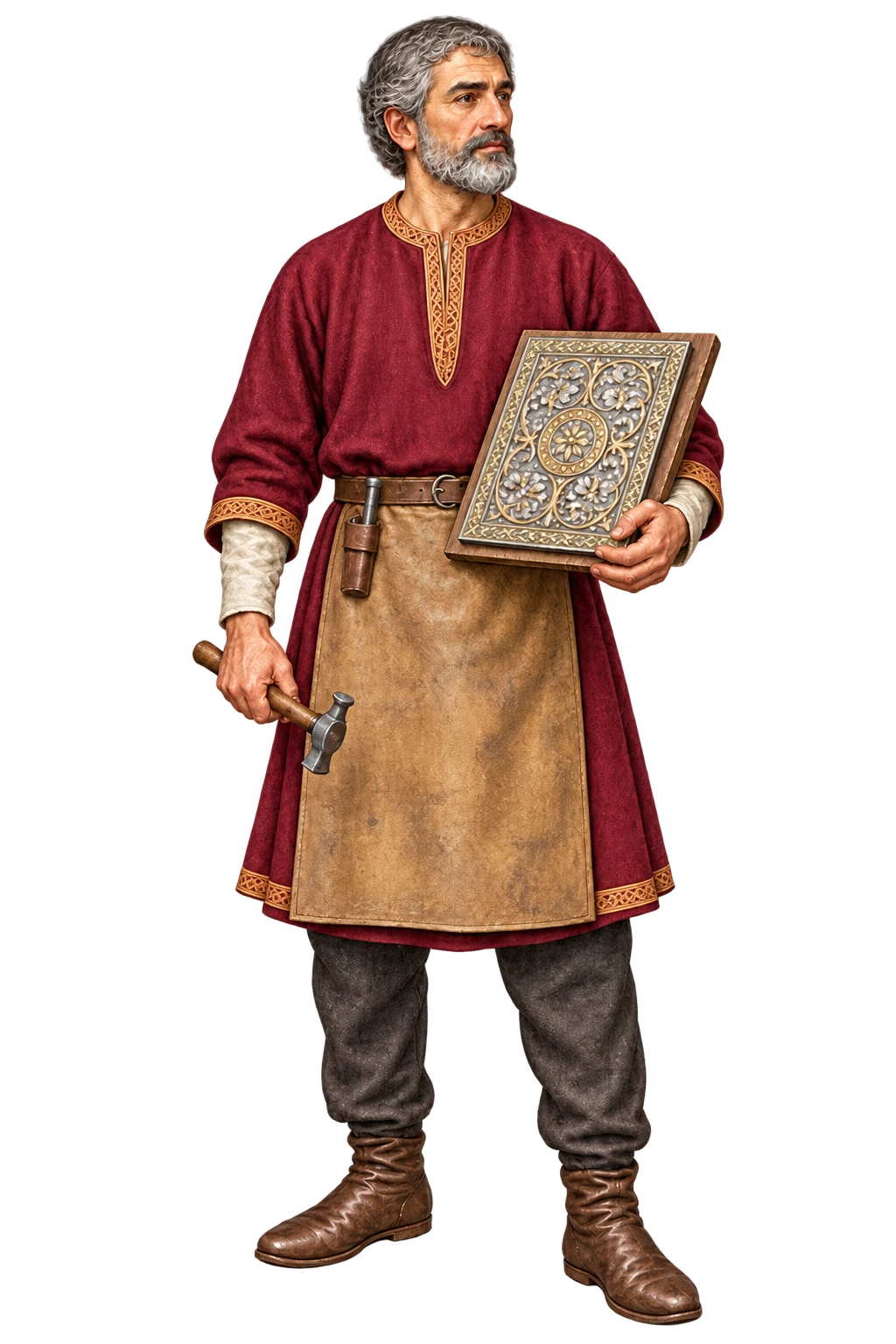
Role in society
Working gold and silver required skill and supplied objects to secular and ecclesiastical patrons.

Role in society
Skills passed on through working alongside a master. This does not imply a uniform system of later guild ranks.

Role in society
Making and repairing shoes.

Role in society
Making and mending clothing. A representative portrayal of the craft.
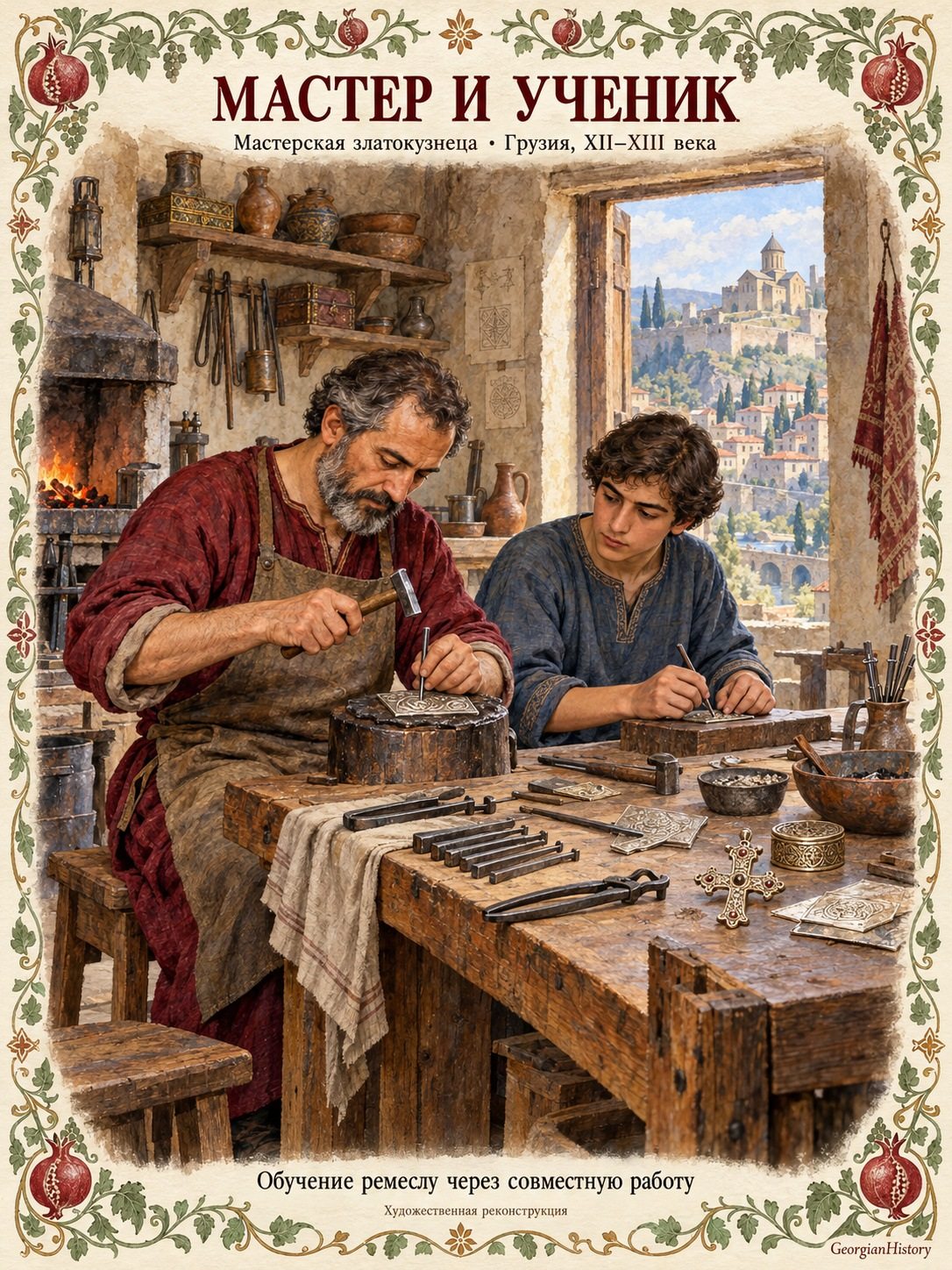
There is no proof that all workshops in Tamar’s time operated under a common statute or had the same set of formal ranks. Much more is known about later craft organisations. The term amkari, ამქარი, familiar from the history of Tbilisi, became widespread in Georgia from the nineteenth century. Scholars describe the predecessor associations as more formally organised in the seventeenth and eighteenth centuries. Earlier cooperation among artisans and merchants remains possible. It must be distinguished from the statutes, banners and titles of later periods.[29]
The same distinction applies to trading associations. A joint undertaking, a transfer of funds and participation in exchange by several people do not establish an institution identical to any later corporation. If a historical name is used for a partnership, it needs to be dated. For Tamar’s reign it is safer to rely on evidence of particular activities than to apply a familiar term retrospectively.
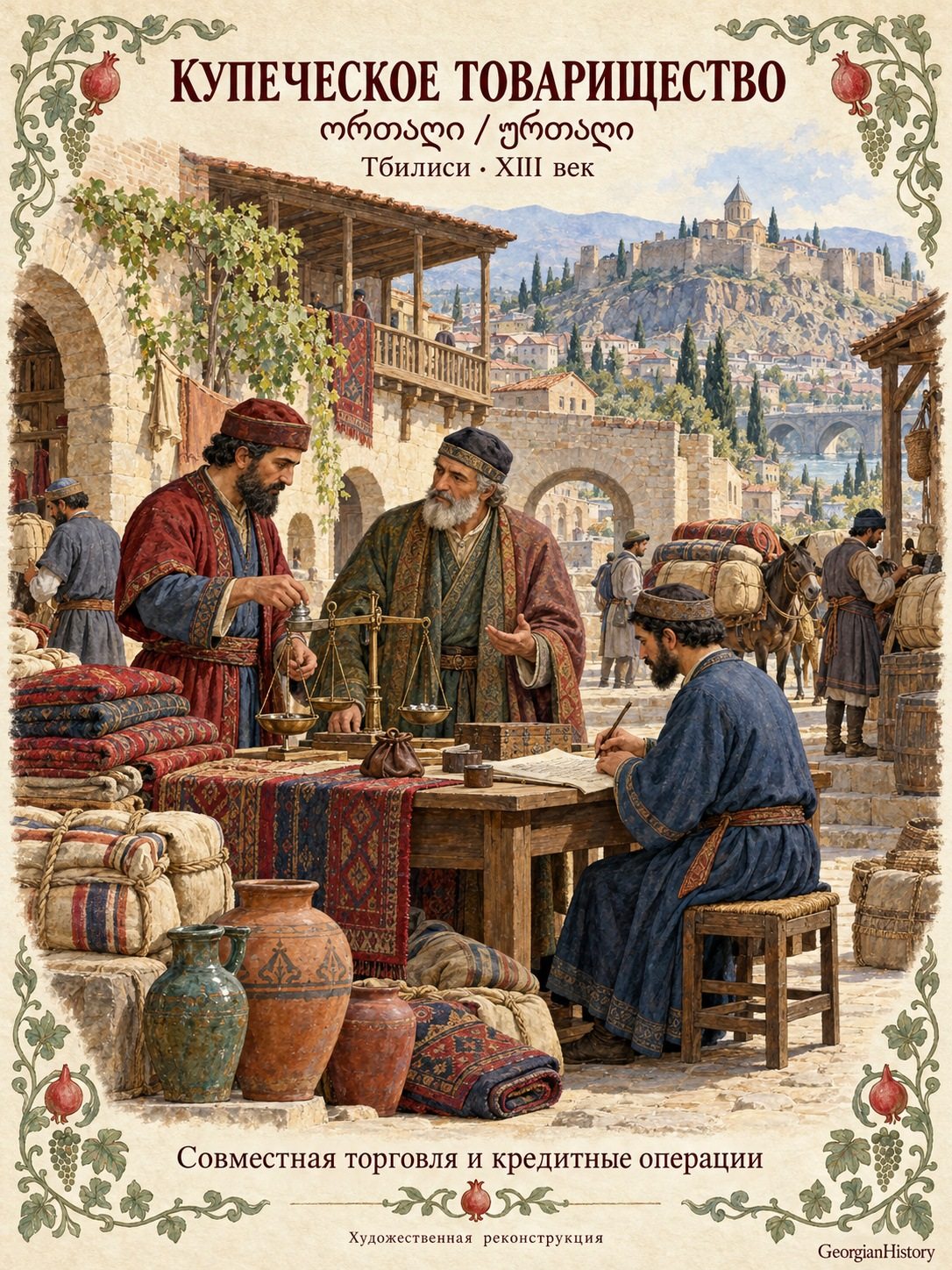
Urban revenue also came from more than one source. The movement of goods, the work of workshops and major commissions entered into different arrangements with authorities and owners. The merchant needed security and recognition of his claims. The sovereign needed funds and supplies. Those needs made cooperation possible without removing the difference in their interests.

Role in society
The exchange of goods linked agriculture, workshops and long-distance trading networks.
Communities and differences in rights
Urban residents differed in more than occupation and wealth. Tbilisi was home to Christians, Muslims and Jews, and its Christian population included Georgian and Armenian communities. Religious affiliation affected places of worship and the everyday terms on which neighbours lived. It did not in itself determine someone’s occupation or means.[58]
Al-Fariqi, who visited Tbilisi in 1153, reported that the conditions granted to Muslims under David IV remained in force, including the right to pray and a special arrangement for using a bathhouse. This evidence predates Tamar’s reign. Protection for a community took the form of specific permissions and obligations. It cannot establish the same rights for all residents.[58]
Confessional differences could run through a single noble house. Zakaria Mkhargrdzeli remained a member of the Armenian Apostolic Church, while his brother Ivane converted to Chalcedonian Orthodoxy. Both held high positions in the service of the Georgian crown. A lineage’s origins, ecclesiastical affiliation and political loyalty should therefore be considered related but distinct aspects of a person’s standing.[57]
The circulation of coinage illustrates the connection of this society with the wider region. Tamar’s coins retain features of Near Eastern monetary practice and use different languages for royal designations. They attest to economic interaction that cannot be explained as barter within a closed estate. The use of money did not end the cultivator’s dependence or remove land as the foundation of political power.[36]
Towns mattered to the kingdom precisely because they brought different occupations together. They gave the court access to necessities, landowners a way to use part of their income, artisans commissions and merchants a market. Their history broadens our picture of feudalism. Society depended on rural estates and on the ties linking villages, urban labour and royal authority.
12. Law and the written record
Feudal relations needed recognised foundations. Land was conveyed, rights confirmed, obligations laid down and exemptions contested. In such a society a document preserved a decision and could be produced when circumstances changed. Someone able to name the basis of their holding and produce the confirming text had a substantial argument in a dispute.

Role in society
Recorded orders and documents. Written evidence helped establish rights.
A written decision did not enforce itself. Its effect depended on the authority behind it, the standing of the parties and their ability to secure compliance. Legal history is therefore tied to political and social history. A document shows what was considered due, while the circumstances of its application show who could actually insist on it.
A revealing example is Chiaber’s charter to the Shiomghvime monastery from the late twelfth century, generally published under the year 1189. It names members of the Mkhitarisdze family from Zhinovani together with their houses and holdings. It requires an annual delivery of wax to the monastery and specifies exemptions from other demands. Chiaber refers to Tamar’s assent, and confirmation in her name strengthens the order. The exact date remains debated. For social history, its place in the late twelfth century is what matters.[39]
The charter brings several parties together. An official disposes of rights, the monastery receives provision, the named people perform a defined duty and royal authority confirms the arrangement. The text itself compares their position to that of other traders attached to the monastery. Additional evidence would be needed to classify the named people as ordinary serfs. Attention to the document’s wording guards against an oversimplified reconstruction of social status.
The order was to remain in force for subsequent holders of Zhinovani. The right extended beyond a personal agreement with one individual. The donation’s recipient could use the document to insist on continuation of the arrangement after a change of official or owner. This illustrates the importance of a written record in a society where people and political circumstances changed.[39]
Justice was closely connected to property affairs. A dispute might involve income, the performance of service, whom people belonged to or a family’s position. There were different spheres of authority and a tradition of Church law. It would be as inaccurate to imagine one uniform court for every group as to reduce all landholding to a single form of ownership.
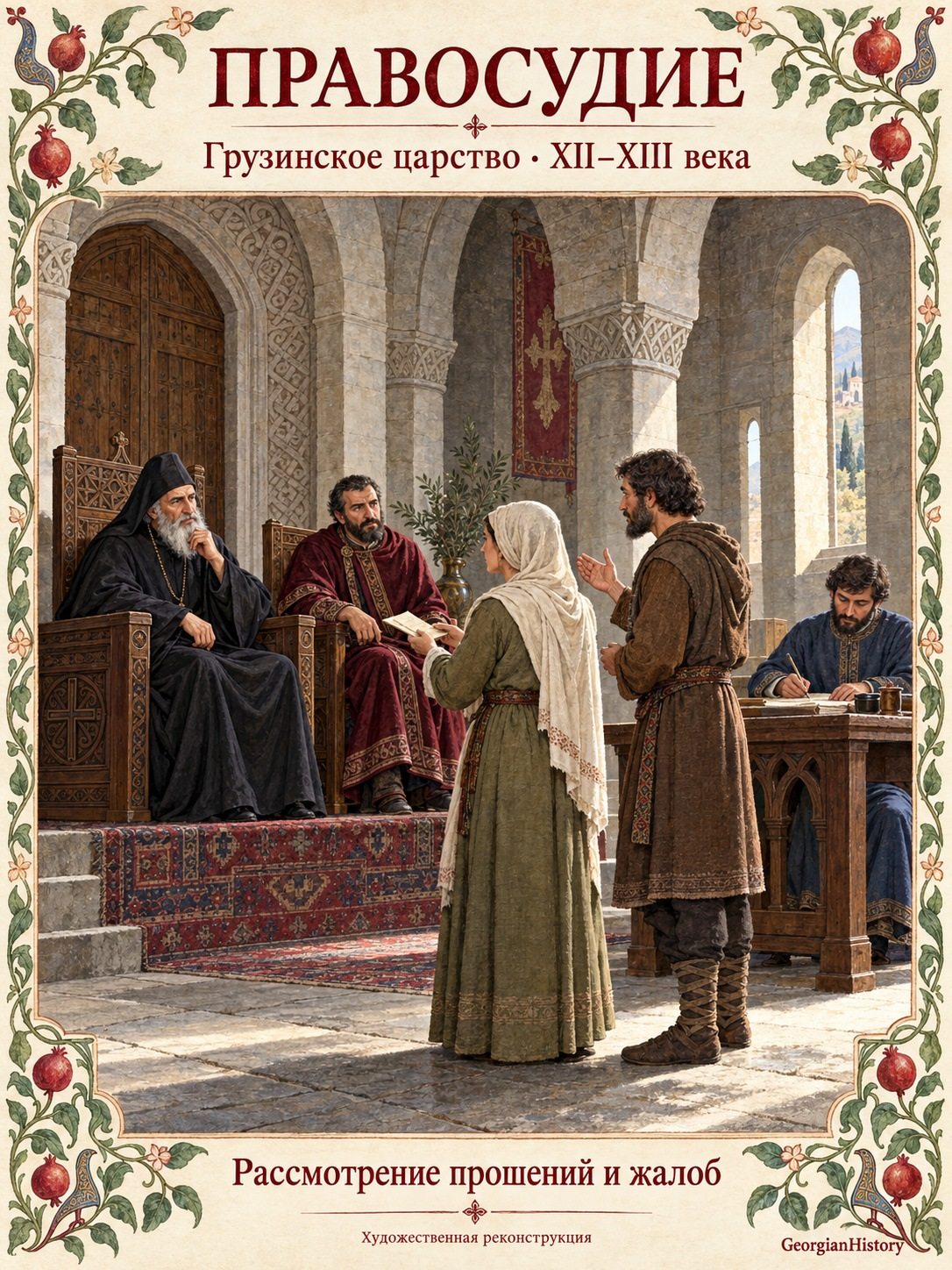
Scholarship in canon law gave educated people a language in which to discuss Church order and the social relations associated with it. The translation of the Didi Sjulisk’anoni associated with Arsen Iqaltoeli belonged to this sustained work. Through reading and interpreting the text, learning helped define proper conduct and authority.[30]
Family and the transfer of property
Property rights continued through the family. When a holder died, the question was what exactly passed to the heirs: the ancestral estate, acquired land, individual possessions or a right tied to service. The history of the family was therefore part of the history of the holding itself. The ability to maintain the estate depended both on the heir’s origins and on the basis of the right being conveyed.
Women’s property was a distinct aspect of these relations. In historical legal vocabulary, mamuli occurs alongside deduli, დედული, associated with property on the female side. The mzitevi, მზითევი, or dowry, also mattered. Its composition and significance depended on the family’s wealth, social standing and historical period. Landed property and personal possessions might be treated differently.[7;52]
The dowry raises the question of a woman’s own property interests within the family. Provision made for her should be distinguished from the common household economy and from the property of her husband’s relatives. The specific terms for disposing of property, returning it or passing it by inheritance have to be established from evidence of the relevant period. Later descriptions of large households are important for legal history. They do not provide a ready-made set of rules for all women of the twelfth century.[52]
Church authority also regulated marriage. The Council of Ruisi-Urbnisi in the early twelfth century prohibited proxy weddings in which the bride and groom, in different places, performed the rite separately with people standing in for them. The rule shows that a marriage was subject to canon law even when noble houses had reached an agreement.[53]
Marriage and inheritance could change the circle of people with an interest in a holding. A dispute over family property touched on maintenance, children’s futures and the ability to continue in service. A woman’s position is therefore illuminated by her participation in court politics and by the origins of her property, the terms of its transfer and recognition of her rights over it.
Later legal compilations are useful for the long history of law, though they cannot replace evidence from Tamar’s time. The scale of penalties, classifications and procedures taken from later texts need to be dated. Otherwise readers may infer that the detailed later order already existed in its entirety at the end of the twelfth century.
Legal acts show which rights were conveyed, which demands were lifted and who confirmed the decision. These details reveal what holding property, service and dependence meant in practice.
13. Military power and its economic support
The army made relations of service particularly visible. Military obligation linked the throne, senior commanders, regional governors, and landholders. Armed men could be mobilized only where there were means to train and supply them. The history of the army is therefore one aspect of the history of landholding and revenue.
A mounted warrior needed a horse, arms, and the ability to leave his household work behind. All of this presupposed the labor of others and the availability of reserves. Differences in wealth affected equipment and the scale of participation. Expensive armor indicates substantial expenditure, but it cannot by itself establish the precise legal title of the person depicted.
Mobilization and command
Military organization drew on several sources. Studies of the amirspasalari examine troops mobilized from regions and estates, the forces of the royal domain, and other military contingents. Their cooperation required leadership and coordination. High command therefore had to bring together resources already organized on different bases.[11]

Role in society
Military service required weapons, equipment and economic support. The shield design is conjectural.
In this context, lashkari (ლაშქარი) means an army that brought together people serving on different terms. Regional forces under eristavis, men of the royal domain, landholders’ detachments, and warriors recruited from outside came under a common military administration. On campaign they acted under unified command while retaining differences in origin and supply.[11]
At the Battle of Basiani, the brothers Shalva and Ivane Akhaltsikheli commanded the Meskhetian vanguard. This shows the detachment’s regional composition, its command by a particular noble house, and its place in the wider battle formation. The name of the Meskhetian force thus indicates its composition and the affiliations of its commanders. By itself it does not imply a separate, independent army.[47;56]
The monaspa and the king’s military retainers
The monaspa (მონასპა), the royal guard traditionally associated with David IV, occupied a distinct place. It consisted of selected warriors in the king’s personal service who depended on him for maintenance and grants. They guarded the monarch and took part in major military operations. According to the Georgian Encyclopedia, these warriors were not slaves in the ordinary sense, but they lacked social freedom and were considered the king’s qma. The term mona therefore needs explanation. Here it denotes personal dependence within armed royal service.[55]
Over the twelfth century, grants of estates helped such warriors enter the landholding nobility. Personal service became a means of social advancement. The report of five thousand guardsmen concerns the organization of David IV’s army. It does not establish that the corps was of the same size in Tamar’s time. The Georgian Encyclopedia notes that the monaspa is not mentioned after 1184, which limits how precisely its later organization can be reconstructed.[55]
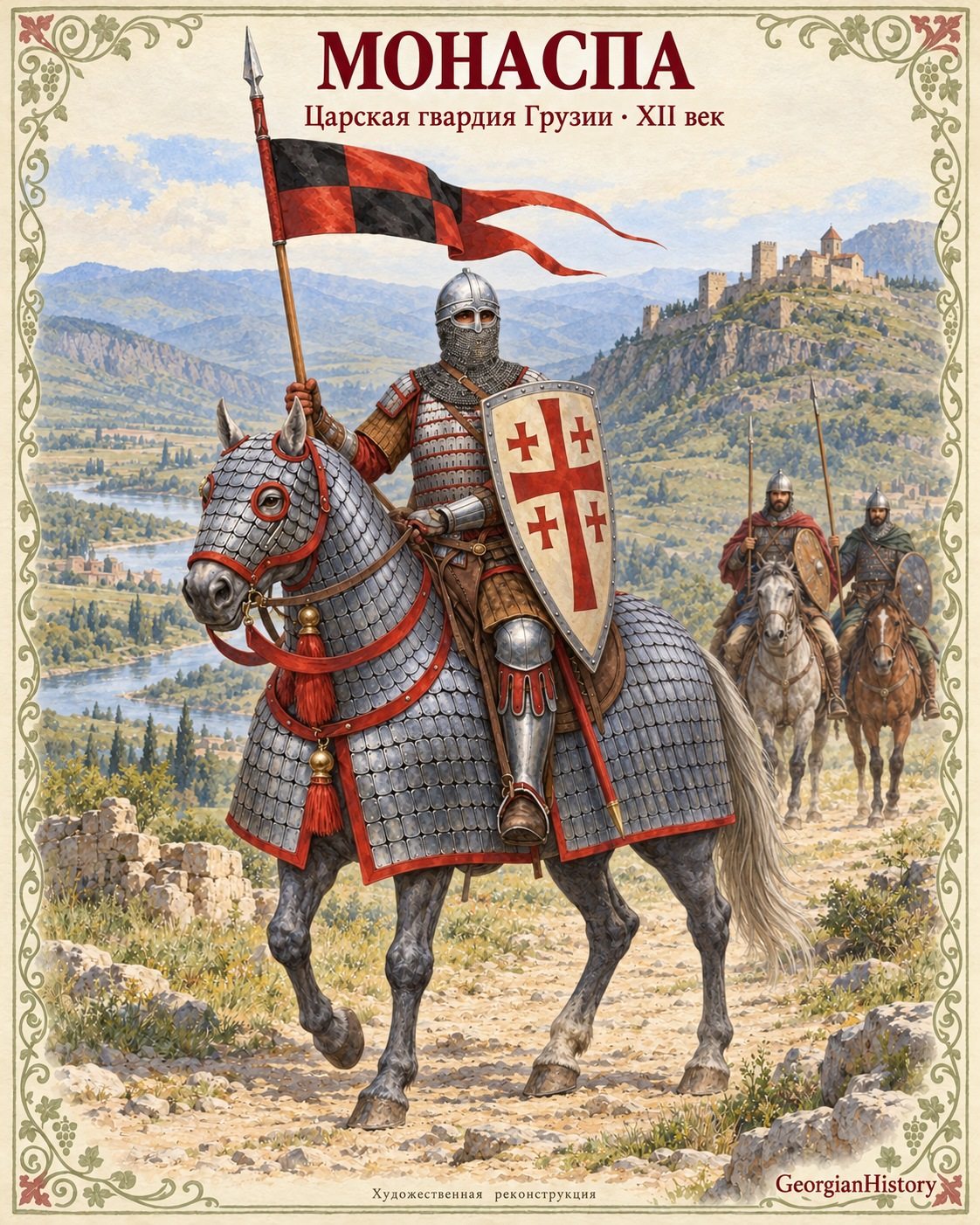
A noble house’s participation in war depended on its ties to the sovereign and its position in the kingdom. Service could bring recognition and grants, while a stronger house could expand its own capabilities. The monarchy’s successes and the growth of individual military families thus reinforced one another. This could support royal policy, while also making the distribution of rewards a political question.
The economy of a campaign
What took place away from the fighting also mattered to society. Animals had to be maintained, equipment prepared and repaired, food delivered, and communications kept open among those on campaign. The court’s stable and armory services supplied one part of this labor, local households and craftspeople another. Military victory rested on the combined work of people of different standing.
Frontier service and the consequences of victory
The region and the frontier fortress were part of the same system. After conquest or the appointment of a governor, authority had to maintain a lasting presence. This meant organizing supplies, stationing personnel, and managing relations with the surrounding territory. The capture of a town is thus only one stage in the military story. It is followed by the work of administering what was gained.
After the capture of Kari, present-day Kars, in the early thirteenth century, Tamar appointed Ivane Akhaltsikheli amirta-amira of the town and monapire (მონაპირე), a frontier commander responsible for guarding the border. The surrounding lands also came under his administration. Military success created a continuing obligation to hold the acquired region. The appointment of a governor and the provision of resources did not in themselves make the whole territory his private hereditary estate.[47]
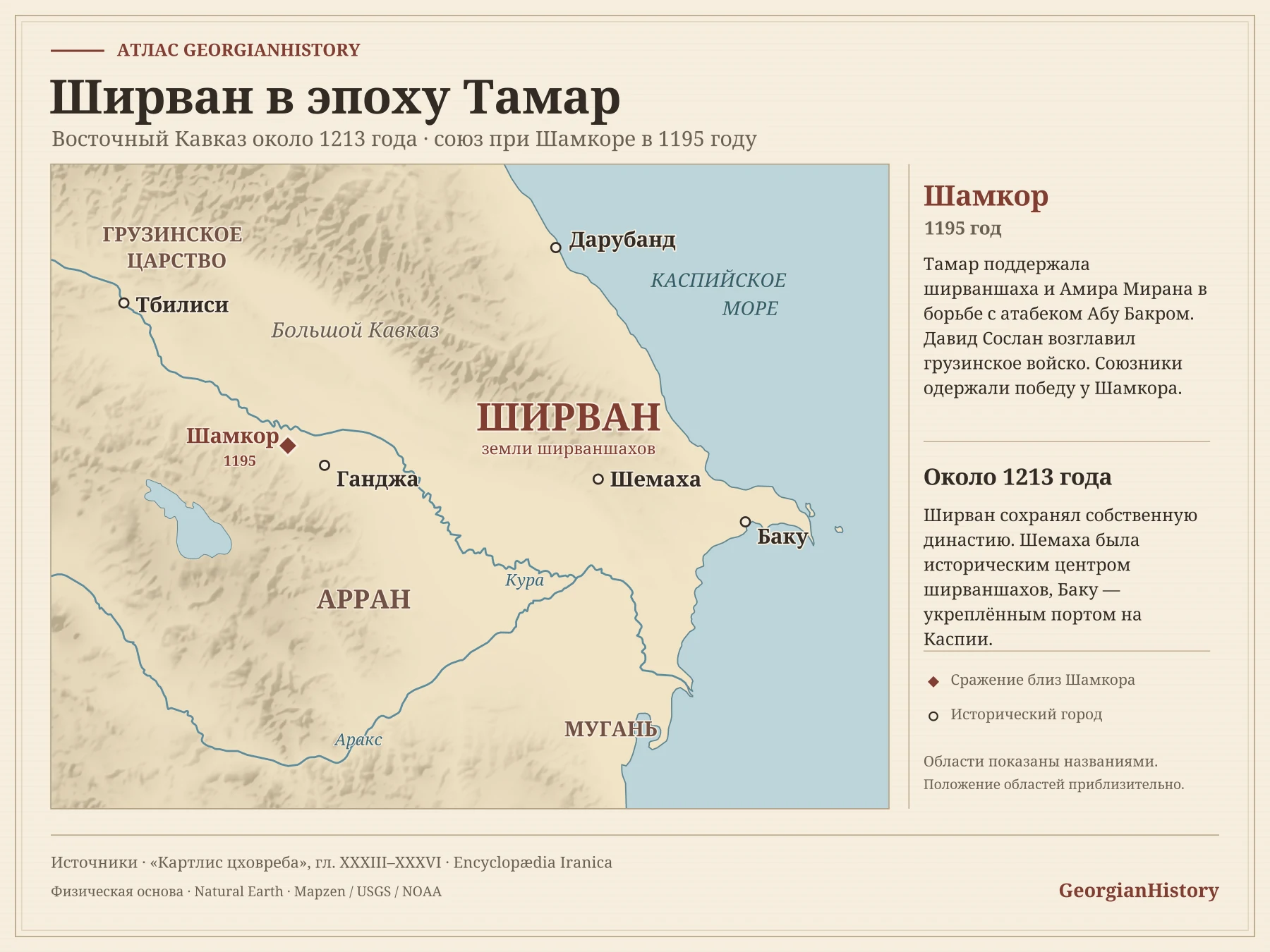
Victory also brought trophies that took on public and religious significance. At the Battle of Shamkor in 1195, Shalva Akhaltsikheli captured the caliph’s standard. Tamar offered it to the Mother of God of Khakhuli at Gelati. A military trophy thus became a temple offering and a witness to royal victory. This example shows one way of disposing of spoils. It cannot establish a general rule for dividing all captured property.[56]
Captivity and ransom
Capture in war had a different basis from a farmer’s dependence on a landholder. It could affect combatants as well as inhabitants of devastated areas. In his account of al-Fariqi’s description of the campaign against Ganja, Shota Meskhia mentions inhabitants being taken to Tbilisi. References to war booty could therefore conceal broken families and the forced displacement of people.[58]
The capture of a noble commander could become the subject of negotiations between states. Around 1210 Ivane Mkhargrdzeli was taken prisoner during the siege of Akhlat. Antony Eastmond links his release to monetary and territorial concessions, the release of Muslim prisoners, and the forced marriage of his daughter Tamta to the Ayyubid ruler al-Awhad. The marriage alliance thus became part of the ransom terms.[57]
The episode shows how much a captive’s position depended on social standing and the possibilities of negotiation. Freeing one dignitary affected the treasury, fortresses, and his family’s fate. The forced removal of inhabitants carried the consequences of war into individual households. Captivity and ransom connected military policy with the structure of society far beyond the battlefield.
The combined military force was more than a collection of separate detachments. They had to act in concert and obey the campaign command. The greater the undertaking, the more important it was for the center to direct men who kept their own ties to patrons, estates, and regions.
Military organization reveals one of the central relationships of feudal society. Land and dependent labor provided the means to serve. Service gave men a place in the kingdom’s fighting power. Grants could in turn give those men new resources. Directing this cycle was one of the throne’s most important tasks.
14. Gelati and Ikalto in the structure of society
Education occupies a central place in the history of feudal Georgia. Managing an estate, drafting a document, interpreting a legal or theological text, and preparing the next generation of readers all required lengthy training. The state and the Church needed people who could work with complex knowledge. Centers of learning were therefore part of the organization of the country and had social importance in their own right.
Work with books depended materially on steady support. A person occupied with translation and interpretation needed time, books, and a livelihood. A monastery brought together a place for such work and an economy capable of sustaining it. Landholding thus supported work whose results reached far beyond the estate itself.
Gelati and Ikalto arose before Tamar’s sole reign. Their importance cannot be reduced to the personal patronage of a single ruler, and the entire circle of known scholars cannot be treated as a faculty teaching in her time. The history of an institution and that of a particular thinker each have their own chronology.
Gelati
The Gelati Academy arose at the monastery in the early twelfth century at David IV’s initiative and with his support. Its tradition brought together Christian scholarship, philosophy, and translation. Comparisons with Athens and Jerusalem expressed the center’s particular calling. These images show the high standing of knowledge in the culture of the kingdom.[31; 32]
The point was to master and develop complex thought in Georgian. Translation required much more than replacing a foreign word with a local one. The translator had to understand the concept, choose an expression, and preserve the chain of reasoning. A mistake could alter the meaning of an entire proposition. Linguistic precision was therefore part of intellectual independence.
The Gelati tradition is associated with the dignity of modzghvartmodzghvari (მოძღვართმოძღვარი), the teacher of teachers. It indicates the high standing of leadership in a scholarly and educational community. Translating the title does not establish a modern administrative staffing structure for the academy. Its historical significance emerges from the relevant evidence and the wider importance of book culture.[31]
The work of Ioane Petritsi offers a particularly telling example. His Georgian translation of Proclus’s Elements of Theology came with an extensive commentary. Petritsi acted as an independent interpreter, enabling readers to follow the course of a philosophical demonstration and work with its concepts. His legacy shows the scale of the task that Georgian scholarship undertook.[33]

Role in society
A thinker of the Gelati school. The portrait is conjectural, and the dates of his life and work remain debated.
A conjectural portrait of the thinker. Scholars debate the dates of his life and work.
Such work created a lasting resource. New readers could use the language that had been developed and the reasoning that had been explained. A book kept a discussion open after the author’s death. An academic center’s importance therefore depended both on how many people it educated and on the intellectual possibilities it left to the culture.
Ikalto
Ikalto was another important monastic and educational center. Its academic tradition is associated with Arsen of Ikalto, who belonged to an earlier generation linked to the age of David IV. That connection does not automatically make Arsen a tutor at Tamar’s court. It shows the intellectual inheritance available to the country by the end of the twelfth century.[30; 34]
Arsen’s name is associated with the Dogmatikon and with the translation of a large collection of canon law. Collecting and transmitting complex theological texts in Georgian enabled educated readers to compare arguments and consult a broad body of Christian knowledge. This also had practical value for ecclesiastical administration, since rules and their interpretation helped define authority and proper conduct.
Gelati and Ikalto had histories and scholarly traditions of their own. Some activities were similar, but the centers were not interchangeable. Each drew its importance from the people who worked there, the books they preserved and produced, continuity in teaching, and connections with the Church and patrons. Distinguishing these histories is important to understanding the diversity of Georgian education.
Studies and the transmission of knowledge
Studies of the Georgian academies discuss grammar, reasoning, rhetoric, mathematical disciplines, music, and astronomy. These subjects belonged to a medieval educational tradition and were related to philosophical and theological learning. The surviving evidence does not support reconstructing an identical timetable, course length, or list of teachers for every decade.[31; 34]
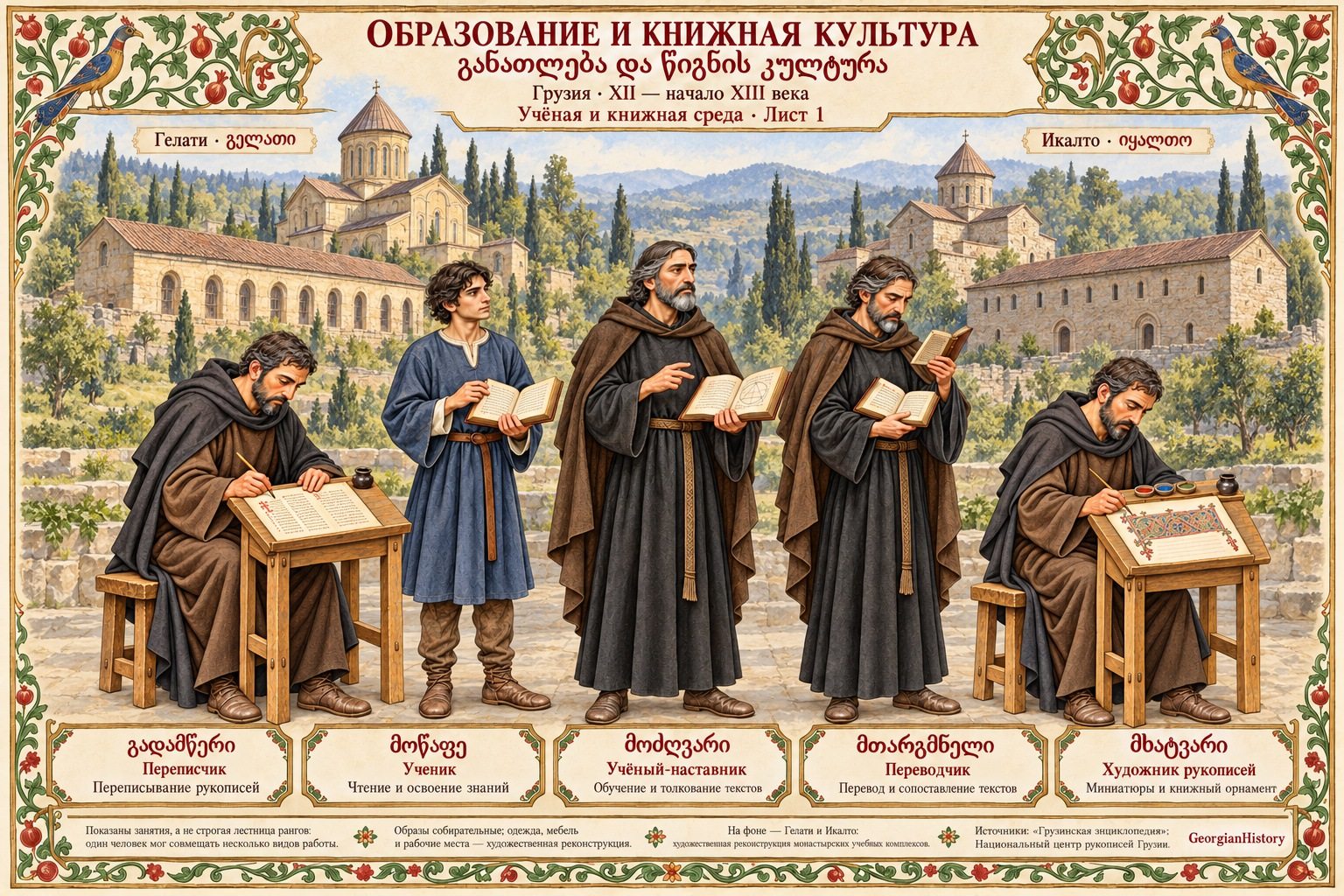

Role in society
A portrayal of an exercise in geometrical construction. No established chair of geometry from Tamar's reign is implied.

Role in society
An illustrative scene of calculation. The icon represents an activity rather than an official court position.

Role in society
An illustrative portrayal of scholarly work based on observation and knowledge from books.

Role in society
Passing on the tradition of chant was part of church culture.
Reconstructions of educational activities. The icons do not represent a documented list of offices or departments in Tamar’s time.
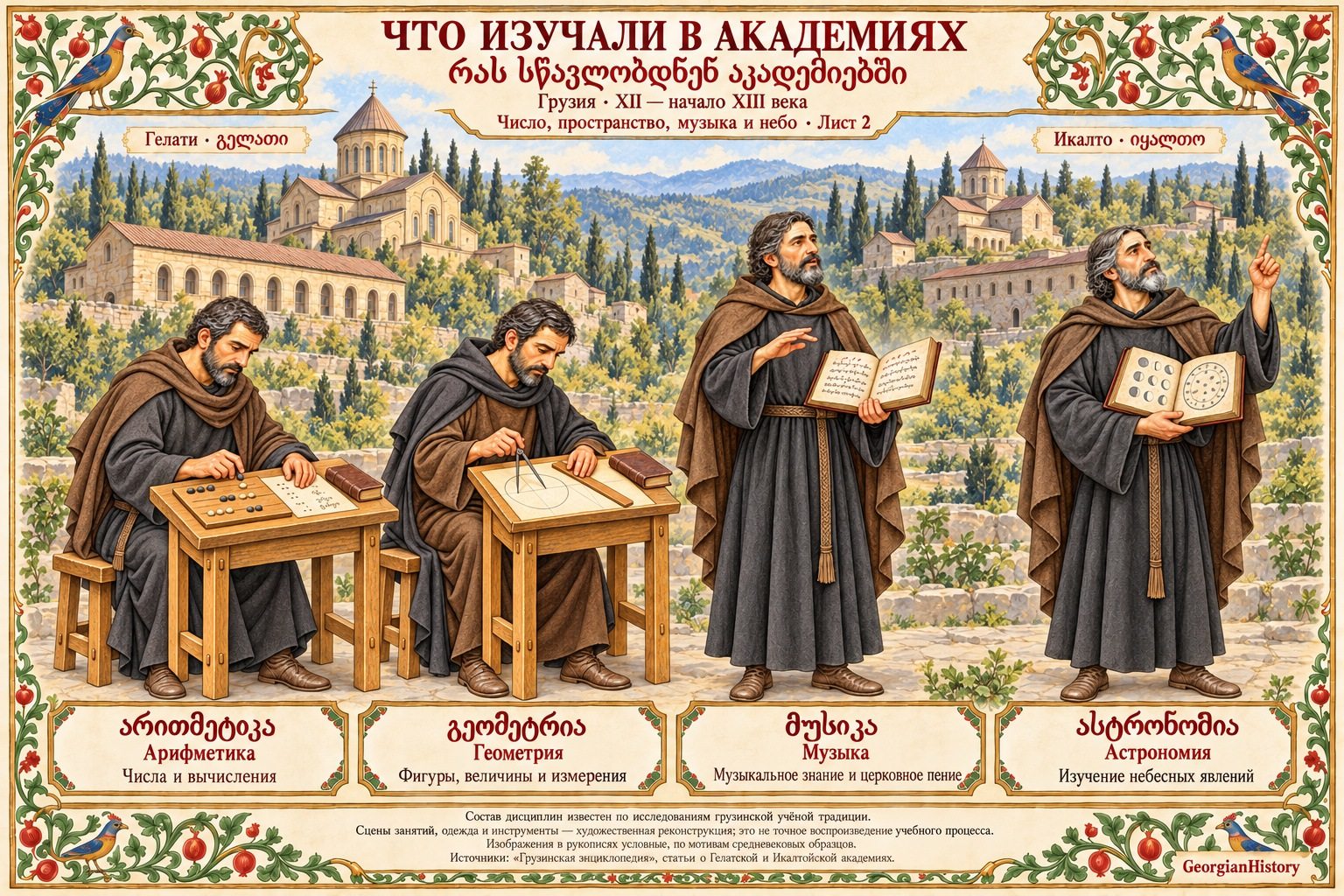
Grammar helped students read and understand a text. Rhetoric concerned the ability to structure speech and convey a thought to listeners. Working with arguments required distinguishing premises from conclusions. Mathematical studies and observations of celestial phenomena belonged to a historically specific body of ideas. Describing them as modern departments would project familiar specializations onto a medieval school.

Role in society
Examining the wording and meaning of a line in a manuscript.

Role in society
An illustrative scene of instruction in reasoning and composing a speech.
Reconstructions of educational activities. They do not constitute a list of official departments.
The relationship between teacher and pupil passed on practiced knowledge. A book could be difficult on first reading and call for explanation. The pupil learned how to work with a text as well as remembering individual pieces of information. A scene of reading or discussion together can therefore convey an important aspect of education without inventing ceremonies for examinations or diplomas.

Role in society
Discussing a text in a circle of scholars.

Role in society
A representative portrayal of work on a theological manuscript.

Role in society
Working with a text involved reading, explanation and discussion.

Role in society
Learning required mastery of the language and of ways to work with books.
Copying and decorating manuscripts formed a distinct part of book culture. Preserving a work meant reproducing it in a new physical copy. This required preparing a writing surface, copying the text, checking readings, and decorating the book when the project called for it. Such work combined intellectual discipline with specialized craft. Its participants performed different tasks, which did not necessarily form a single hierarchy of academic ranks.

Role in society
Copying preserved the text and required a trained hand.
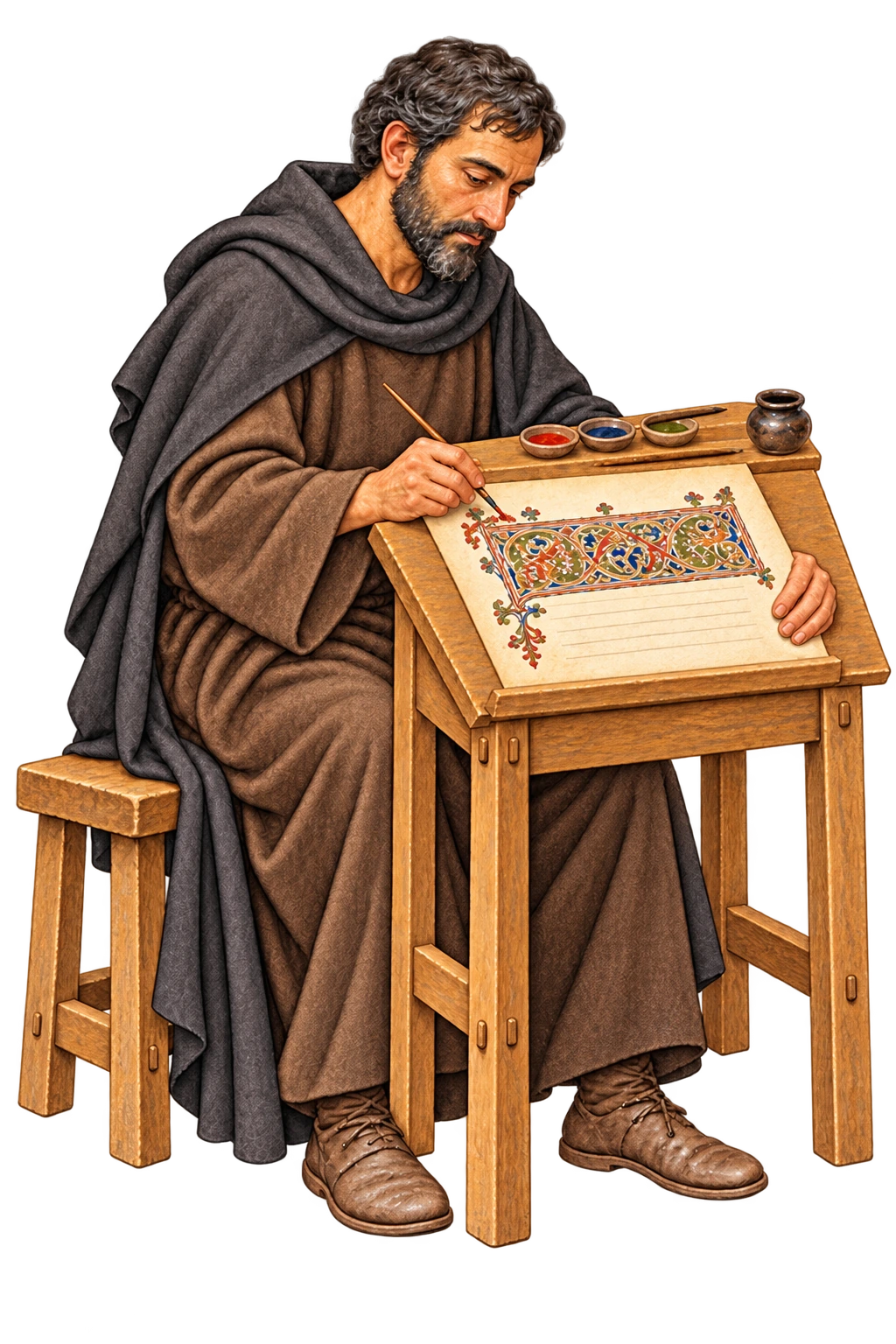
Role in society
Manuscript decoration brought book culture together with artistic skill.
The book brought scholarly and craft cultures together. A well-made object helped preserve a text and made it usable, while knowledge gave purpose to the labor and materials that went into it. The means to support this work showed a patron’s economic resources. The book itself could continue to shape the culture after the circumstances of its commission had passed.
These centers mattered to feudal society precisely because they connected knowledge with institutions and resources. The state needed literate administration, the Church needed educated servants and interpreters, and society needed to preserve the language of law and faith. Gelati and Ikalto were among the places where this continuity acquired a lasting form.
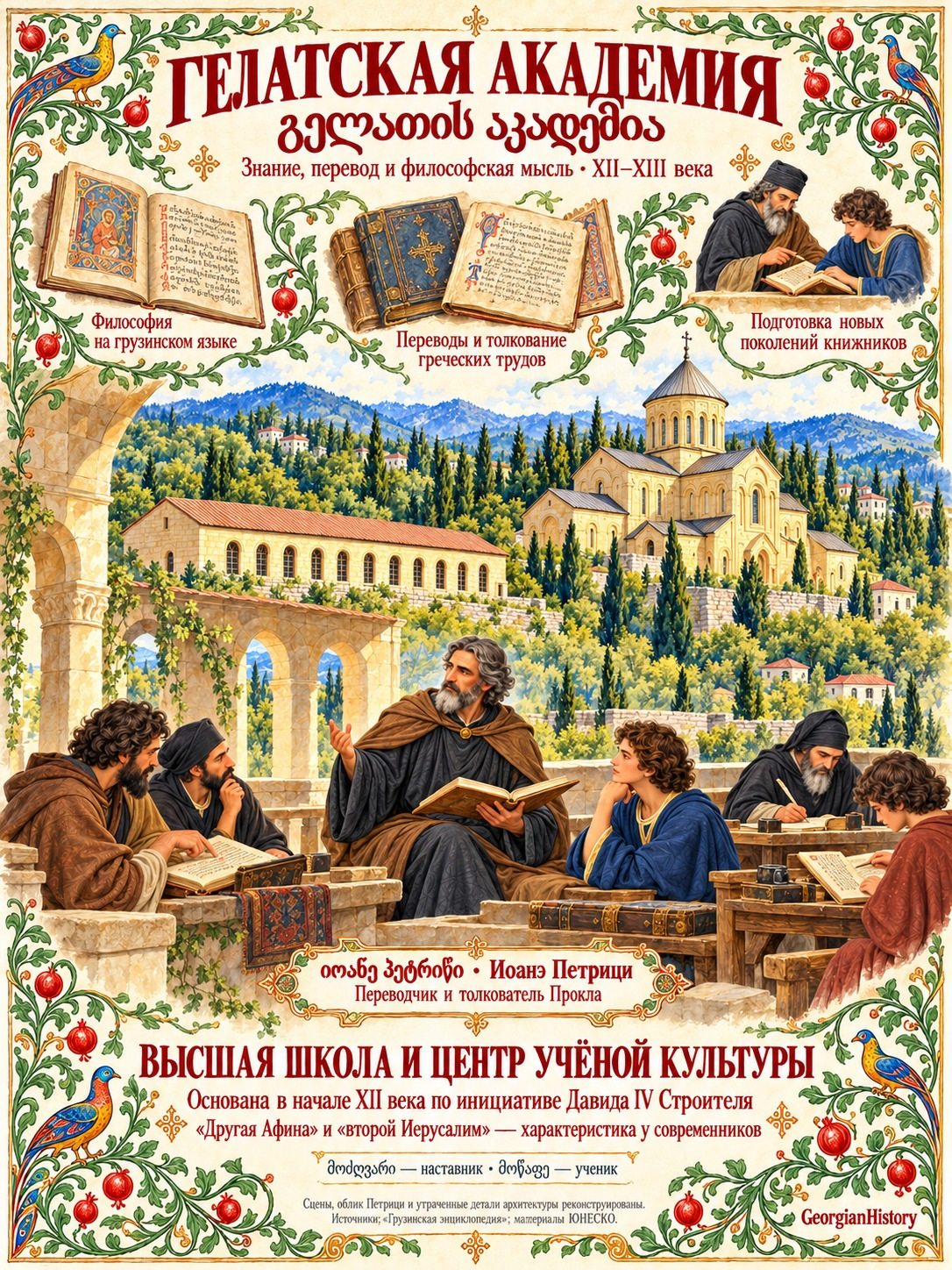
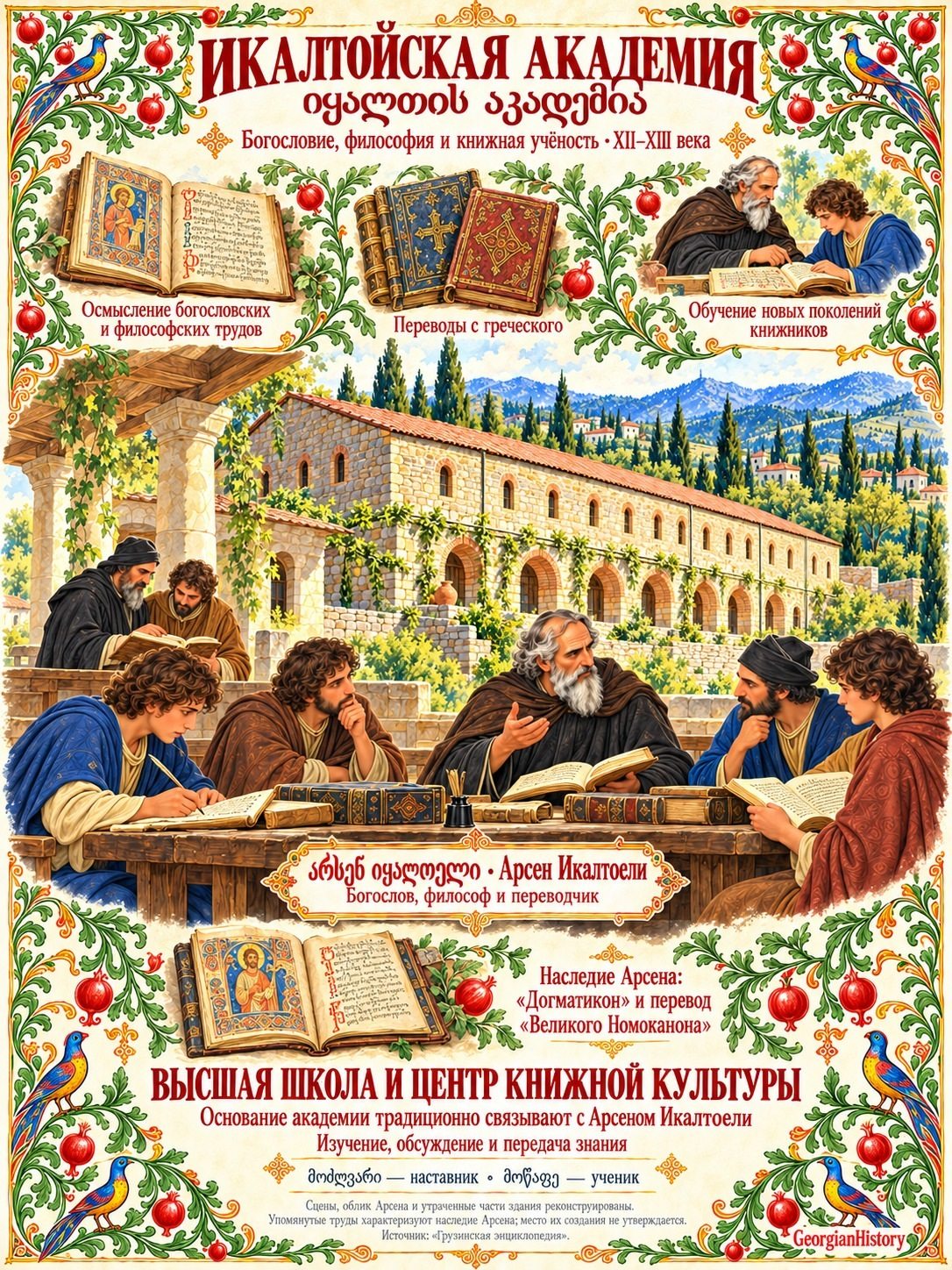
15. Political conflicts as a test of the system
An account of society becomes fuller when we see what happened as its participants came into conflict. Tamar’s reign is important here as a period in which tensions between hereditary standing, royal appointment, and personal service are visible. Historical episodes let us see how relationships examined separately worked in practice.
The uprising of 1177–1178 and its suppression led to a redistribution of offices and estates. Giorgi III elevated men who had remained loyal to him. Qubasar received substantial authority, and Afridon became msakhurtukhutsesi. The changes affected resources and honors previously held by other political actors. Their consequences therefore outlasted the fighting.[1; 15; 37]
For established houses, the origins of a new appointee mattered alongside the loss of their own influence. Discontent could be voiced in terms of honor and lineage, but it cannot be separated from competition for office. This combination explains the force of the demands made after Giorgi III’s death.
Qubasar’s case helps distinguish office from property. According to the chronicle, his removal cost him his powers and Lori, but he retained a considerable part of his property and recognition for past service. Replacing a dignitary therefore did not necessarily affect every basis of his standing in the same way. The throne could change an appointment while limiting the consequences for the house itself.[37; 38]
This matters for the history of how service was supported. If a person received a resource through an office, transferring the office to someone else could also affect that resource. It did not follow that all the person’s holdings had the same origin. A single case thus brought out differences between official authority, the estate attached to it, and the family’s other property.
The movement led by Qutlu Arslan’s supporters raised a different question. Who would make the most important decisions, and what role would the sovereign retain? It showed that collective pressure on the throne was possible. The existence of negotiations and a settlement does not give us a complete account of a new political order. The scope of what was achieved remains a subject of research.[26]
Yet the whole period should not be cast as an unbroken struggle between two fixed sides. The sovereign needed experienced officials and influential houses, while those houses needed recognition and support from the authority they shared. Military and economic tasks gave them reasons to cooperate. Conflict arose over the division of authority and benefits within a system on which all participants depended.
Women of noble houses could also matter in this setting. The participation of Kravai Jaqeli and Khvashak Tsokali in negotiations shows that social authority extended beyond formal office. Lineage, family standing, and the ability to be heard could enable women to carry out important political work.[27]
Tamar’s reign thus lets us see feudal monarchy in operation. The state’s capacity grew as economic and military resources accumulated. Using them required attention to the rights, service, and standing of different people. Maintaining a common order meant winning victories and keeping decisions enforceable within the country.
16. How the parts of the feudal system fit together
Georgian society in the late twelfth and early thirteenth centuries cannot be reduced to a single ladder, though such a diagram may help as an introduction. A person had a lineage, a level of wealth, and a particular relationship to service. An institution had a spiritual or administrative function, estates, and a body of dependants. Together these elements produced many positions that cannot be arranged in a single sequence of comparable titles.
Understanding the system calls for several separate questions. Who held an estate, and how did they acquire the right? Who drew its income? Who administered it? What service did the holder owe? Who confirmed the decision and could require compliance? The answers did not always point to the same person.
That was the source of the complexity of royal government. Landholding supplied power, but independent houses and Church institutions held part of it. The court directed service while itself depending on economic support. Urban life provided new means and skills while continuing to interact with a society based on land. Centers of learning preserved knowledge and had their own material foundations.
The system was far from immobile. A grant could become established as a hereditary holding, a man in service could rise, a lineage could lose an office, and an institution could secure confirmation of its rights. These changes occurred within an order in which land, recognized standing, and relations of dependence retained their paramount importance.
The power of Georgia in Tamar’s time came from the capacity to bring these resources together across the kingdom. It drew on the labor of a rural family, the skills of a townsman, the service of an armed man, the experience of a dignitary, and the scholarship of a man of letters. They were connected by concrete ways of collecting income, fulfilling obligations, confirming rights, and making decisions.
This perspective brings out the full historical complexity of the Golden Age. Its high culture and political successes arose in a society marked by unequal rights and great internal diversity. Examining its structure brings into view the country, its people, and its institutions, which made its medieval greatness possible.
Notes and sources
1. R. Metreveli. «გიორგი III» — Giorgi III. Georgian Encyclopedia, Georgian National Academy of Sciences. The events of 1177–1178, appointments, and joint rule.
2. «თამარი» — Tamar. Biographical Dictionary of the National Library of Georgia. Joint rule, the categories of participants, and the beginning of her sole reign.
3. «თამარ მეფე» — Queen Tamar. National Library of Georgia. It gives 1179 as an alternative to 1178 for the start of the joint reign. The main account uses the commonly accepted date, 1178.
4. «აზნაური» — Aznauri, Georgian Encyclopedia. The entry «აზნაური» in the encyclopedic reference work Democratic Trends: The Ancient World and Georgia, National Library. Differences within the nobility, service, inheritance, and the later emergence of the tavadi as a distinct group.
5. «დიდებული» — Didebuli. Georgian Encyclopedia. The upper stratum of the nobility and the relationship of high standing to service and landholding.
6. «ბატონყმობა» — Batonqmoba. Georgian Encyclopedia. Dependence, differences in terminology, and scholarly interpretations of patronqmoba and batonqmoba.
7. «მამული» — Mamuli. Georgian Encyclopedia. Meanings of the term and hereditary landholding.
8. «ქართული სამართლის ისტორიის წყაროები» — Sources for the History of Georgian Law, 1984, electronic text. National Library of Georgia. The accessible passage on the distinction between mamuli and sakargavi was used. The entire edition was not collated.
9. «ერისთავი» — Eristavi. Georgian Encyclopedia. Administrative functions and relations between local and central authorities.
10. V. Guchua. «ერისთავთერისთავი» — Eristavt-eristavi. Georgian Encyclopedia. The literal meaning of the title and what it entailed in the unified monarchy.
11. N. Shoshiashvili. «ამირსპასალარი» — Amirspasalari. Georgian Encyclopedia. The military administration and the evolution of the office.
12. Central and Local Offices in Medieval Georgia. Encyclopedic dictionary edited by Mzia Surguladze. Tbilisi, 2017, Korneli Kekelidze Georgian National Centre of Manuscripts. Entries on the mtsignobartukhutses-chqondideli, the city amira, and the mushribi. Also Giorgi Chqondideli. National Library and Georgian Encyclopedia.
13. M. Kldiashvili. «მანდატურთუხუცესი» — Mandaturtukhutsesi. Georgian Encyclopedia.
14. I. Ujmajuridze. «მეჭურჭლეთუხუცესი» — Mechurchletukhutsesi. Georgian Encyclopedia. The treasury and its associated institutions.
15. I. Ujmajuridze. «მსახურთუხუცესი» — Msakhurtukhutsesi. Georgian Encyclopedia. Duties and the officeholder’s admission to the viziers under Rusudan.
16. I. Ujmajuridze. «მოლარეთუხუცესი» — Molaretukhutsesi. Georgian Encyclopedia. The salaro, documentation, and the seal. Later duties are not projected back onto the twelfth century.
17. «მესაწოლე» — Mesatsole. Georgian Encyclopedia. Protection of the sovereign and the royal chambers, and the role of the doorkeeper.
18. N. Shoshiashvili. «ამილახორი» — Amilakhori. Georgian Encyclopedia. Military logistics services. It notes different interpretations of how the offices related to one another.
19. «მეჯინიბეთუხუცესი» — Mejinibetukhutsesi. Georgian Encyclopedia. Head of the stable service.
20. «მეაბჯრეთუხუცესი» — Meabjretukhutsesi. Georgian Encyclopedia. Head of the armorers.
21. «მონადირეთუხუცესი» — Monadiretukhutsesi. Georgian Encyclopedia. Hunting, hunting grounds, and attendants.
22. I. Surguladze. «მესტუმრე» — Mestumre. Georgian Encyclopedia. Reception of envoys and guests, and the official in charge.
23. «მეღვინეთუხუცესი» — Meghvinetukhutsesi. Georgian Encyclopedia. First mentions from the twelfth century and the wine service.
24. «მეღვინე» — Meghvine. Georgian Encyclopedia. The king’s personal cupbearer and other attendants.
25. «დარბაზი» — Darbazi. Georgian Encyclopedia. Forms of assembly and different scholarly interpretations of the institution.
26. «ყუთლუ არსლანი» — Qutlu Arslan. The scholarly dictionary Central and Local Offices in Medieval Georgia, published by the National Library.
27. «კრავაი ჯაყელი» — Kravai Jaqeli. Biographical Dictionary of the National Library of Georgia, based on the Georgian Soviet Encyclopedia, vol. 11.
28. «გლეხობა» — The Peasantry. Georgian Encyclopedia. Social categories and households. Later detailed rules have not been used to describe the twelfth century.
29. J. Kakhniashvili and N. Shiolashvili. «ამქარი» — Amkari. Georgian Encyclopedia. History of the term and of occupational associations.
30. Giorgi Khuroshvili. «არსენ იყალთოელი» — Arsen of Ikalto. Encyclopedia of Georgian Philosophy and Theology, 2023. Biographical debates, the Dogmatikon, and the translation of the collection of canon law.
31. «გელათის აკადემია» — Gelati Academy. Georgian Encyclopedia.
32. Damana Melikishvili. «გელათის აკადემია» — Gelati Academy. Encyclopedia of Georgian Philosophy and Theology, 2021. The Gelati school, the translation tradition, and the relationship of philosophy to theology.
33. Tengiz Iremadze. «იოანე პეტრიწი» — Ioane Petritsi. See also the Georgian Encyclopedia entry. Translation and commentary on Proclus. Biographical questions are distinguished from securely attested surviving works.
34. «იყალთოს აკადემია» — Ikalto Academy. Encyclopedia of Georgian Philosophy and Theology. The educational center and its connection with Arsen of Ikalto.
35. I. Antelava. «მიქელ IV» — Mikel IV. Georgian Encyclopedia. The Catholicos-Patriarch, his accession to the office of mtsignobartukhutses-chqondideli in 1184, and different assessments of his political role.
36. I. Jalaghania. «თამარის მონეტები» — Tamar’s Coins. Georgian Encyclopedia. Tamar’s name on a coin of Giorgi III after the proclamation of joint rule, and a coin carrying the names of both sovereigns.
37. «ყუბასარი» — Qubasar. Biographical Dictionary of the National Library of Georgia, based on the Georgian Soviet Encyclopedia, vol. 10, 1986, p. 661. Offices, the holding of Lori attached to service, and his dismissal.
38. Anonymous. The Histories and Eulogies of the Sovereigns, chapters X and XV. Translated by K. S. Kekelidze. Tbilisi, Academy of Sciences of the Georgian SSR, 1954. Online publication by DrevLit. The episodes of Tamar’s elevation and Giorgi III’s oath were checked, as was the mediation of Khvashak Tsokali and Kravai Jaqeli. The account is a panegyric. Evidence for actions is distinguished from the author’s judgments.
39. Chiaber’s charter to Shio-Mghvime Monastery. Online transcription of the primary text from «ქართული სამართლის ძეგლები», vol. II, 1965, no. 12, and «ქართული ისტორიული საბუთების კორპუსი», vol. I, 1984, no. 19. The publication gives the original’s shelfmark as Ad-2. The page dates it to 1189. Scholarship also proposes other dates in the late twelfth century, so the main text gives 1189 as a common but disputed date. The later note on the reverse of the document is not used in the account.
40. The Life of Tamar, Queen of Queens. Traditionally attributed to Basili Ezosmodzghvari. Translated by V. D. Dondua. Tbilisi, Metsniereba, 1985. Online publication by DrevLit. The episode of the address to the Church council was used. Direct speech is given as reported by the historian, with no claim to a verbatim record. Accounts of aid to the poor and the ransoming of captives were also used, with attention to passages the editor identifies as reconstructed. The account of reports from frontier commanders and the decision to summon the army was also consulted.
41. N. Shoshiashvili. «ვასალიტეტი» — Vassalage. Georgian Encyclopedia. Georgian vocabulary for service and dependence, sakargavi, and Church patronage.
42. «ბეგარა» — Begara. Georgian Encyclopedia. Meanings of the term and differences among forms of obligation.
43. D. Muskhelishvili. «ამირთა ამირა» — Amirta-amira. Georgian Encyclopedia. Urban administration from the end of the twelfth century.
44. N. Shoshiashvili. «ათაბაგი» — Atabeg. Georgian Encyclopedia. Origins, functions, and evolution of the office.
45. A. Gogoladze. «დავით აღმაშენებლის ანდერძი შიომღვიმისადმი» — David the Builder’s Testament to Shio-Mghvime Monastery. Georgian Encyclopedia. The document of 1123–1124 and the history of ecclesiastical immunity.
46. I. Surguladze. «გარიგება ჴელმწიფის კარისა» — Regulations of the Royal Court. Georgian Encyclopedia. Dating, state of preservation, and contents of the work.
47. N. Shoshiashvili. «ახალციხელი ივანე» — Ivane Akhaltsikheli. Georgian Encyclopedia. Administration of Kari and frontier service in the early thirteenth century.
48. «მანდატური» — Mandaturi. Georgian Encyclopedia. Administrative service and the term’s attestation from the eleventh century.
49. «თამარ მეფის საბუთის კალკაზე გადაღებული პალეოგრაფიული პირი ეტრატზე დაბრუნდა» — Overview of Tamar’s charters. National Archives of Georgia. Description of the 1187 charter assigning part of the income from the village of Chorvila to support twelve monks at Gelati. The archival description of the act’s contents was used.
50. «დაბა» — Daba. A. Bogveradze. Georgian Encyclopedia. The history of rural neighborhood communities and changes in settlement terminology. The term’s early history is distinguished from village organization in Tamar’s time.
51. «თემი» — Temi. D. Muskhelishvili. Georgian Encyclopedia. Territory and community, the different scales of the concept, and its written attestation from the twelfth century.
52. I. Tsivtsivadze. «დიდ ოჯახში ქალის პირადი საკუთრება — „მზითევი“ და „სათავნო“». Women’s personal property in the extended family, the dowry and satavno. Justice and Law, 2020, no. 3(67), pp. 169–181. The historical overview on pp. 169–171 was used. Later rules are not presented as an unchanged twelfth-century system.
53. «გვირგვინის კურთხევა კიდეს-კიდე» — Marriage by Proxy. G. Nadareishvili. Georgian Encyclopedia. The prohibition of the Council of Ruisi-Urbnisi in 1104, with reference to the edition of the council’s decree in Monuments of Georgian Law, vol. III, 1970.
54. «თამარ მეფის სიგელი შიომღვიმისადმი» — Tamar’s Charter to Shio-Mghvime Monastery. G. Arakhamia. Georgian Encyclopedia. Kosaidze households and maintenance of the water supply. Here the act is dated to 1196, while the National Archives overview gives 1202. The main text does not choose a precise year.
55. «მონასპა» — Monaspa. Georgian Encyclopedia. The royal guard, personal service, grants, and the social advancement of warriors. Its reported strength under David IV is distinguished from Tamar’s period. The last mentions are dated to 1184.
56. N. Shoshiashvili. «ახალციხელი შალვა» — Shalva Akhaltsikheli. Georgian Encyclopedia. The Meskhetian vanguard at Basiani and the caliph’s standard captured at Shamkor in 1195 and donated by Tamar to Gelati.
57. Antony Eastmond. Tamta’s World: The Life and Encounters of a Medieval Noblewoman from the Middle East to Mongolia. Cambridge University Press, 2017. Chapter 1, “A New World of Encounters,” pp. 1–20. The openly available first chapter was used for Ivane Mkhargrdzeli’s capture around 1210, the terms of his release, Tamta’s fate, and confessional differences within the family.
58. Sh. Meskhia. «ძლევაჲ საკვირველი» — The Miraculous Victory. Electronic publication of the study. The section on Tbilisi after 1122 uses accounts by al-Fariqi and Sibt ibn al-Jawzi on communities and their rights, and separately describes the removal of inhabitants of Ganja. The specific disputed amounts and durations of tax concessions are not projected onto Tamar’s period.
59. «მსტოვარი» — Mstovari. Georgian Encyclopedia. The meaning of the term, the network’s link with David IV’s reforms and the monitoring of officials and nobles, and the historiographical assessment that the network weakened under Tamar. Later reconstructions are not treated as surviving staff lists.
About the illustrations
The GeorgianHistory illustrations and icons are reconstructions. The aznauri figures are based on Giorgi Tsiklauri’s sketches, and the royal clothing draws on the Vardzia frescoes. The icons of educational activities do not constitute a list of official posts. The text identifies later practices separately.
 All journal maps →