Warmth on a Foreign Road
Petritsoni, 1083. The rule of a Georgian monastery in Byzantium set out how to help travellers, from food and warmth in winter to shelter for the sick.
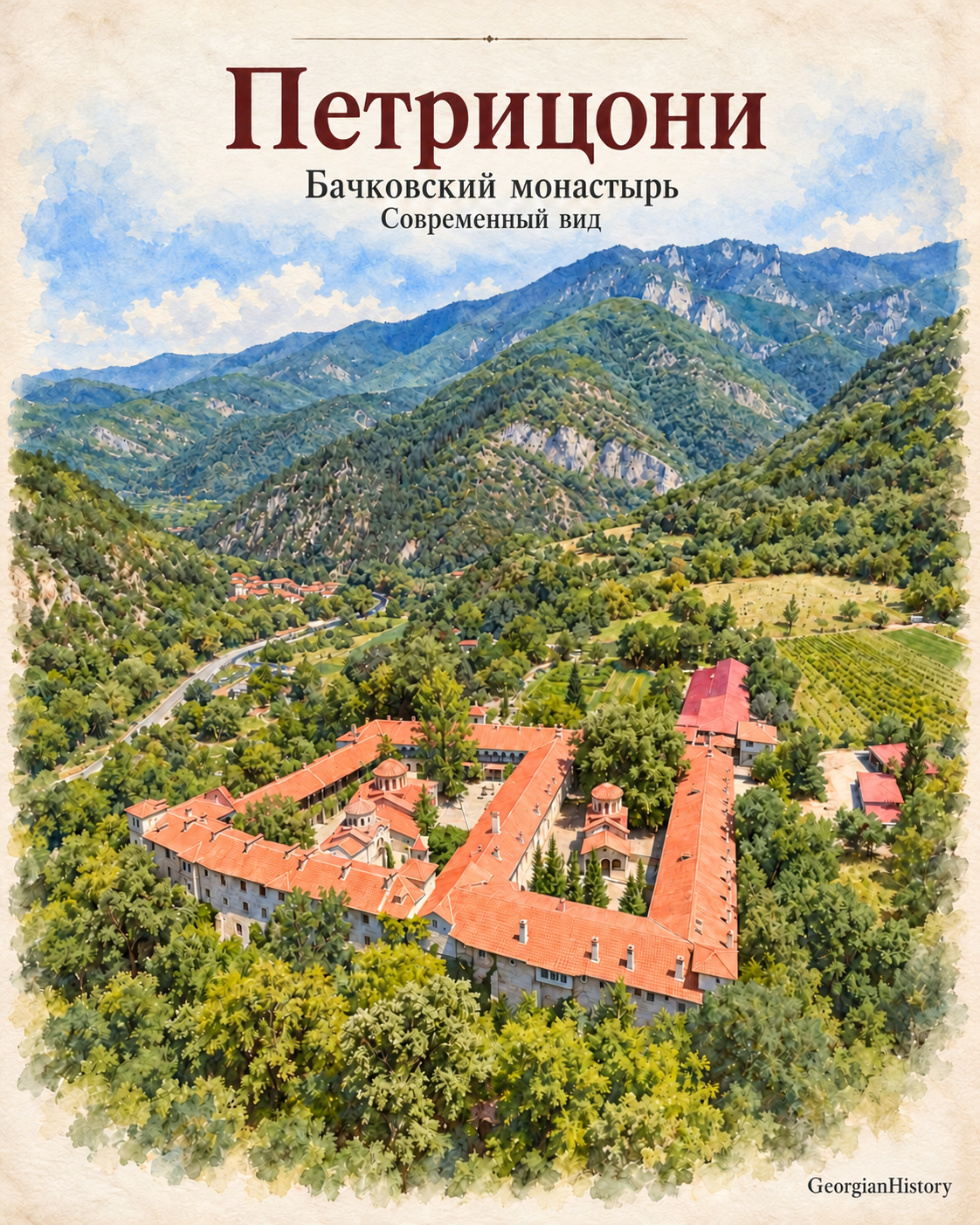
 A sick traveller was entitled to three days’ rest, and anyone too weak to continue the journey could stay until they recovered. These were the provisions of the typikon of Petritsoni Monastery, drawn up in December 1083. They concerned a hospice in Stenimachos, now Asenovgrad in Bulgaria. [1, 4]
The man behind the document was Gregory Bakuriani, known in Byzantine sources as Gregory Pakourianos. A military commander, he held the office of Grand Domestic of the West and belonged to the circle of Emperor Alexios I Komnenos. In 1083, he founded the Georgian monastery of Petritsoni, today known as Bachkovo, and endowed it with substantial property. He then set down the rules by which it was to live. [2]
This Georgian community lived in Byzantine territory, far from the Caucasus. Its history shows how Georgian monastic life continued away from its homeland. The monks maintained a community of their own and took part in the life of the surrounding society. Modern Bulgaria locates the site on today’s map. The political setting in which the founder acted was Byzantine. [2, 4]
Charity had a clear religious meaning. Helping the poor was linked to the salvation of the soul, and people in need were called brothers in Christ. The scholar Dirk Krausmüller discusses the Petritsoni typikon among the sources for monastic almsgiving. His study centres on who was to administer alms, an individual monk or the community. The way assistance was organised bore directly on the order of monastic life. [3]
In Stenimachos, hospitality was supported by specific resources. The statute assigned the hospice grain and wine from the settlement’s revenues, provided for pulses and vegetables, and allotted a watermill. A dependent peasant was excused from other obligations and tasked with supplying firewood and water and looking after the house. His duties changed, while his dependent status remained. [1]
The house was to be heated in winter. Sick travellers were entitled to three days’ rest. If they were too weak to continue, they were to stay until they had fully recovered. The rule took into account whether each individual was able to set out again. [1]
The duty to help was to outlive the founder. His successors were forbidden to reduce the provision made for the hospices. As monastic revenues grew, hospitality was to improve. Charity thus acquired an economic foundation and became a responsibility of those who governed the monastery. [1]
The document calls for careful reading. It is a statute, and the record of how guests were actually received is a separate matter. It cannot tell us how many people received help or whether the rules were always observed. The detail of the rules is significant in itself, however. Behind the broad term ‘charity’ we can see how an institution was organised and what its staff were required to do.
Petritsoni reminds us that the Georgian presence in Byzantium took many forms of service. These included military office, the founding of monasteries, spiritual life and care for people far from home. The surviving statute gives this care a specific historical form.
Sources and further reading
- 1. Gregory Pakourianos (Bakuriani). Typikon of the Monastery of the Mother of God Petritzonitissa, December 1083. Translated by Robert Jordan, in Byzantine Monastic Foundation Documents, ed. John Thomas and Angela Constantinides Hero, vol. II, Dumbarton Oaks, 2000, no. 23, pp. 507–563. Chapter 29, pp. 549–550, on provision for the hospice, duties, heating and the stay of sick travellers. PDF of the scholarly edition on a third-party mirror.
- 2. A. Bogveradze and V. Silogava. ‘გრიგოლ ბაკურიანის ძე’ (‘Gregory Bakuriani’). Georgian Encyclopaedia of the Georgian National Academy of Sciences. The online publication is undated. On the founder’s office, the foundation and the Georgian character of the monastery.
- 3. Dirk Krausmüller. From Individual Almsgiving to Communal Charity: the Impact of the Middle Byzantine Monastic Reform Movement on the Life of Monks. Jahrbuch der Österreichischen Byzantinistik, 66, 2016, pp. 111–126, introduction and p. 112. The religious and communal context of almsgiving.
- 4. Visit Plovdiv. Bachkovo Monastery. Municipal tourism portal. Undated. Historical background on modern names, the location and later buildings in the complex.
The rule is cited from Robert Jordan’s scholarly English translation of the Greek version. The Old Georgian manuscript was not checked separately.
GeorgianHistory illustration. A watercolour of the monastery today based on a reference photograph of the complex. The present complex includes buildings from several periods. Open the full watercolour.