Balavariani: A Georgian Book on Its Way to Europe
A Georgian Christian tale rooted in an Indian tradition became the basis of the Greek Barlaam and Josaphat and entered medieval European literature.
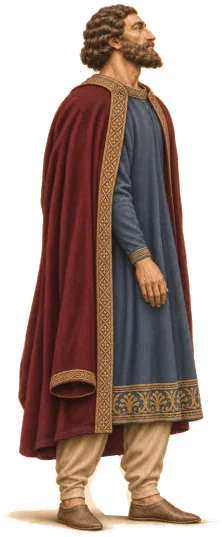
 In the Balavariani, a prince grows up in a palace where anything that might disturb his peace is hidden from him. Illness, old age and death are meant to stay outside its walls. Yet Iodasaph learns about suffering, and his familiar life loses its old meaning. His mentor Balavar helps him look beyond wealth and power for something to live by. So begins a story that would pass through Georgian book culture into the literature of medieval Europe. [5]
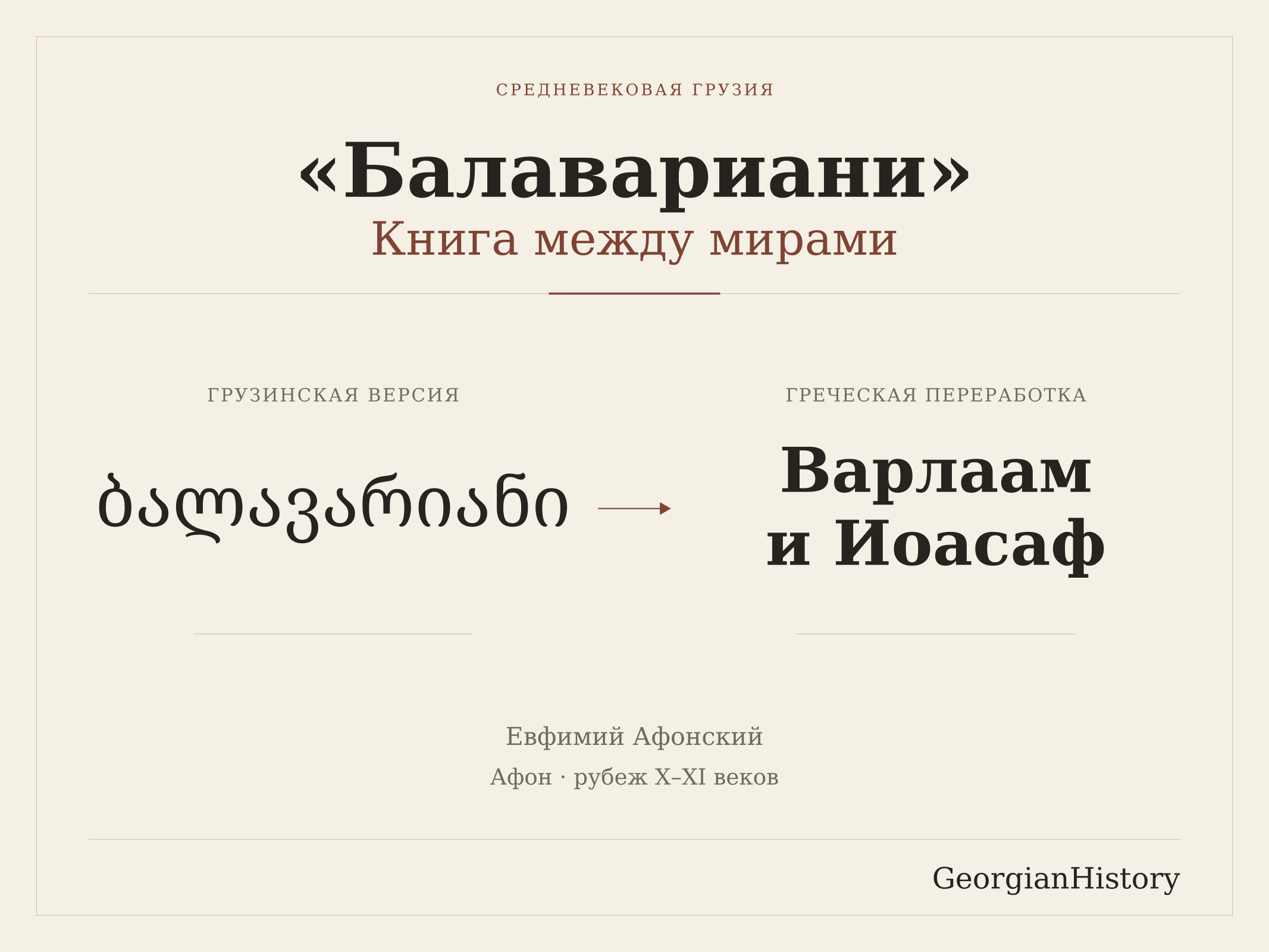
In Georgia the tale is known as the Balavariani, and in the Greek tradition as Barlaam and Josaphat. Beneath the changed names survives an ancient story whose roots lie in accounts of the Buddha’s life. As the tale crossed languages and religious settings, it changed, taking on new meanings and reaching new readers. Its characters belong to literary tradition. The tale is not reliable evidence that an Indian prince converted to Christianity. [3]
The story reached Georgian readers through literature in Arabic. In its Georgian version, it had already taken Christian form. Here a future translator found an account of faith, renouncing earthly goods and spiritual guidance. Centuries of transformation lay between the story’s Indian origins and its life in Byzantium. [3]
At the turn of the eleventh century, Mount Athos became a key place in this transmission. The Georgian monk Euthymios worked there, translating biblical, theological and ascetic writings from Greek into Georgian. He selected and reworked texts, opening the rich literary tradition of Byzantium to Georgian readers. His work linked the two literary worlds in both directions. [2]
An account by George the Athonite survives. In the Life of John and Euthymios, written in the eleventh century, he mentions translating Balavar, Abukura and other works from Georgian into Greek. This is important evidence for the history of the Balavariani. A medieval author names the translator and the language from which he worked. [1, 4]
The Greek tale was later ascribed to John of Damascus. His name became established in the manuscript tradition and the attribution endured for centuries. Modern studies associate the Greek version with Euthymios the Athonite. Comparing texts and studying manuscripts have restored the Georgian scholar to his place in the work’s history. [4]
Sometimes the direction of translation shows up in a small choice of words. The Georgian text speaks of food for worms, whereas the corresponding Greek passage speaks of food for enemies. Researchers explain the difference as a possible confusion between similar Georgian words. The suspected error helps trace the book’s journey. The unexpected Greek reading makes more sense if it goes back to a Georgian text. [5]
The Greek version also expanded the narrative considerably. It incorporated biblical quotations and material from Christian literature. The inherited story gained a fuller theological treatment and a form suited to Byzantine readers. The medieval translator’s work was also a creative adaptation. He conveyed the story while making a new literary setting for it. [4]
The tale passed from Greek into Latin and Church Slavonic, among other languages. Through Latin it spread through the literatures of the medieval West. Readers treated the story as a Christian saint’s life, and Barlaam and Josaphat were venerated as saints. A tale that grew out of Indian tradition found its place in the literary and religious life of societies far from India. [3, 5]
This journey holds particular significance for Georgian history. Georgian scholars helped create works that were later read beyond their own language. Athos connected their work with Byzantium, and Greek and Latin translations carried the text farther west. The story of the Balavariani makes this contribution visible with unusual precision, through testimony about the translator, changes to the narrative and traces of Georgian words in another literature.
GeorgianHistory poster: vertical 4:5 format · 4:3 format.
Sources and further reading
- 1. George the Athonite. Life of John and Euthymios, eleventh century. Georgian extract on the translation of Balavar and Abukura from Georgian into Greek. National Parliamentary Library of Georgia.
- 2. V. Baakashvili and N. Chikvatia. “ექვთიმე მთაწმიდელი” (Euthymios the Athonite). Georgian Encyclopedia of the National Academy of Sciences. Publication date unspecified. Work at Athos, directions of translation and adaptation of texts.
- 3. David Marshall Lang, with an introduction by Ilia V. Abuladze. The Balavariani (Barlaam and Josaphat): A Tale from the Christian East. 1966. Routledge reprint, 2022. Accessible excerpt, pp. 9–13 and 19. Origins of the tale and its Georgian transmission.
- 4. Christian Høgel. Euthymios the Athonite, Greek-Georgian and Georgian-Greek Translator – and Metaphrast? The Kartvelologist, no. 29, 2021–2022. Pp. 11–18 and 22–23 on attribution, dating and the makeup of the Greek adaptation.
- 5. Chia-Wei Lin. The Buddha’s Journey to the West: The Textual Traditions of Barlaam and Josaphat from a Linguistic Perspective. Hualin International Journal of Buddhist Studies, 8.2, 2025, pp. 190–224. DOI: 10.15239/hijbs.08.02.08. Plot and transmission. “Worms/enemies” on p. 213, table 6.
This article leaves open the exact year of the Greek adaptation and the authorship of the original Georgian version. The National Parliamentary Library pages may be intermittently unavailable. Christian Høgel also discusses George the Athonite’s testimony on p. 16 of source 4.