The Costume of Demetre Hypatos on the Jvari Relief
How People Dressed in Georgia · Issue 4. Mtskheta, Kartli · Around 600. An empty cloak sleeve, a patterned hem, and a Byzantine title on the stone portrait of one of Jvari’s patrons.
 On the east façade of Jvari, an empty sleeve hangs beside Demetre’s hand. His arm, in the fitted sleeve of his tunic, bends in front of his chest. The longer sleeve of the cloak hangs beside his body. This detail helps distinguish the two layers of clothing on the small stone relief. [1, 3]
Relief and reconstruction
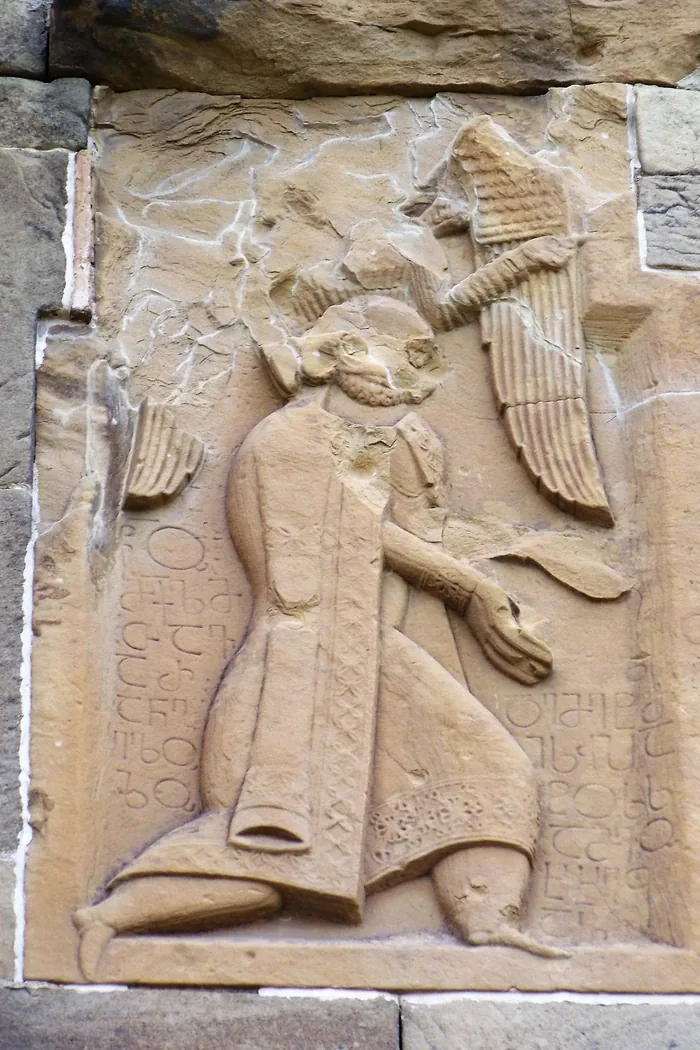
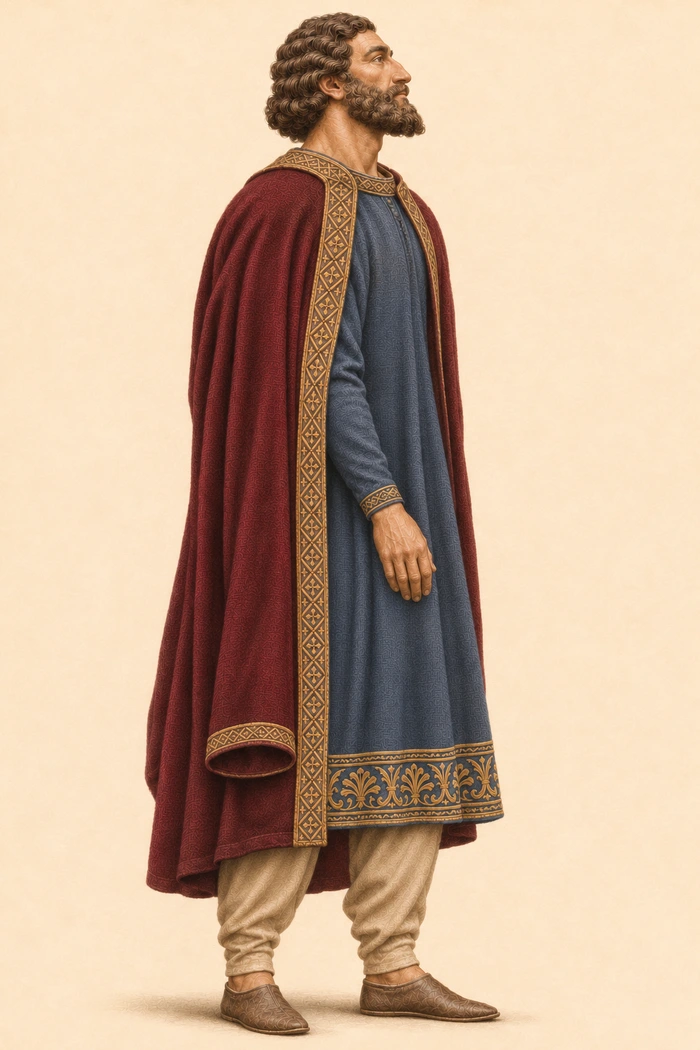
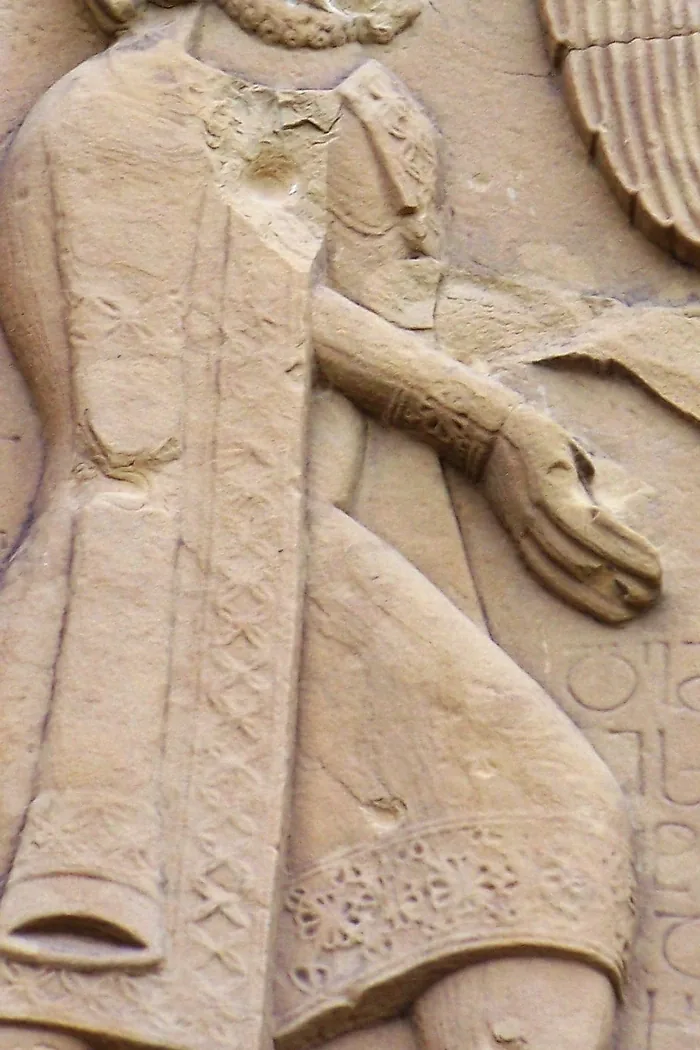
Relief photograph Jaba1977 · Cropped by GeorgianHistory · CC BY-SA 4.0
Demetre beneath the archangel’s wings
Demetre kneels before the Archangel Michael. A carved prayer on either side of the figure addresses the archangel and names the man and his title — Demetre Hypatos. Hypatos was a Byzantine honorific. Antony Eastmond identifies Demetre as one of Jvari’s three principal patrons, alongside Stepanoz and Adarnase. [1, 2, 4]
The fitted sleeve and the false sleeve
The tunic has a fitted sleeve. The outer garment has a long, hanging sleeve with an open end. It is called a false sleeve because the figure’s arm is not inside it. A diamond pattern is visible on the hanging sleeve, while a band of plant ornament runs along the tunic’s hem. The detail view helps identify which layer carries each pattern. [1, 3]
In Giorgi Kalandia’s description, both layers are made of thick fabric. The fiber content is unknown. Eastmond compares the outer garments of Jvari’s patrons to Persian riding coats with long, hanging sleeves and richly decorated hems. His comparison concerns the form of the garment. The Byzantine title is carved next to the figure on the same stone. [2–4]
Reconstructing the costume
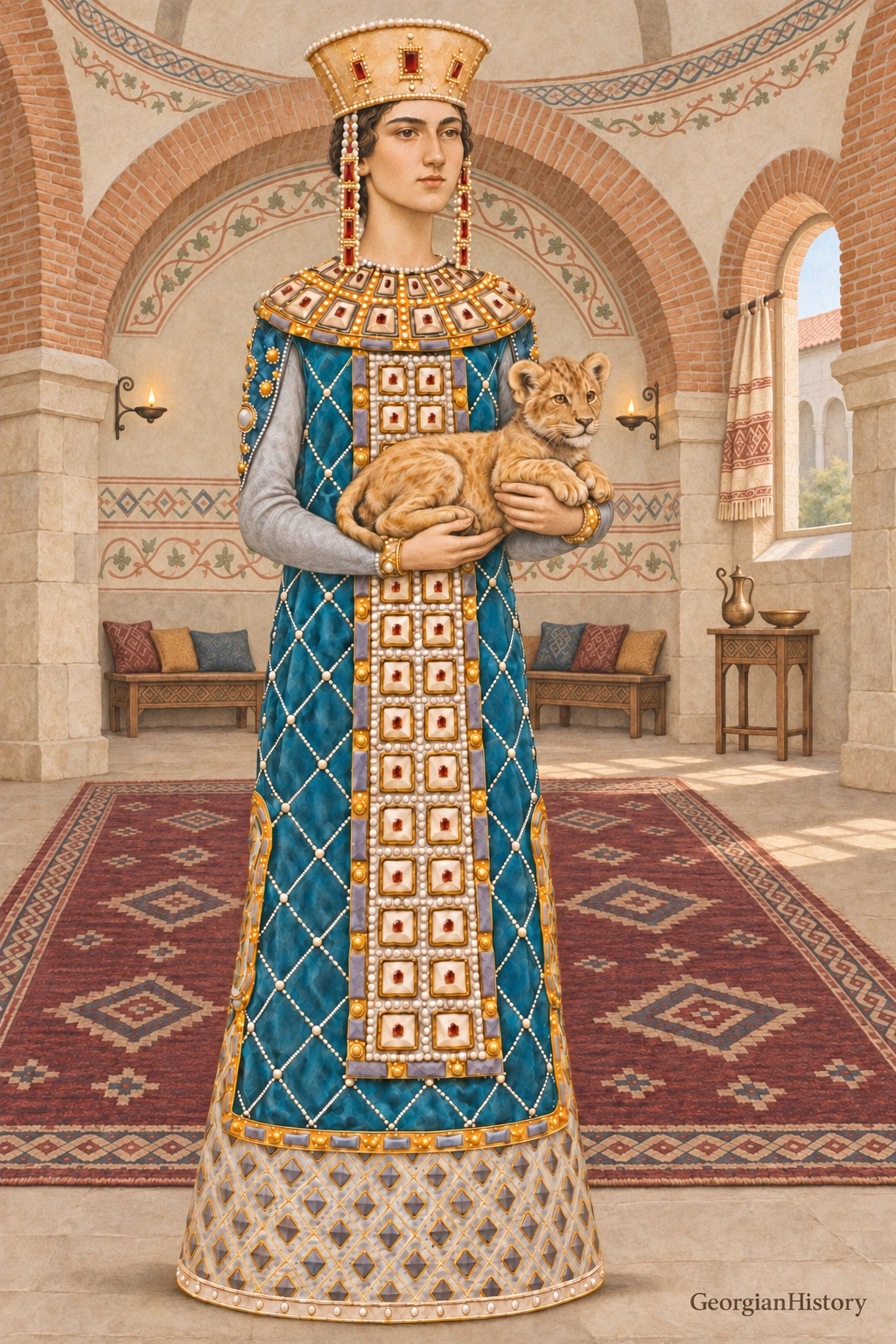
The GeorgianHistory reconstruction shows Demetre standing at full length. The fitted sleeve of his blue tunic and the hanging sleeve of his burgundy cloak convey the layers visible in the relief. The diamond pattern and plant-patterned trim follow the stone carving. The standing pose, colors, fabric texture, face, and hidden parts of the cut are conjectural.
GeorgianHistory