Royal Dress in the Age of Tamar
How People Dressed in Georgia · Part 1. Late twelfth-century royal dress: the bisoni, loros, pearl ornament, and crown, examined through the Vardzia portrait and a museum reproduction.
 In the Vardzia fresco of the 1180s, Tamar wears a crown with pearl pendants and richly decorated royal garments. This portrait offers a close view of one of the best-known images of Georgian court dress from the late twelfth century. It opens GeorgianHistory’s series “How People Dressed in Georgia”. [1, 2]
Georgian museum publications call the ceremonial royal garment a bisoni. Its long form created an elongated silhouette, while decorated elements drew attention to the shoulders, chest, and wrists. The album Textile from Georgia notes that bracelets were worn over narrow sleeves. Precious ornament formed part of the whole composition, from the neckline to the hem. [1]
The loros held a special place: a long, decorated band of Byzantine imperial dress adopted at the Georgian court. In the Vardzia portrait, its front section and a pale length draped over the arm are visible. Pearls and coloured settings stand out against the light ground. Their arrangement, the width of the bands, and their relationship to the main garment help explain the construction of ceremonial dress. [1, 2]
The crown completed the ensemble. Its side pendants descended beside the face, echoing the vertical ornament on the chest. Along with her royal title and other regalia, it marked Tamar’s position as ruler. In art historian Irakli Tezelashvili’s interpretation, her dress and the presence of George III beside her at Vardzia helped affirm dynastic continuity. [2]
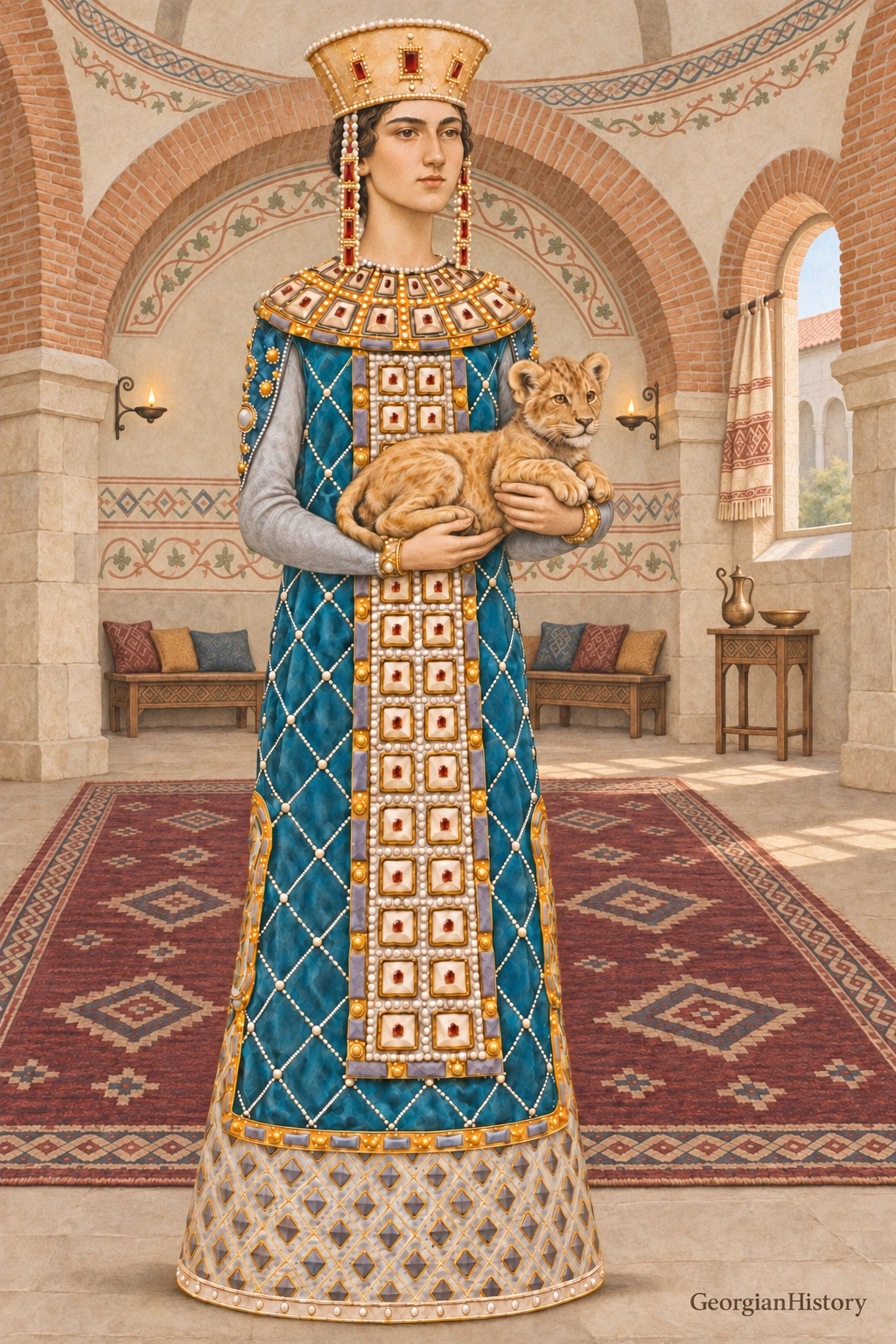
In the twentieth century, the artist Soliko Virsaladze created a well-known reproduction of Tamar’s garments based on the Vardzia fresco. The costume is held at the Art Palace in Tbilisi. It features a diamond lattice of pearls, paired rows of pale rectangular elements on the chest, and a broad decorated element over the shoulders. This museum costume provided the basis for the clothing in our illustration. Its modern date matters: it shows how an artist reconstructed the volume and arrangement of the garments from a painted image. [1, 3]
The fresco and the museum reproduction offer different ways to study dress. The painting preserves outlines, patterns, and the arrangement of ornament; the three-dimensional costume shows how those elements come together on a figure. Reconstruction must take the condition of the painting into account and distinguish visible details from restored ones. Colours, concealed tailoring, and the exact dimensions of individual ornaments need separate examination.
This first instalment focuses on royal ceremonial dress. The series will turn next to clothing worn by nobles and townspeople, and to women’s and men’s dress from different periods and regions of Georgia. Each ensemble will be examined through a specific source: a fresco, miniature, written description, or surviving object.
About the illustration
The lion cub relates to the chronicler’s account of a gift sent to Tamar by the Shirvanshah. The source describes the lion after it had been raised and its behaviour at court; the specific pose with a cub in Tamar’s arms is reconstructed. [4]
The architecture of the background draws on descriptions of the palace at Geguti. The chronicle does not identify the location of the scene. The wall painting, furniture, and arrangement of objects represent a possible royal interior. [5]
The blue garment and pearl lattice follow the chosen museum costume. The size and placement of the small red settings on the pale panels in the illustration are not historically established. The facial features and the volume of the fabric are artistic interpretations.
Sources and further reading
- 1. Textile from Georgia / ქსოვილი საქართველოდან. Tbilisi: Art Palace of Georgia, 2017. Pp. 50–63. PDF on the museum’s website.
- 2. Tezelashvili I. T’amar Bagrationi (1184–1210). Encyclopedia. 2022. 2(3). Pp. 1483–1493; Vardzia: pp. 1485–1486; loros: p. 1492.
- 3. Art Palace of Georgia. Georgian costumes in the Art Palace. Tamar’s costume and Soliko Virsaladze’s work. Google Arts & Culture.
- 4. Histories and Eulogies of the Sovereigns, in Kartlis Tskhovreba. Vol. II, ed. S. Kaukhchishvili. Tbilisi, 1959. Pp. 61–62: the account of the lion cub.
- 5. Beradze T., Tsitsishvili I. Palace of Geguti. Georgian Encyclopedia. Architectural reference for the illustration.
 Three coins in 3D →