One Arch over the Besleti
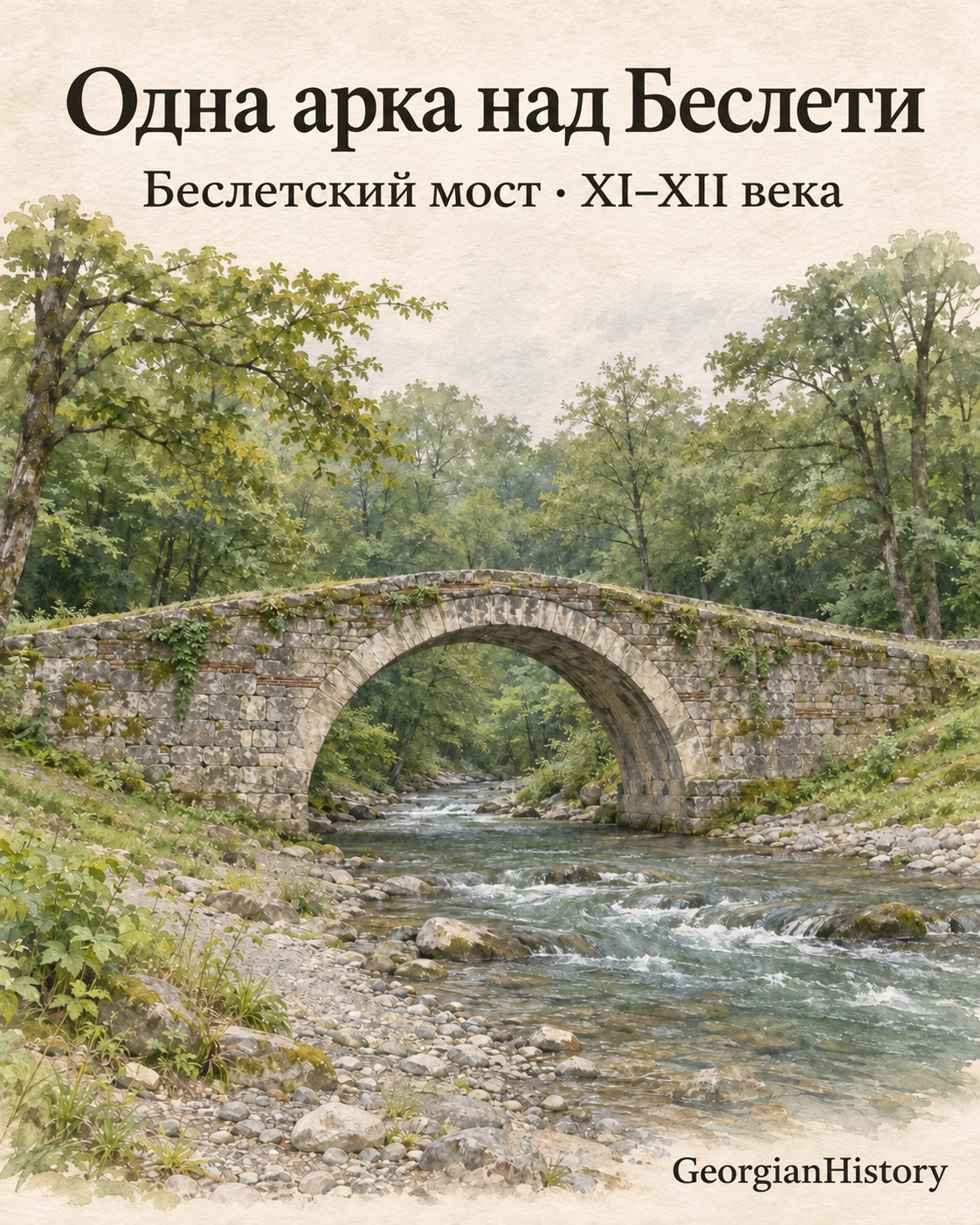
Besleti Bridge near Sokhumi, eleventh to twelfth centuries. What a stone arch and a Georgian prayer tell us about a medieval river crossing.
 The inscription on Besleti Bridge is best sought from the side, on the western edge of the arch. Where dressed stones trace the span above the river, a stonecutter carved a single line in the Georgian asomtavruli script. It has not survived intact. The bridge tells us about the builders' work; the surviving words tell us about the people who thought it fitting to leave a prayer at the crossing. [1, 2]
Near Sokhumi, builders raised a single stone arch over the Besleti River. According to the measurements reported in the Georgian Encyclopaedia, the bridge is 35 metres long, with a span of 13.3 metres. It was built of limestone slabs laid in mortar. Thin courses of flat bricks run between rows of dressed stone in parts of the facing. Earthen embankments lead up to the raised roadway on both sides. These details are easiest to see from the side: one arc crosses the channel and gives way to long approaches on either bank. [2]
The design had a practical advantage: no intermediate support was needed in the riverbed. The builders transferred the load to two abutments. Yet the structure alone cannot tell us the full course of the road that used this crossing. The heritage catalogue suggests it was an important trade route. The bridge shows that a permanent crossing was built here; plotting the road on a map and identifying its destinations would require further evidence. [2, 3]
The inscription calls for a different approach. In the Epigraphic Corpus of Georgia, Lia Akhaladze presents the surviving letters separately from a reading that expands abbreviations and proposes restorations for lost text. The opening is read as an address to Christ, followed by a prayer. The distinction between what survives and what has been restored is crucial when it comes to the ruler's name. The heritage catalogue reports a reference to King Bagrat; the name is not legible in the corpus transcription. Akhaladze considers Bagrat III, Giorgi I or Bagrat IV possible, and dates the inscription to the eleventh century based on its lettering. None of these possibilities on its own identifies who commissioned the bridge. [1, 3]
The bridge is also known by Tamar's name. The name belongs in an account of the monument: it is how people know and look for it. The origin of the name and the date of construction are separate questions. The encyclopaedia dates the bridge to the eleventh or twelfth century; the sources propose narrower and differing dates for the inscription. The name does not establish that the bridge was built during Tamar's reign or on her orders. [1, 2, 3]
Besleti Bridge matters because it preserves two kinds of evidence. The masonry and measurements show how the builders solved the problem of crossing the river. The carved line shows that a Georgian prayer could be inscribed on a structure people used on their journeys. The identity of the patron remains an open question. Even without a name, the arch and the line give us a glimpse of a part of medieval life that rarely makes it into a chronicle: how people crossed rivers and what words they left along the way. [1, 2]
Sources and further reading
- 1. Lia Akhaladze, ed. “ბესლეთის ხიდის წარწერა” (Besleti Bridge Inscription). Epigraphic Corpus of Georgia, no. ECG452, © 2025. Western edge of the arch, asomtavruli script, transcription, palaeographic dating and proposed identifications of the king.
- 2. G. Ushveridze and I. Tsitsishvili. “ბესლეთი” (Besleti). Georgian Encyclopaedia, Georgian National Academy of Sciences; article undated. Architectural description, measurements, eleventh- to twelfth-century dating and photograph.
- 3. Ministry of Education and Culture of Abkhazia. Bridge in Besleti village, undated heritage catalogue entry. Historical-architectural description: Tamar's name, the reading of Bagrat and the trade route hypothesis.