Zaza Panaskerteli-Tsitsishvili’s Costume
How People Dressed in Georgia · Issue 2. Kartli and Kintsvisi. Zaza Panaskerteli-Tsitsishvili lived in the fifteenth century. We examine his costume through the surviving painting and the history of the medical book through manuscript Q 877.
Costume and biography
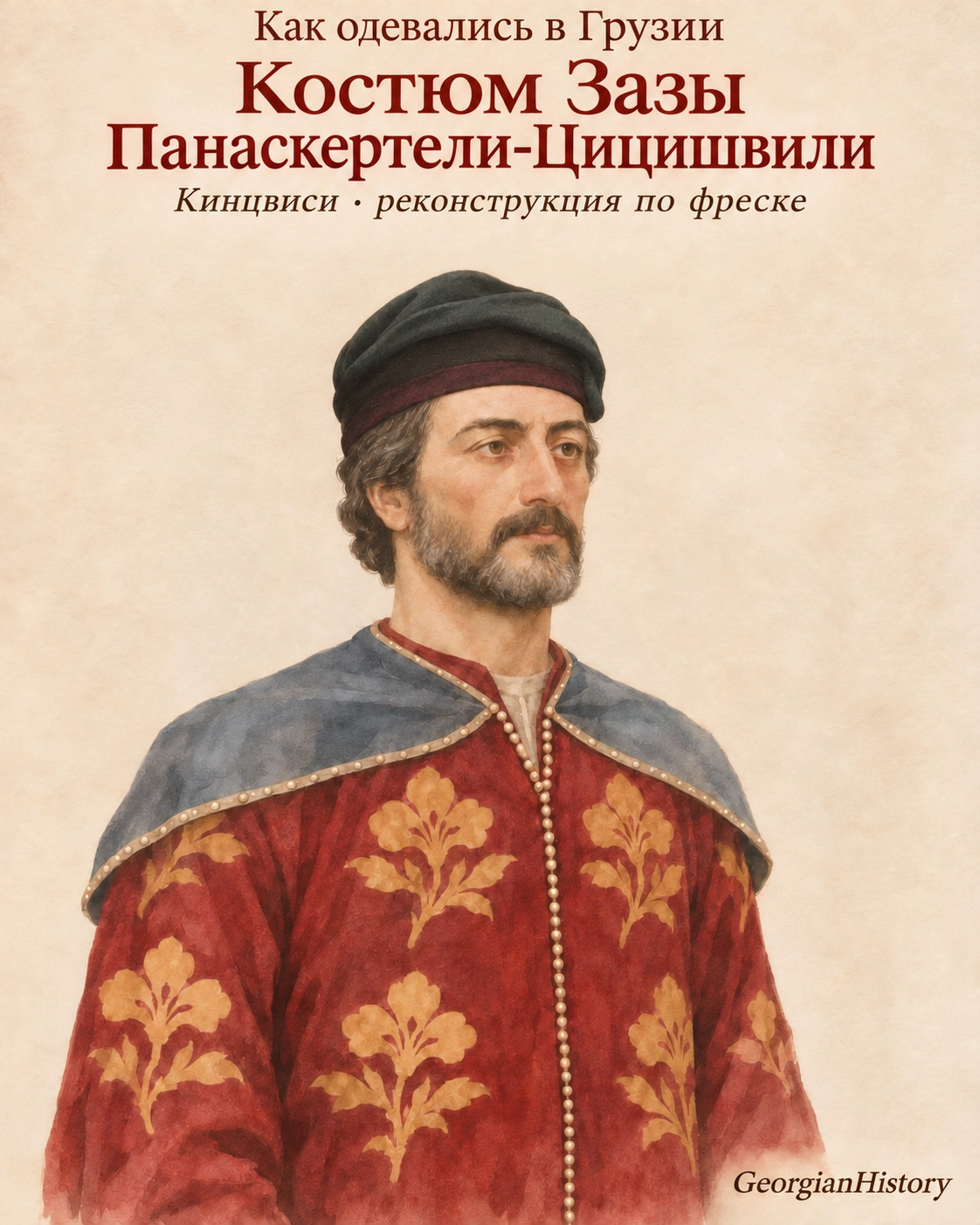
 The first thing you notice in the Kintsvisi portrait is the large yellow flowers on the crimson garment. A row of small pale dots runs along its open edges. The historian Giorgi Kalandia describes an open-front garment resembling an Eastern robe, edged with pearls. A bluish cloak with pale edging and pearl trim covers the shoulders. A tall dark cap with a turned-up brim completes the ensemble. This is how the church painting presents a nobleman. [1]
Dating the costume from this fresco is harder than describing it. Kalandia identifies the portrait with the fifteenth-century Zaza and suggests that a painter repeated details of the earlier clothing when renewing the image. The Orthodox Encyclopedia dates the same painting on the north wall of the narthex to the mid-eighteenth century. It also records a donor of the same name who funded the renewal of an icon in 1751. The visible details can be reproduced, but whether they belong to fifteenth-century costume remains open. [1, 2]
The flowers have a story of their own. The researcher Sokrat Salukvadze suggested they were dog rose blossoms. Kalandia thought the design made it difficult to identify the plant. A connection between the pattern and the healer’s work remains a hypothesis. What can clearly be seen on the fresco is the large floral pattern itself. [1]
Zaza Panaskerteli-Tsitsishvili came from a family with ties to Tao, one branch of which settled in Kartli. In the second half of the fifteenth century he was a landowner and court official. According to the National Centre of Manuscripts, he served King Constantine II, restored Kintsvisi Monastery and added a chapel. Giorgi Khuroshvili calls him the mech’urch’letukhutsesi, the official in charge of the royal treasury, and lists Uplistsikhe among his estates. Where Zaza was educated is unknown. Records do survive of his work with books: several Georgian translations of John Chrysostom’s writings were collected and copied at his direction. [3, 4]
The history of the medical book
Zaza’s name is associated with the Qarabadin, a fifteenth-century Georgian medical book. Its first part describes how to examine patients, identify illnesses and approach treatment. The second covers diseases of individual organs, their symptoms and ways to treat them. The work draws on earlier Georgian medical books, including the Ustsoro Qarabadin, as well as practices from folk medicine. [5]
Manuscript Q 877 preserves 684 paper leaves. It is written in Georgian Mkhedruli script in black and red ink, and the catalogue distinguishes two scribal hands. The opening is lost. Zaza is named in a prayer at the beginning of the second part. This and other mentions are the basis for attributing the medical book to him. [5]
In 1709 Vakhtang, the future King Vakhtang VI, ordered the scattered leaves to be gathered and bound. He recorded this in an annotation. In 1945 the philologist Tornike Chkonia found the manuscript in an archive in Gorky, now Nizhny Novgorod, and brought it to Georgia. The two parts were published together in 1978. This is where the title comes from: texts on treatment were gathered in the fifteenth century, and more than two centuries later the leaves of the manuscript itself were gathered. [3, 5]
GeorgianHistory
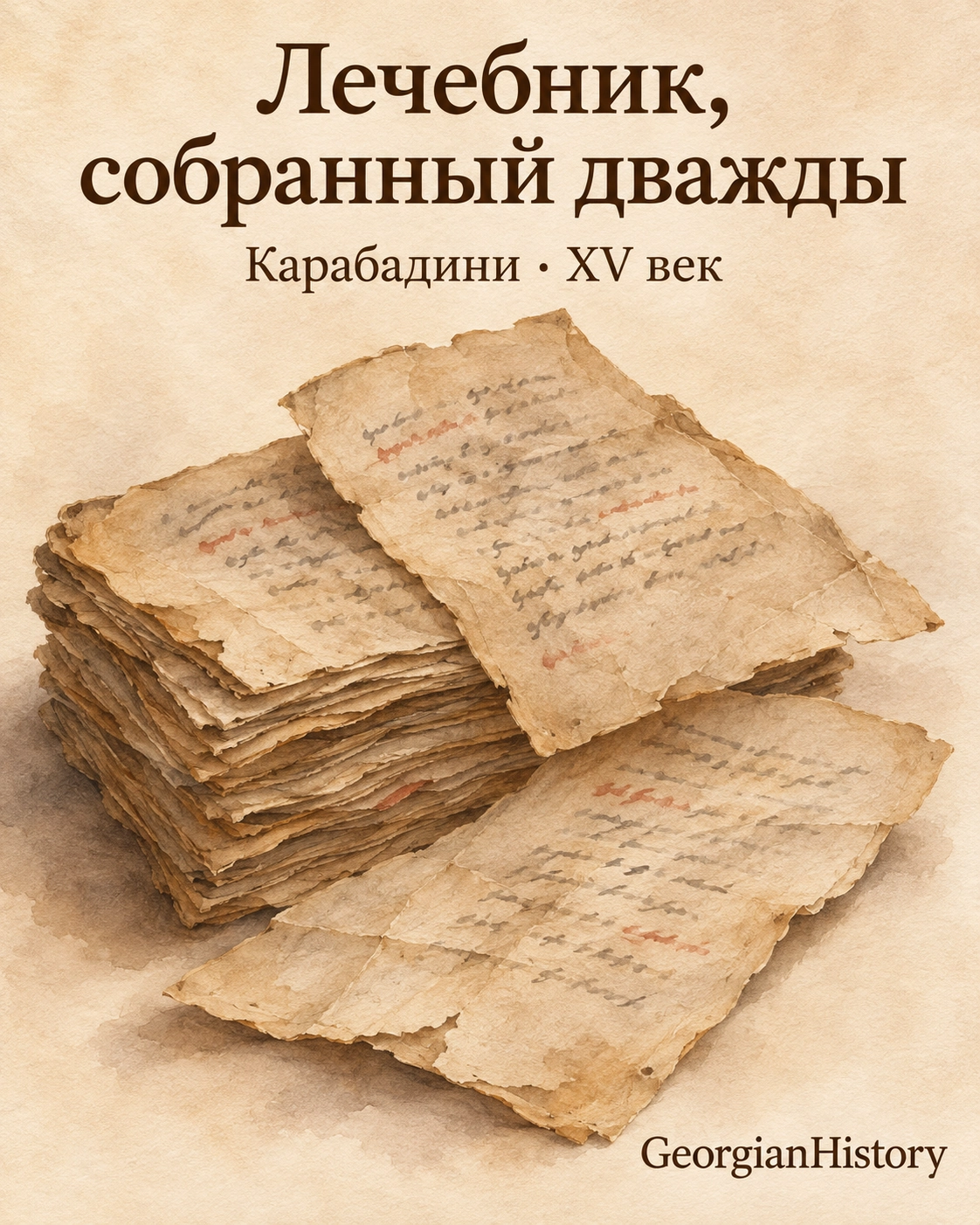
Digitised edition: Qarabadin, Tbilisi, 1978 · National Parliamentary Library of Georgia.
Sources and further reading
- 1. Giorgi Kalandia. History of Georgian Fashion. Art Palace of Georgia, 2022, pp. 74–75. Description of the clothing, the dog rose hypothesis and the renewal of the fresco. Link to the book presentation at Tbilisi State University.
- 2. M. Didebulidze. Kintsvisi. Orthodox Encyclopedia, vol. 33, pp. 571–576; online 2018. Dating of the narthex painting and the donor recorded in 1751.
- 3. Giorgi Khuroshvili. Zaza Panaskerteli-Tsitsishvili, 2024, sections 1–2. Biography, work with the texts of John Chrysostom, Vakhtang’s annotation and published editions.
- 4. Tamar Abuladze. Zaza Panaskerteli-Tsitsishvili. National Centre of Manuscripts, undated. Service under Constantine II and works at Kintsvisi.
- 5. Tamar Abuladze and Liana Samkurashvili, eds. Medical and Veterinary Manuscripts in the Depositories of Georgia and Abroad. Tbilisi, 2022, pp. 34–35, 104. Manuscript Q 877, its contents, dating and accession to the museum.