The Gate of Ganja: Iron at Gelati
11th–12th centuries. What an Arabic inscription and an Armenian chronicle reveal about the iron gate leaf at Gelati.
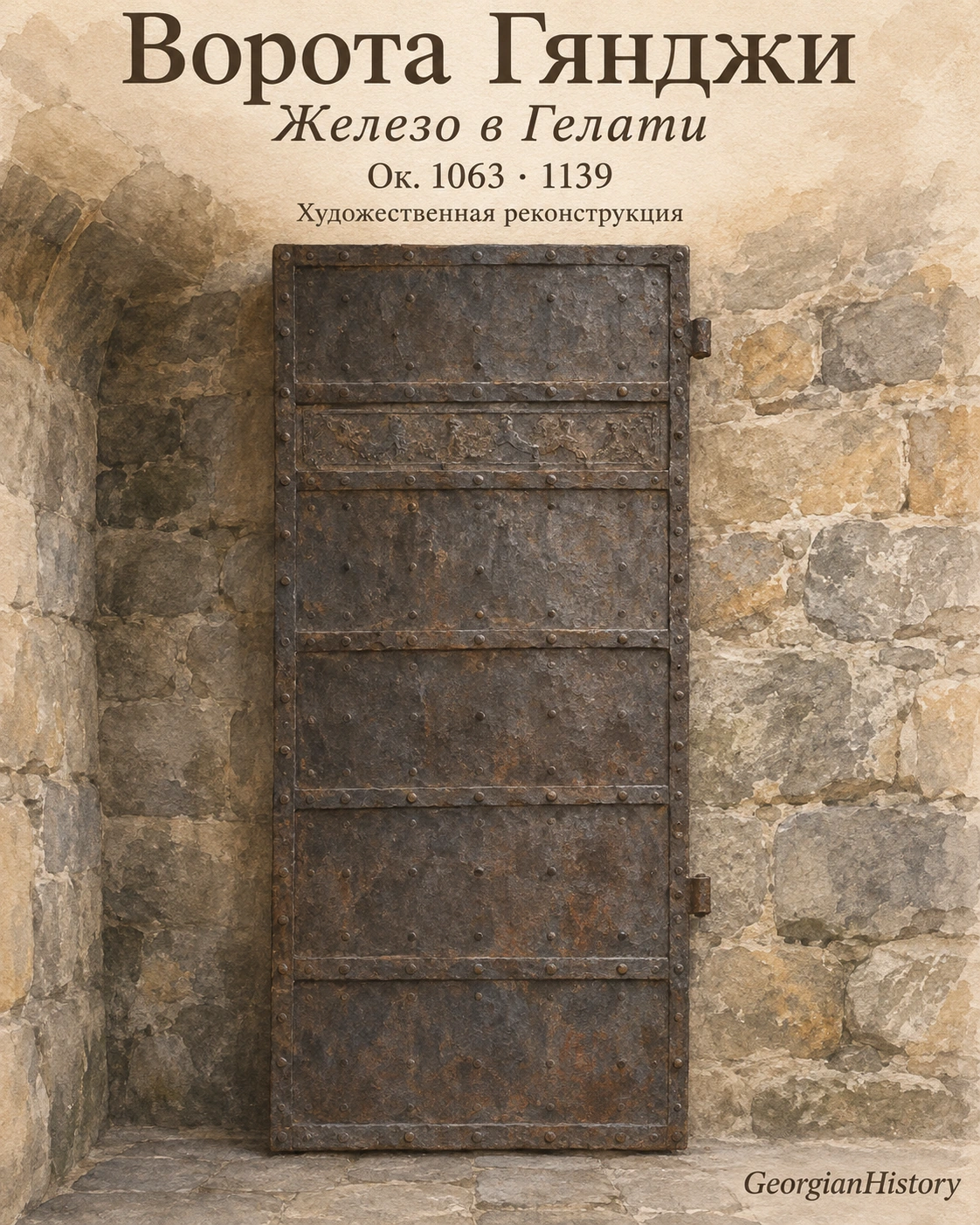
 An iron gate leaf survives in the southern gatehouse at Gelati. Its most important feature is an Arabic inscription that names an emir, an administrator and a blacksmith. No Georgian king is named: the leaf was made long before it reached the monastery. To understand how part of a city gate came to Gelati, we need both the object and the account of the destruction of the city for which it was made.
The inscription dates the work to AH 455, which Jost Gippert’s scholarly edition equates with 1063. The gate was commissioned by the Shaddadid emir Shawur ibn al-Fadl. Abu al-Faraj Muhammad ibn Abdallah oversaw the work, and the blacksmith Ibrahim ibn Uthman made the gate. The inscription preserves a detail rarely recorded for an urban structure: alongside the ruler, it names those who oversaw and carried out the work. [1]
The next episode belongs to the twelfth century. In 1139 an earthquake devastated Ganja, which the Armenian historian Kirakos Gandzaketsi calls Gandzak. Writing in the thirteenth century, several generations after the event, he begins with collapsed buildings and the deaths of townspeople. He then tells how the Georgian king Demetre I came to the stricken city and took booty, including its gates. The Georgian historian Ivane Javakhishvili dated the expedition to 1138–1139. The sources establish the sequence but leave open how the heavy leaves were carried or on what day they reached Gelati. [1–3]
At Gelati the leaf acquired a different setting. In Ganja it was part of the city entrance; at the monastery it recalled the expedition. The Arabic inscription remained on the iron, recording the original commission. There was another witness: in 1848 Marie-Félicité Brosset still saw traces of a Georgian wall inscription in the gatehouse and associated it with Demetre’s expedition and the transfer of the gate. The inscription is lost and cannot be checked in the same way as the surviving text on iron. [1, 4]
Over time the story of the leaf’s origin changed. In the eighteenth century Vakhushti Bagrationi recorded a version in which David the Builder brought the iron gate from Derbent. This is evidence of how the object was understood centuries later. The agreement between the other two sources carries more weight: the Arabic inscription names an emir who ruled Ganja, and Kirakos explicitly connects the removal of the city gate with Demetre. The published reading does not contain the city’s name; the identification comes from comparing the evidence. [1, 2]
Two kinds of evidence preserve the story of this leaf. The chronicle records the earthquake, the loss of life and the expedition; the iron records the emir’s commission and the blacksmith’s work. Together they trace an object that changed place and purpose while retaining evidence of the city from which it was taken.
Sources and further reading
- 1. Jost Gippert. The Gate of Ganja, 2023, pp. 571–578. Reading of the inscription, transfer of the gate and photograph (fig. 2).
- 2. Kirakos Gandzaketsi. History of the Armenians, thirteenth century, ch. 10. English translation by Robert Bedrosian, 1986.
- 3. Ivane Javakhishvili. History of the Georgian Nation, book II, section on Demetre I; 1983 collected edition, Georgian extract.
- 4. Lara Frentrop. Gelati Monastery. Courtauld Institute of Art, undated. South gate and photo gallery. The guide gives 1062; this article follows the epigraphic edition [1]: AH 455, c. 1063.