A Letter with a Bird’s Wing
The Mokvi Gospels of 1300
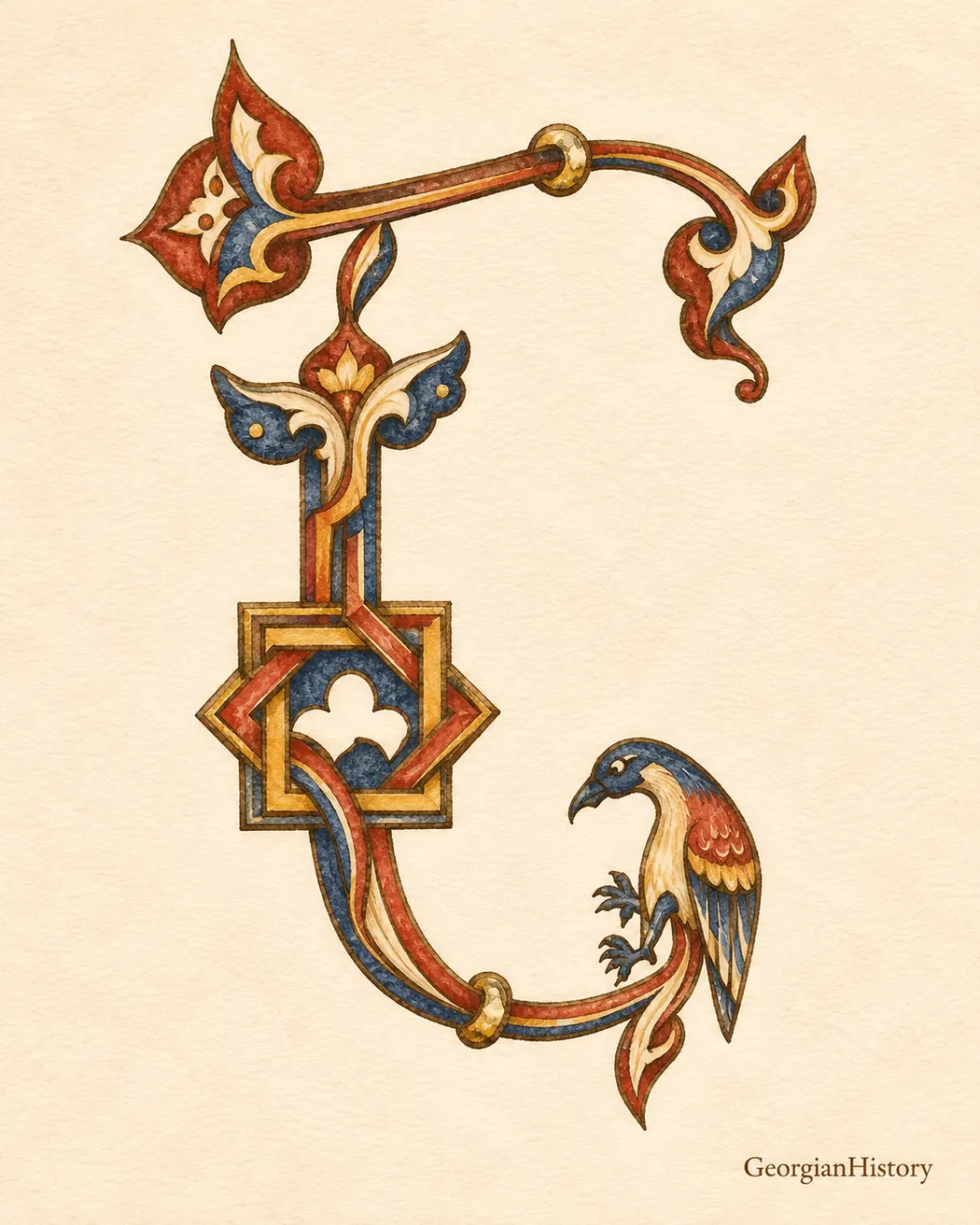
 On one initial in the Mokvi Gospels, the lower stroke curves upward into a bird’s neck. Its beak points towards the centre of the letter. Above it, a narrow ribbon runs through a knot made from a square and a diamond. Marina Tevzaia reproduces this initial in her album Georgian Ornament.
In 1300, the calligrapher Ephrem copied the four Gospels in Mokvi, Abkhazia, at the commission of Archbishop Daniel. The manuscript survives in 329 parchment leaves. The main text is laid out in two columns in Nuskhuri, an angular Georgian book hand. On folio 328 recto, Daniel is shown kneeling before the Virgin and Child.
How the initial is formed
Plain capitals in the Mokvi Gospels are written in cinnabar, a vivid red pigment. The larger initials are decorated with paint and gold. Some are as tall as twelve lines of text. They are based on Asomtavruli, an earlier Georgian script.
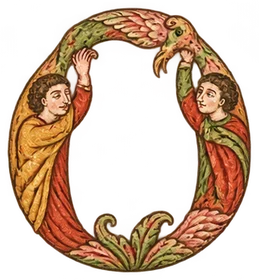
On folios 35 verso and 74 verso, versions of the letter Ⴃ (d) are made from figures of birds. In paired compositions, their entwined necks form the horizontal stroke, while their curved bodies outline the rounded part of the letter. The same letter could take different forms and remain recognisable.
Where a new passage begins
Each Gospel opens with a headpiece, an ornamental design placed before the text. In the dense columns of script, large initials mark the beginnings of individual verses. On folio 269 verso, the verse about the miraculous feeding of the crowd opens with the Georgian letter a in the shape of a whale. A human foot protrudes from its mouth. The scholar I. Chichinadze connects the image with the biblical story of Jonah.
The manuscript is held at the Korneli Kekelidze Georgian National Centre of Manuscripts in Tbilisi under the shelfmark Q 902.
GeorgianHistory
Sources and further reading
- M. Tevzaia. Georgian Ornament. Part I, 2005, p. 16 (PDF page 15), lower-left initial.
- Georgian National Centre of Manuscripts. Mokvi Gospel. Catalogue, p. 99, Q 902.
- I. Chichinadze. Mokvi Gospels. Orthodox Encyclopaedia, vol. 46, pp. 362–366, section on decorated initials.
- A. Pataki-Hundt et al. The Mokvi Gospel. Journal of Paper Conservation, vol. 17, nos. 3–4, pp. 112–119.