Gelati: Temporary Roof Due for Removal by the End of 2027
Georgia’s heritage agency has announced a removal date for the temporary structure for the first time. Its assertion that the interior is fully protected from precipitation is presented as the agency’s official position.
 On 5 November, Georgia’s Minister of Culture Maia Bitadze visited Gelati Monastery near Kutaisi. She said the condition of its main church, dedicated to the Nativity of the Virgin, was stable. She credited the joint work of the Patriarchate, the state and Georgian and international specialists.
Flaws in the roofing installed between 2015 and 2018 allowed water to enter the church, damaging its wall paintings. In 2023 the Georgian Patriarchate accepted the state’s offer to lead conservation work at the complex.
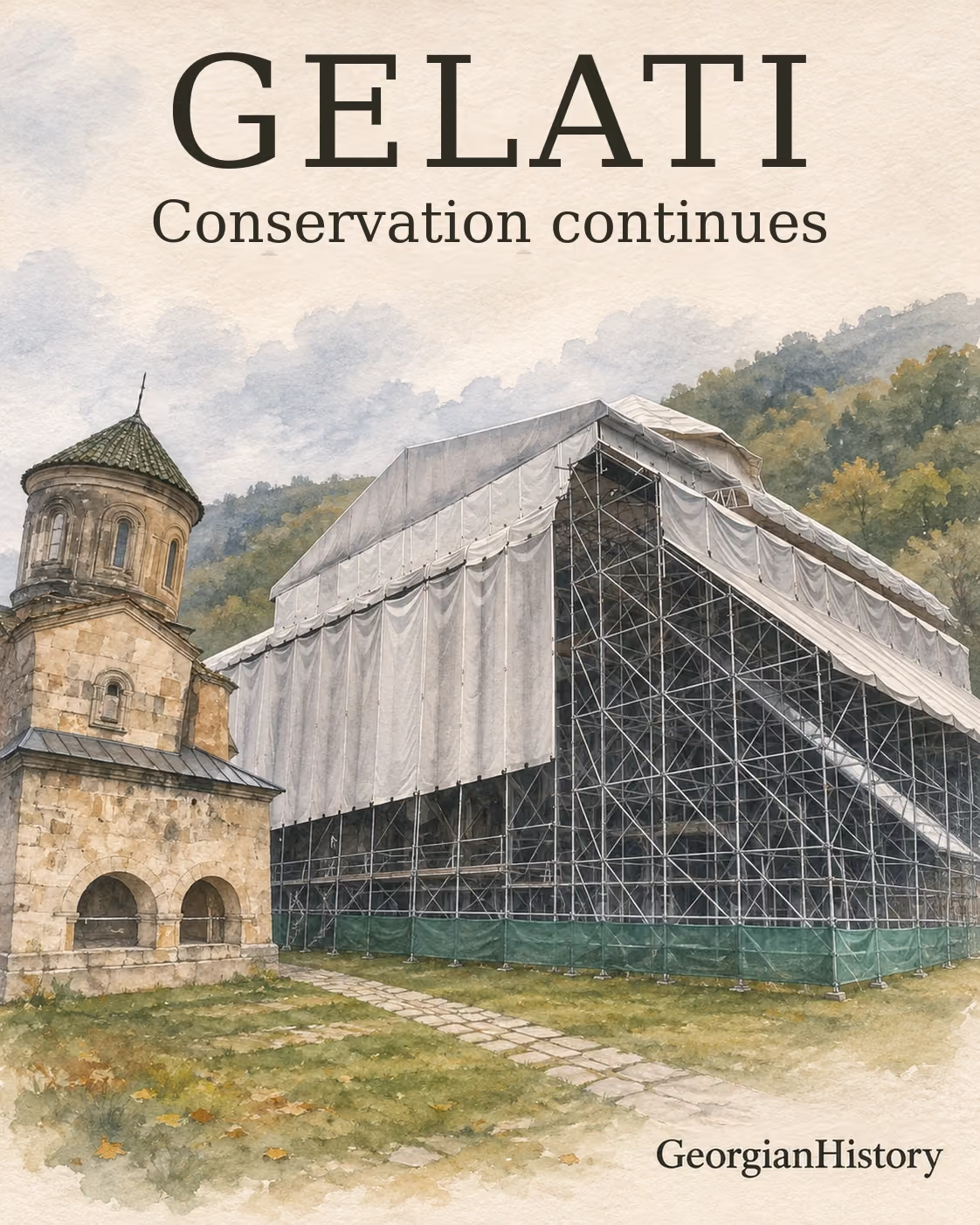
A temporary roof and drainage system now protect the church. According to the Ministry of Culture, specialists have completed the immediate conservation work and reinforced the most vulnerable areas of the wall paintings. They continue to monitor the condition of the building and its indoor climate.
On 15 November, the National Agency for Cultural Heritage Preservation announced a removal date for the temporary structure for the first time. The agency said work on the permanent roof was under way and that removal of the temporary roof was planned for the end of 2027. This is a provisional date announced by the agency, not a report that the work has been completed.
The statement responded to images circulated on social media. According to the agency, an outdoor area filmed during rain had been presented as the church interior. The agency asserts that the temporary structure fully protects the interior from precipitation. No independent report prepared after this episode has been published in the open sources reviewed; GeorgianHistory therefore presents this assessment as the agency’s official position, not as an independently verified finding.
David IV the Builder founded Gelati in 1106. The academy at the monastery was one of medieval Georgia’s leading centres of learning. The sanctuary apse of the main church retains a twelfth-century mosaic of the Virgin and Child flanked by two archangels. In May 2026, the Temporary Committee for the Rehabilitation of Gelati reported that a specially designed support had been installed for sections of the mosaic that had detached.
The state funds the phased restoration of the complex. The work follows a conservation plan drawn up by international experts in line with recommendations from the UNESCO World Heritage Centre and its advisory bodies. In 2025 the World Heritage Committee asked Georgia to submit the permanent roofing design for expert review before work begins.
“Our main aim is for Gelati Monastery, a symbol of our country’s unity, faith and national identity, to have a future that spans centuries,” Maia Bitadze said.
Sources and further reading
- Georgian Public Broadcaster, Channel One. Maia Bitadze’s statement and information from the Ministry of Culture, 5 November 2026
- National Agency for Cultural Heritage Preservation. Statement on the temporary and permanent roofing, carried by Interpressnews on 15 November 2026
- UNESCO World Heritage Centre. State of conservation report, 2023, pp. 78–80
- World Heritage Committee. Decision 47 COM 7B.106 on conservation and the permanent roofing project, 2025
- Temporary Committee for the Rehabilitation of Gelati. Emergency conservation of the mosaic, 7 May 2026
- UNESCO World Heritage Centre. The history of Gelati Monastery, the academy and the mosaic
- Georgian Public Broadcaster, Channel One. Video report of 5 November 2026
- Aerial photograph published by Interpressnews on 24 June 2025