Shemokmedi: Rehabilitation Project Prepared
The National Agency for Cultural Heritage Preservation has presented a conservation plan for the complex in Guria. No start date has yet been announced.
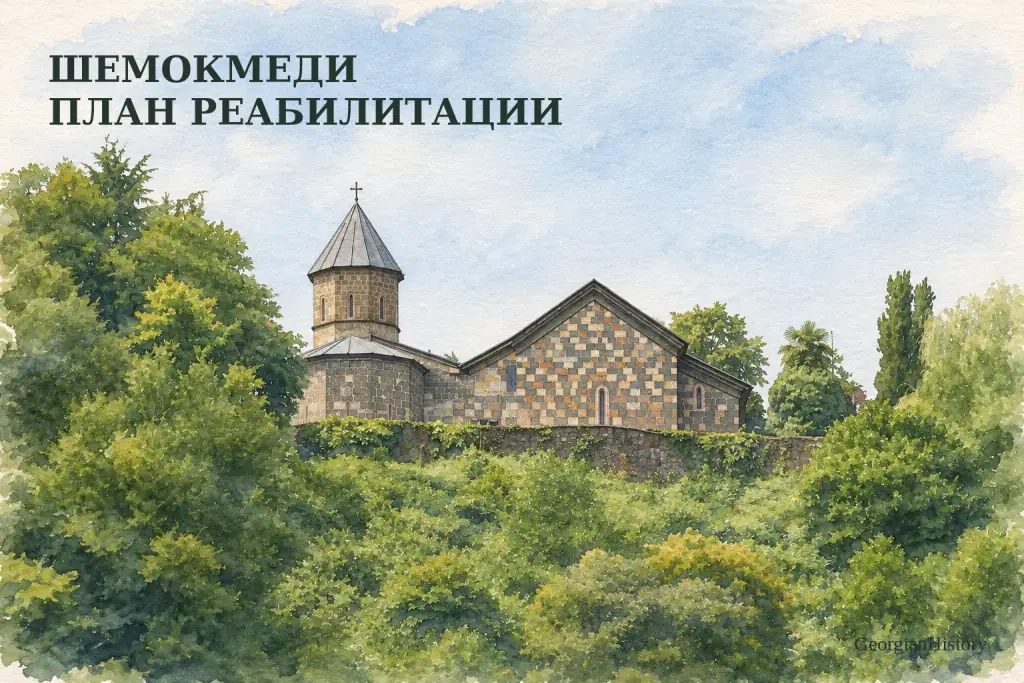
 On 13 November 2026, Georgia’s National Agency for Cultural Heritage Preservation announced plans to rehabilitate the Shemokmedi architectural complex, a monument of national importance in the village of Shemokmedi, Ozurgeti Municipality. The agency said that details of the project had already been presented to local authorities.
Before work begins, the agency prepared design and cost-estimate documentation. Architectural, structural and engineering studies were carried out, existing damage was assessed, and methods were defined for rehabilitation and conservation of the stonework and wall paintings.
The plan released by the agency includes conservation of the masonry and paintings, full replacement of the roof, and installation of a drainage system. This is a list of proposed works, not a report on completed rehabilitation.
The complex includes the churches of the Saviour and Zarzma, a bell tower, and an enclosure wall. The agency dates the three-aisled Basilica of the Saviour to the twelfth–fourteenth centuries and the domed Church of Zarzma to the sixteenth century, associating its construction with Vakhtang Gurieli.
The 13 November statement does not give a starting date, contractor, budget, or procurement stage. At present, the preparation of project documentation and the presentation of the plan are confirmed; the start of physical intervention at the monument must be verified separately.
Sources and further reading
- Georgian Public Broadcaster, 13 November 2026. National Agency for Cultural Heritage Preservation statement on the Shemokmedi rehabilitation project.
- Georgian government portal, 13 November 2026. List of studies and planned works.
- Jaba1977 / Jaba Labadze. Shemoqmedi church.JPG, 28 June 2015, Wikimedia Commons. Photographic reference for the watercolour; reuse and adaptation are permitted with attribution.