The warrior saint of Pavnisi
Warriors in frescoes · Sheet F07. Shield and lamellar armour in a twelfth-century Georgian mural.
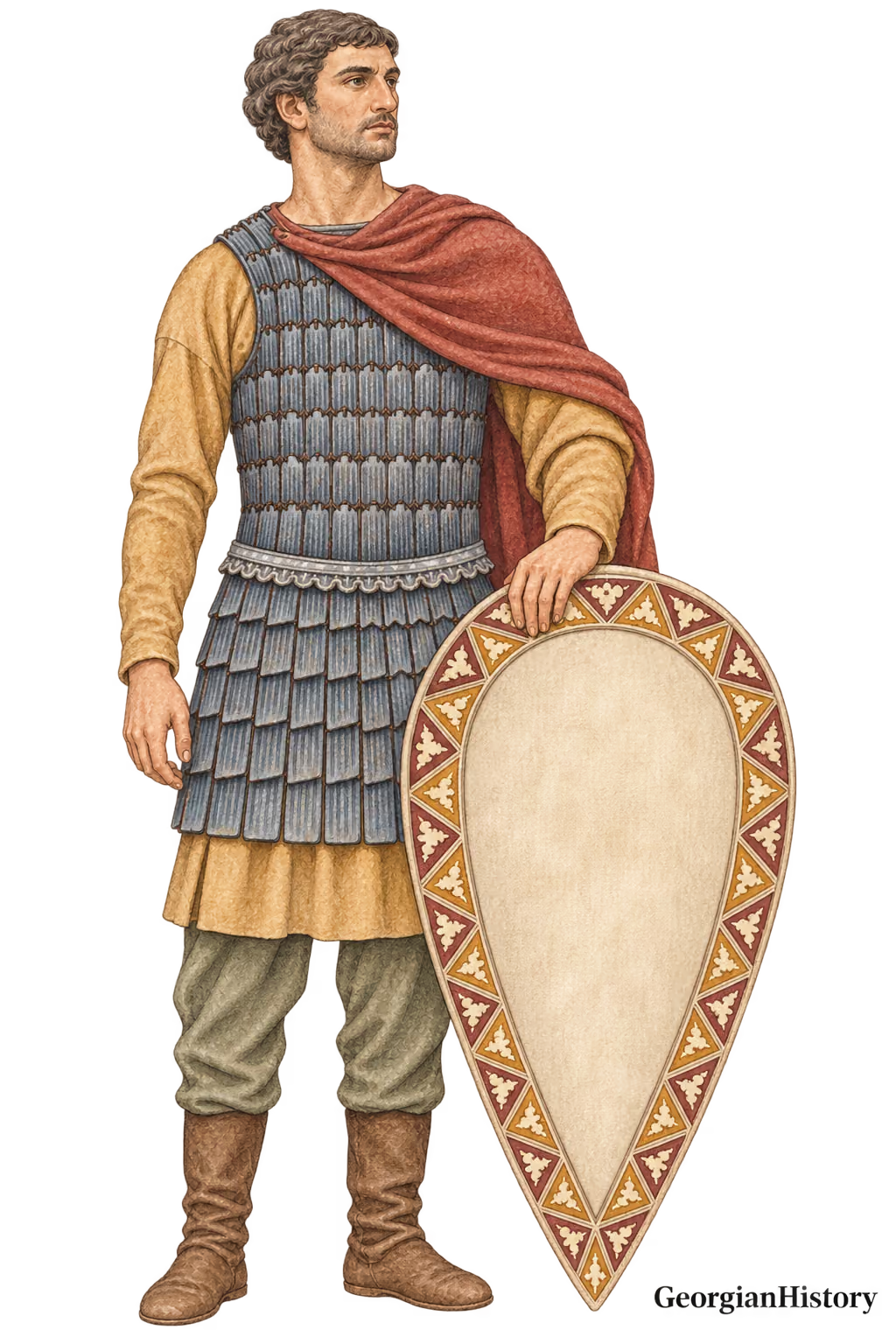
 Part of a warrior saint survives in a late twelfth-century fresco at Pavnisi. The narrow plates of his armour, his hand resting on a shield and a section of the shield’s floral border are still visible. We used these details to reconstruct the shield first, then the full-length figure.
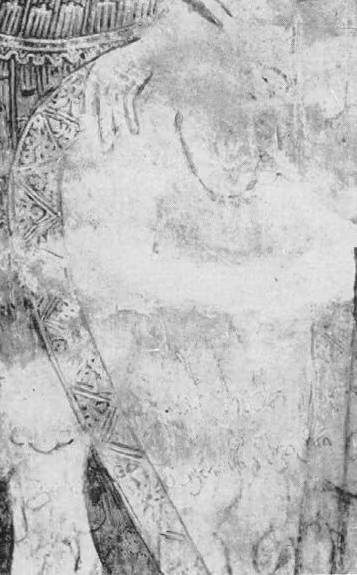
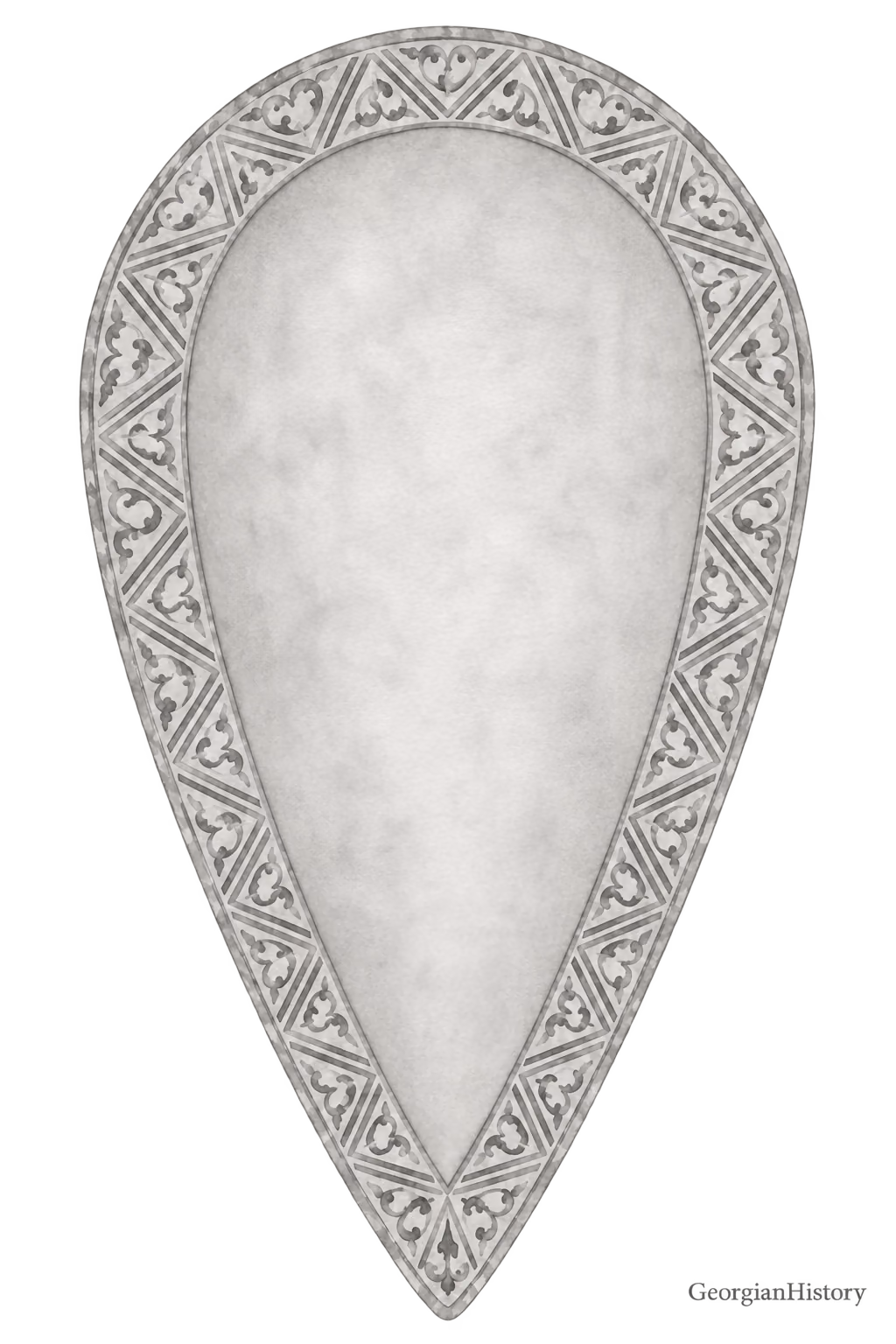
A damaged fresco in the Church of St George at Pavnisi preserves the shield's broad, patterned border. Diagonal lines divide it into triangles containing curling plant forms. The surviving section shows how the painter fitted the plant motif into a geometric frame.
Pavnisi is in Shida Kartli. The mural dates to the late twelfth century. Ekaterine Gedevanishvili cites Ekaterine Privalova's dating to the 1180s. Dionysios Mourelatos proposes a similarly late date, around 1170–1180.
Mamuka Tsurtsumia reproduces the fragment from Privalova's monograph and identifies the figure as a warrior saint. A hand rests on the shield. Tsurtsumia describes the armour as lamellar, made up of laced plates with projections pointing upwards. In a separate study, he identifies lilies in the border. The motif's meaning and any connection to a particular family remain unknown.
For the watercolor we used the surviving edge and the divisions of the ornamental band. The full teardrop outline, the pointed base and the pattern repeated all the way around are conjectural. The fresco preserves the structure of the border. The watercolor shows one way the pattern could have continued across the lost sections.
We left the central field light. The black-and-white photograph does not establish whether it once bore a design or what colors the painter used. The grey tones render the pattern as it appears in the reproduction. The shield's underlying material and the arrangement of its fittings remain unknown.
Reconstructing the figure
The rows of plates and the shaped edge at the waist in the color watercolor follow the fresco. The clothing, footwear, face and palette are conjectural. The photograph does not clearly show a weapon, so the warrior carries only a shield in this version.
Sources and further reading
- M. Tsurtsumia, The Evolution of Splint Armour in Georgia and Byzantium, pp. 82, 97
- Fresco reproduction after E. Privalova, pl. 15, in M. Tsurtsumia, fig. 25
- M. Tsurtsumia, The Helmet from the Wawel Royal Castle Museum, p. 98
- E. Gedevanishvili, Warrior Saints in Medieval Georgian Art, pp. 184–186
- D. Mourelatos, The Formation and Evolution of Monumental Painting in Georgia, pp. 120–121