Arms and Armour of Georgian Warriors in Queen Tamar’s Time
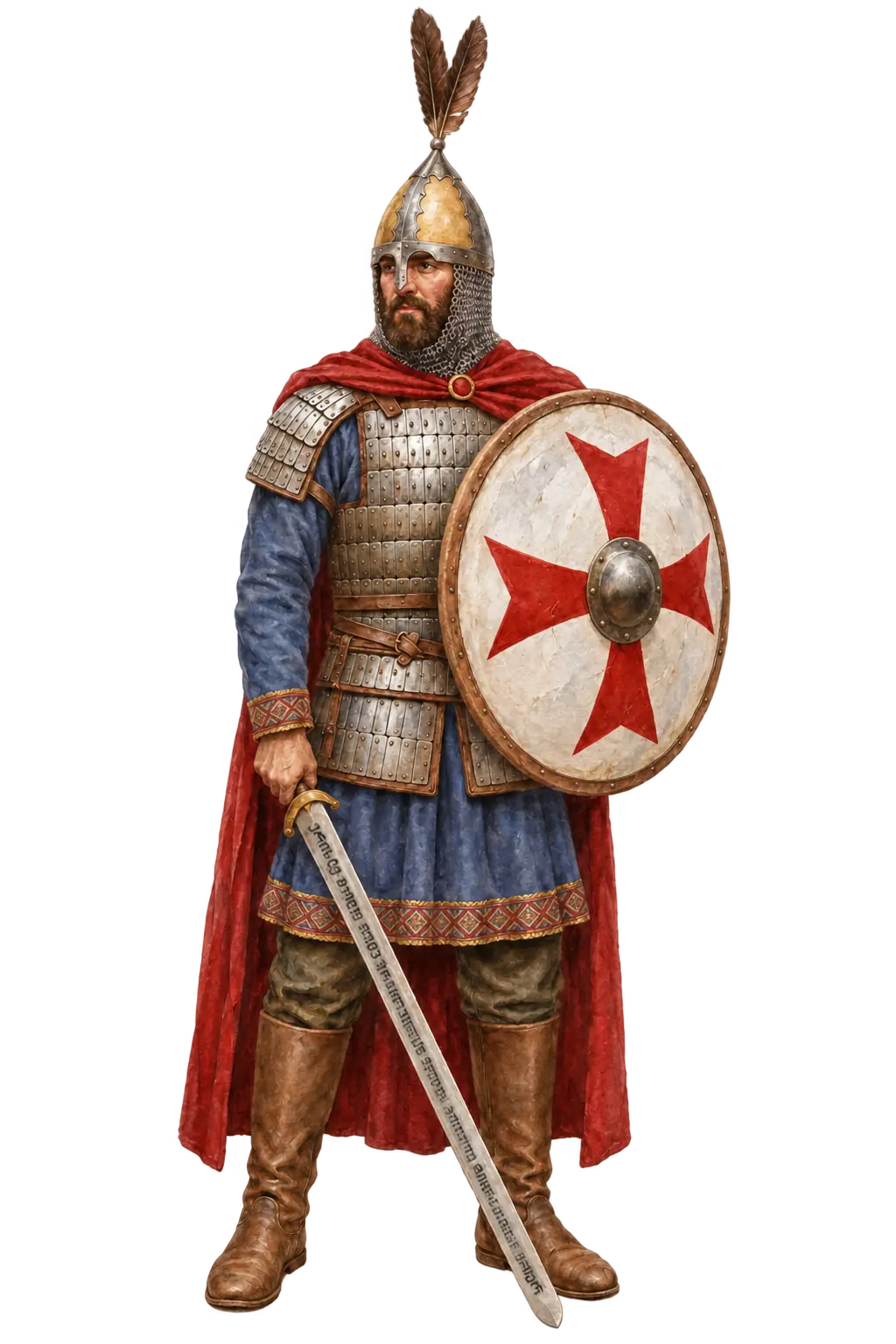
A foot soldier and two horsemen in three GeorgianHistory watercolours.
 In Shota Rustaveli’s poem, Avtandil ends a conversation and spurs his horse. The action takes up half a line, “ცხენი გაქუსლა დეზითა”. The spur appears as an object familiar to the reader. Wall paintings and repoussé icons bring other details into view, including rows of plates across the chest, the outline of a shield and the high bow of a saddle. Together, these sources help us picture military equipment in the Kingdom of Georgia around 1200. *The Knight in the Panther’s Skin*, stanza 214 · Study of Georgian military equipment
The three watercolours show composite sets of equipment. The foot soldier and two mounted warriors let us compare what the shield covers, how the armour sits and what equipment a horse adds to the picture.
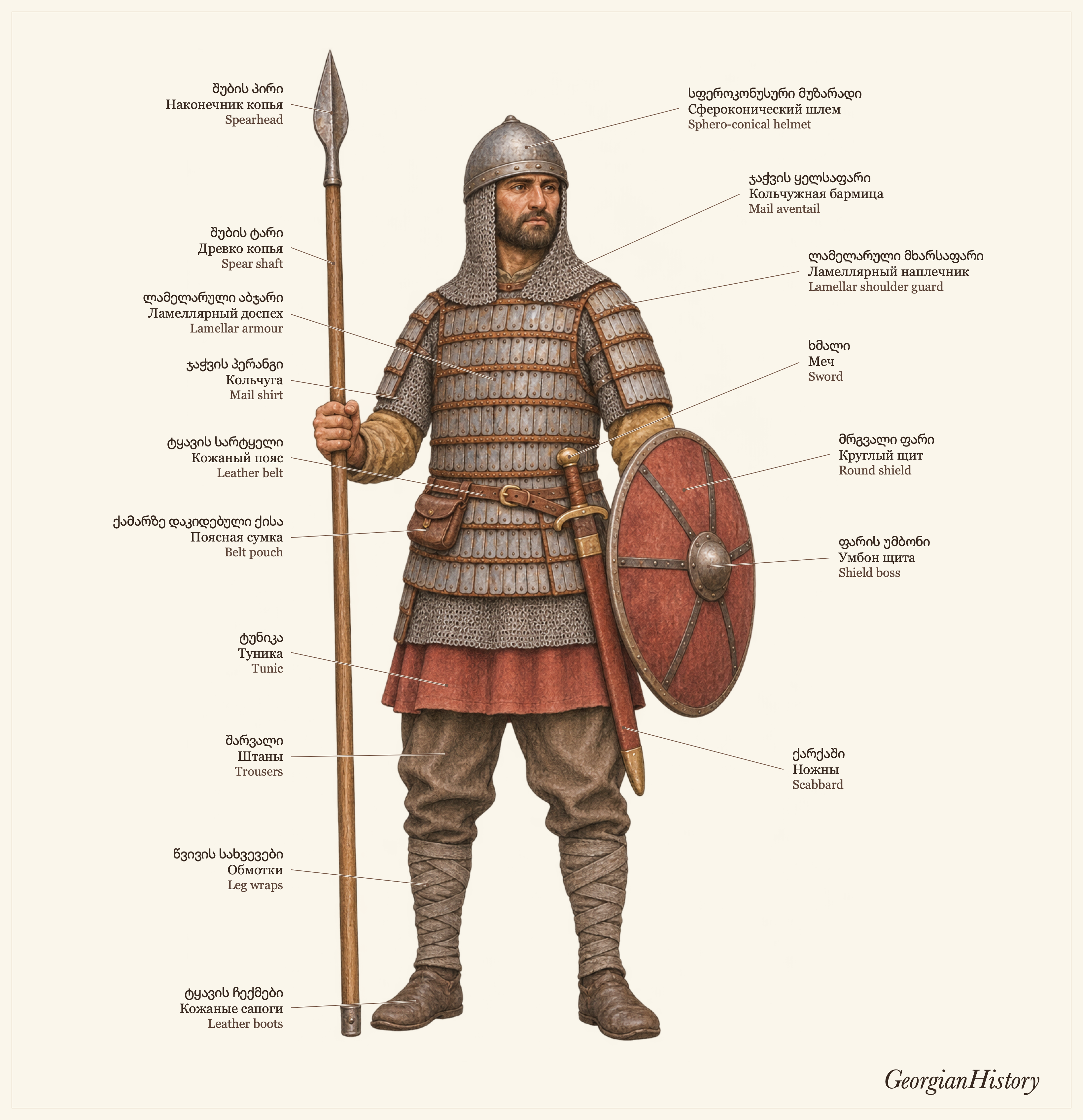
A Foot Soldier with a Round Shield
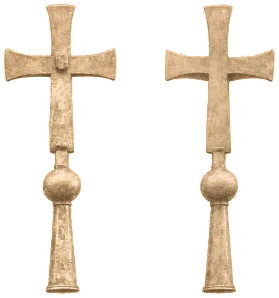
Rows of narrow lamellae cover the soldier’s chest. The flexible sleeves and hem of his mail shirt are visible beneath them. Mamuka Tsurtsumia notes similar rows of plates on the twelfth-century processional cross from Pari in Svaneti. A thirteenth-century mural of St Theodore at Davit Gareja provides another example. These images give an idea of how the plate armour was arranged. The cut of the clothes, the leg wraps and the belt pouch are conjectural details in the watercolour. Tsurtsumia on lamellar armour, p. 79 and fig. 19
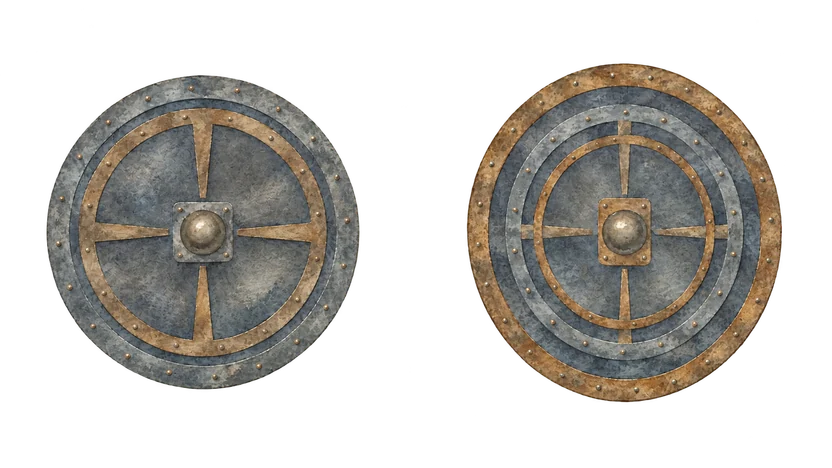
The round shield has metal strips radiating from its raised central boss. A shield in the early thirteenth-century paintings on the west side of Timotesubani has comparable straight radial strips. The watercolour pairs the shield with a spear and a sheathed sword in an imagined kit for a well-equipped foot soldier. Tsurtsumia on shields, p. 255 and fig. 4, panel й
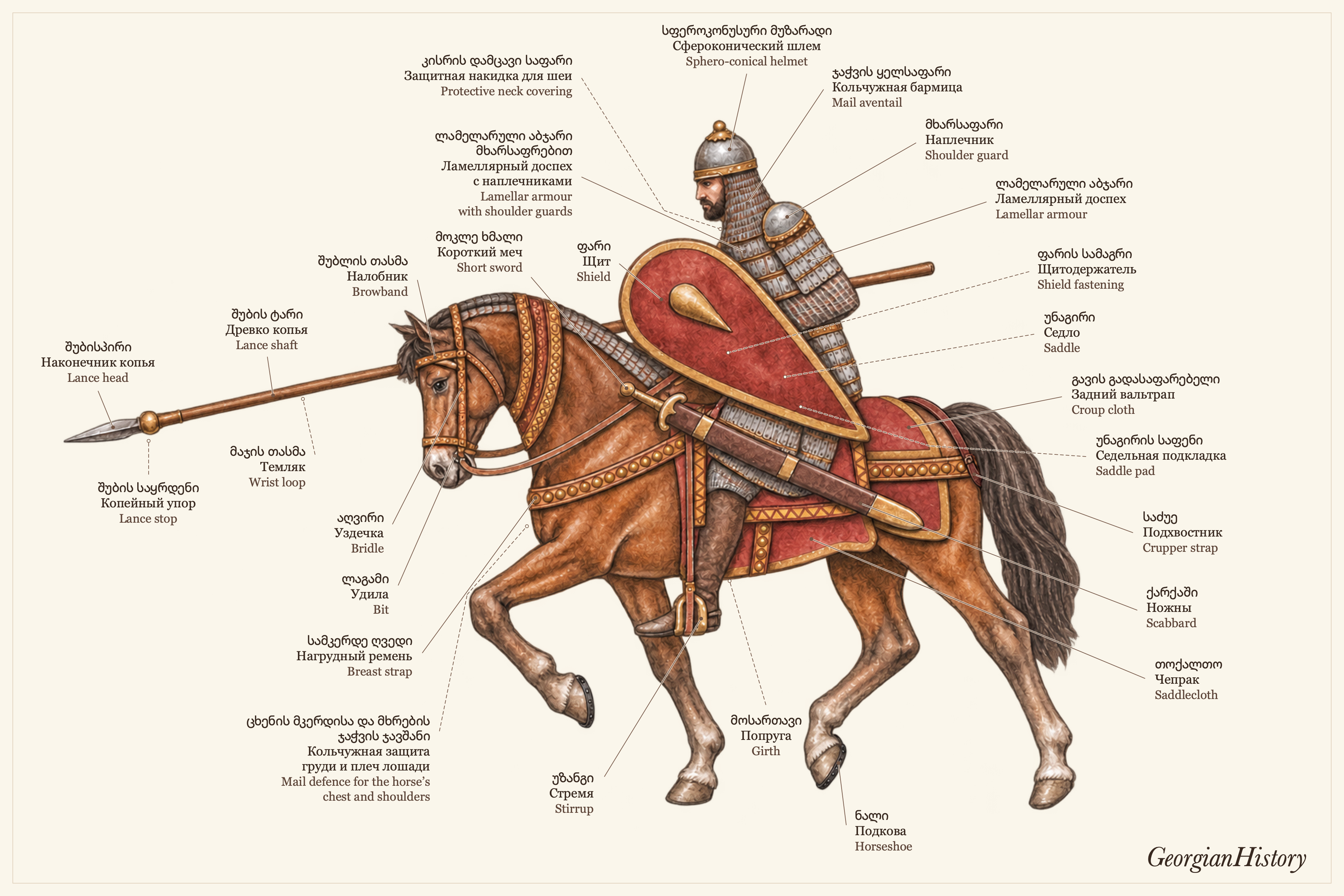
A Horseman with an Almond-Shaped Shield
The lower end of the long shield reaches the rider’s thigh. Almond-shaped shields appear in Georgian icons, wall paintings and manuscript illuminations. The side view in the second watercolour shows how the shield lies along the rider’s body. The horse’s tack also comes into focus. The reins run to the bit and the rider’s boot rests in the stirrup. Tsurtsumia on cavalry equipment, pp. 99–101
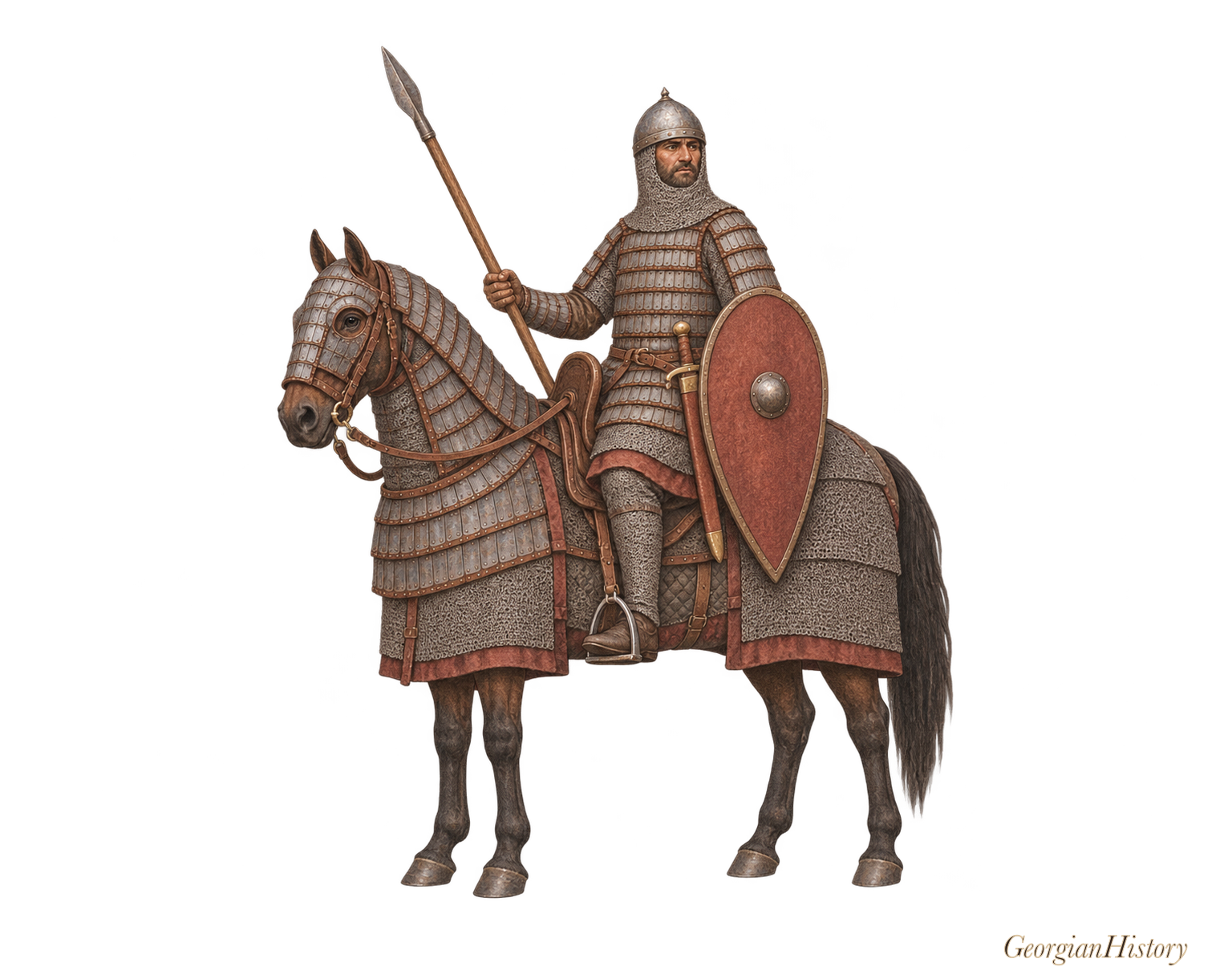
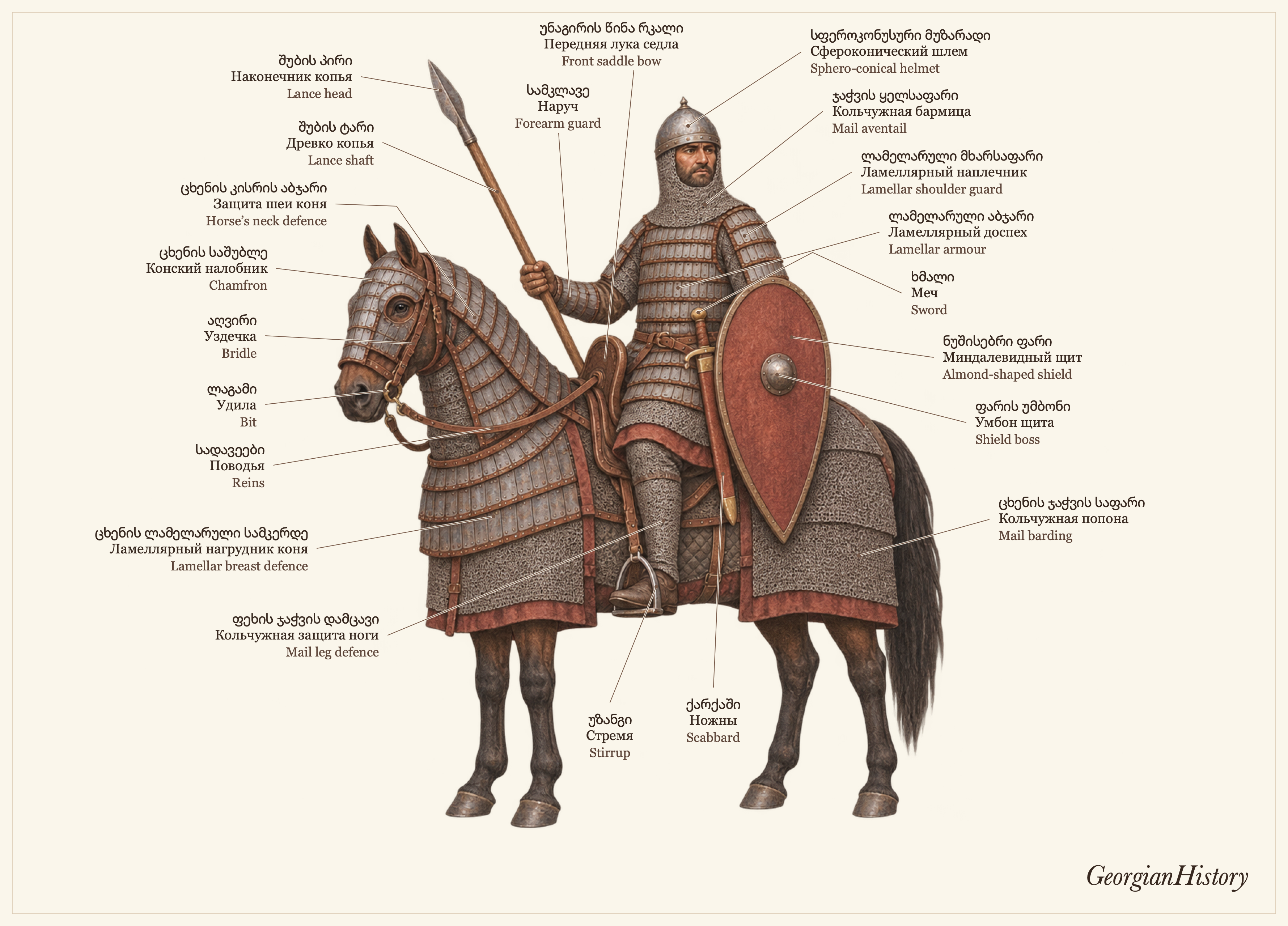
A Heavily Armoured Rider and His Horse
In the third watercolour, the armour extends to the rider’s arms and legs. The horse wears a face defence, overlapping plates over its neck and chest, and a mail covering over its body. Medieval written sources attest to horse armour in Georgia. Earlier reliefs at Nikortsminda and murals at Adishi offer parallels for the plated neck defence. A complete Georgian set from this period has not survived, so the combination of face defence, breast defence and mail covering in the watercolour is conjectural. Tsurtsumia on horse armour · Nikortsminda and Adishi, figs. 2.3–2.5
Tsurtsumia identifies the aznauri and didebuli nobles as the best-equipped members of the Georgian cavalry. Individual details come into focus in different sources. A painting shows the outline of a shield, a poem names a spur, and a relief preserves the shapes of the plates on a horse’s neck. The watercolours put those details together. The callouts show where the illustration has to go beyond what the sources reveal. Tsurtsumia on the personnel of the Georgian army, pp. 127–128
Sources and materials
- Shota Rustaveli, The Knight in the Panther’s Skin, stanza 214 in the TITUS edition
- Mamuka Tsurtsumia, The Evolution of Splint Armour in Georgia and Byzantium, 2011, pp. 79–80 and fig. 19
- Mamuka Tsurtsumia, The Evolution of Medieval Shields Reinforced with Metal, p. 255 and fig. 4, panel й
- Mamuka Tsurtsumia, Couched Lance and Mounted Shock Combat in the East: The Georgian Experience, 2014, pp. 99–101
- Mamuka Tsurtsumia, Horse Armour in Medieval Georgia, pp. 81–100
- Mamuka Tsurtsumia, Georgian Military Equipment – Between Art and Reality, 2025, pp. 55–57 and figs. 2.3–2.5
- Mamuka Tsurtsumia, Military Personnel of the Medieval Georgian Army, 2013, pp. 127–128