The Warrior from Timotesubani
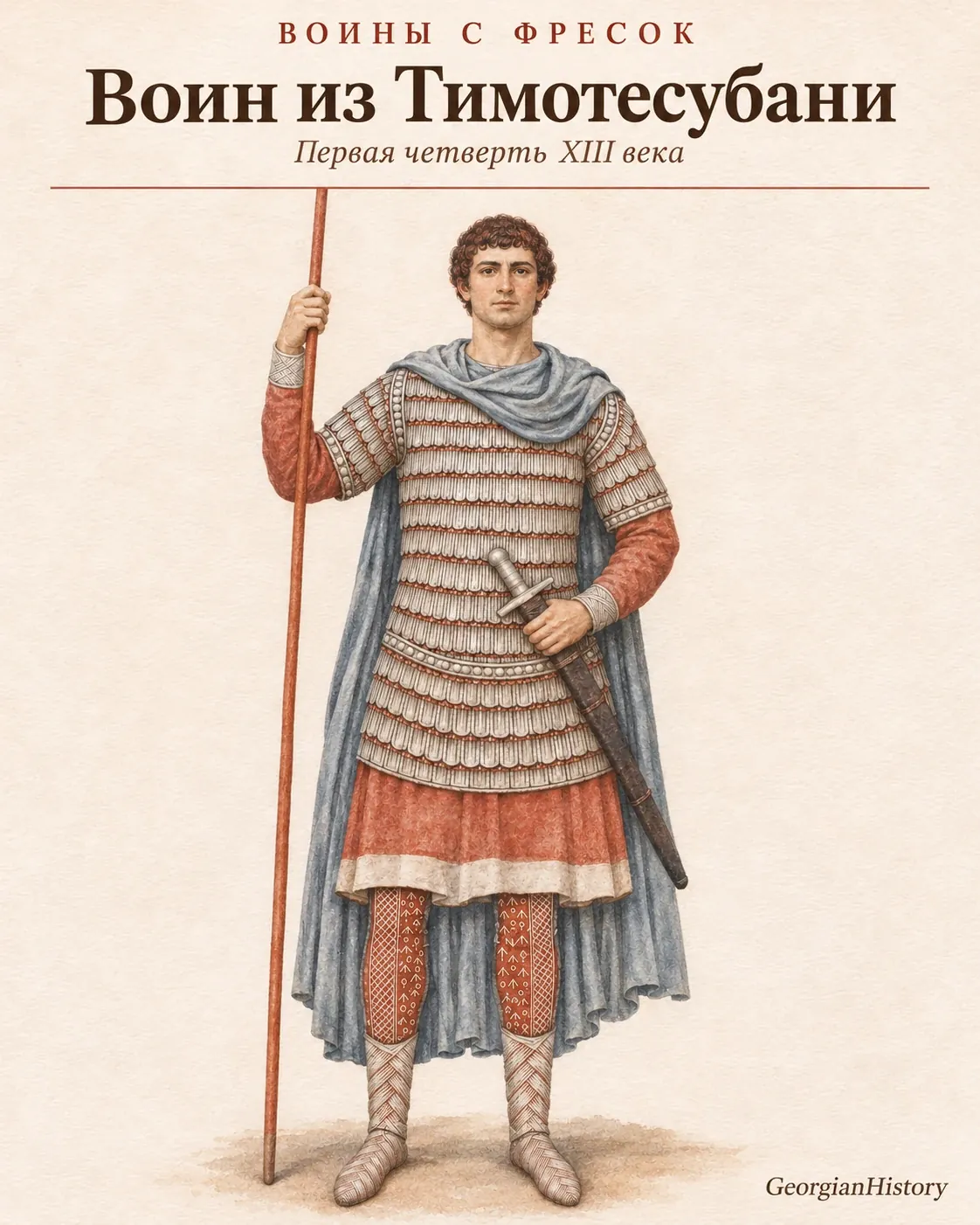
Armour and weapons in a thirteenth-century Georgian fresco. Warriors from the Frescoes, plate F01.
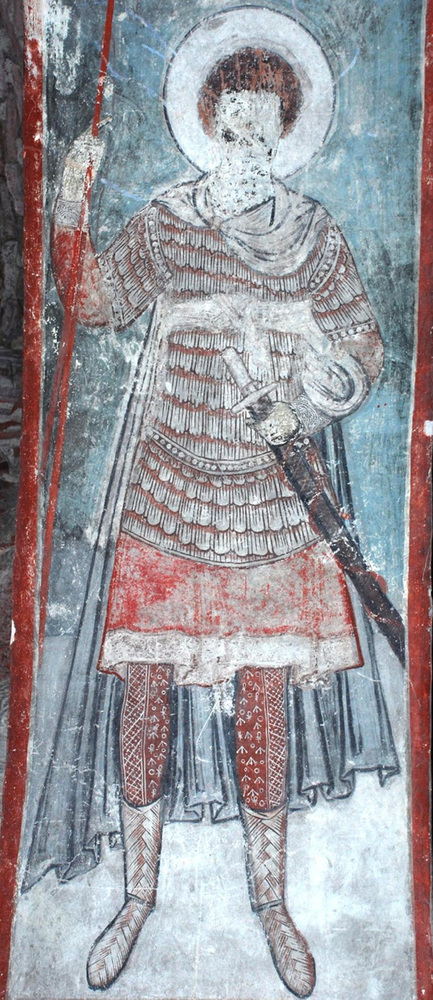
 On the wall of the Church of the Virgin at Timotesubani, the warrior saint’s face has almost worn away. Below his belt, the edges of individual plates are still visible. At his left hip, one can make out the outline of a sword in its scabbard. The paintings of the church in the Borjomi Gorge date to the first quarter of the thirteenth century. This figure opens our reconstruction series “Warriors from the Frescoes”. [1, 3]
Lamellar armour
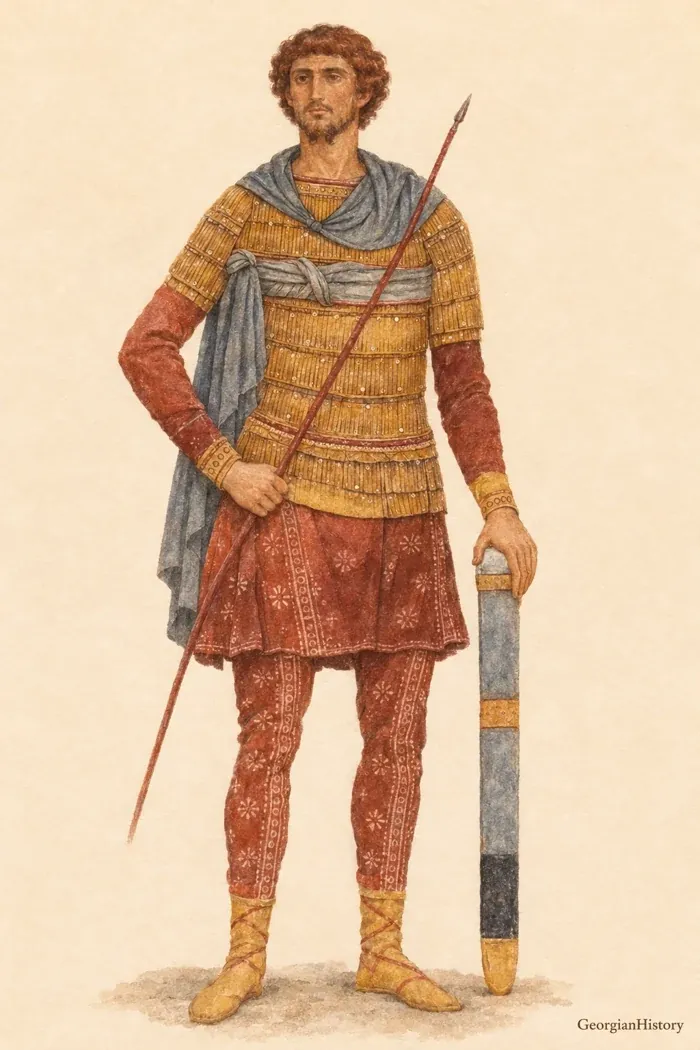
The armour covers the chest and extends below the waist, widening over the hips. Short sections of plates are visible on the shoulders and upper arms. Mamuka Tsurtsumia identifies the armour as lamellar. It consists of small plates joined together in horizontal rows. At Timotesubani, the projections at the ends of the plates point downwards. [2, 3]
At Pavnisi, the same researcher identifies plates with upward-pointing projections. Details like these help distinguish different forms of armour. The purpose of the elaborate finish remains open. Tsurtsumia suggests that such forms may have been used in ceremonial equipment. [2]
Sword and spear
The warrior holds a spear in his raised right hand, with his left hand lowered towards the sword. The hilt and the crossguard that protected the hand are visible above the dark scabbard. [3]
While studying a medieval sword from Khevsureti at the Georgian National Museum, Tsurtsumia measured the blade and used the holes in the tang to determine how the hilt had been attached. The fresco helps us reconstruct how the weapon sat when the armour was worn. The hilt is at belt level, and the scabbard runs diagonally along the thigh, beside the lower rows of plates. [3, 4]
How the fresco guides the reconstruction
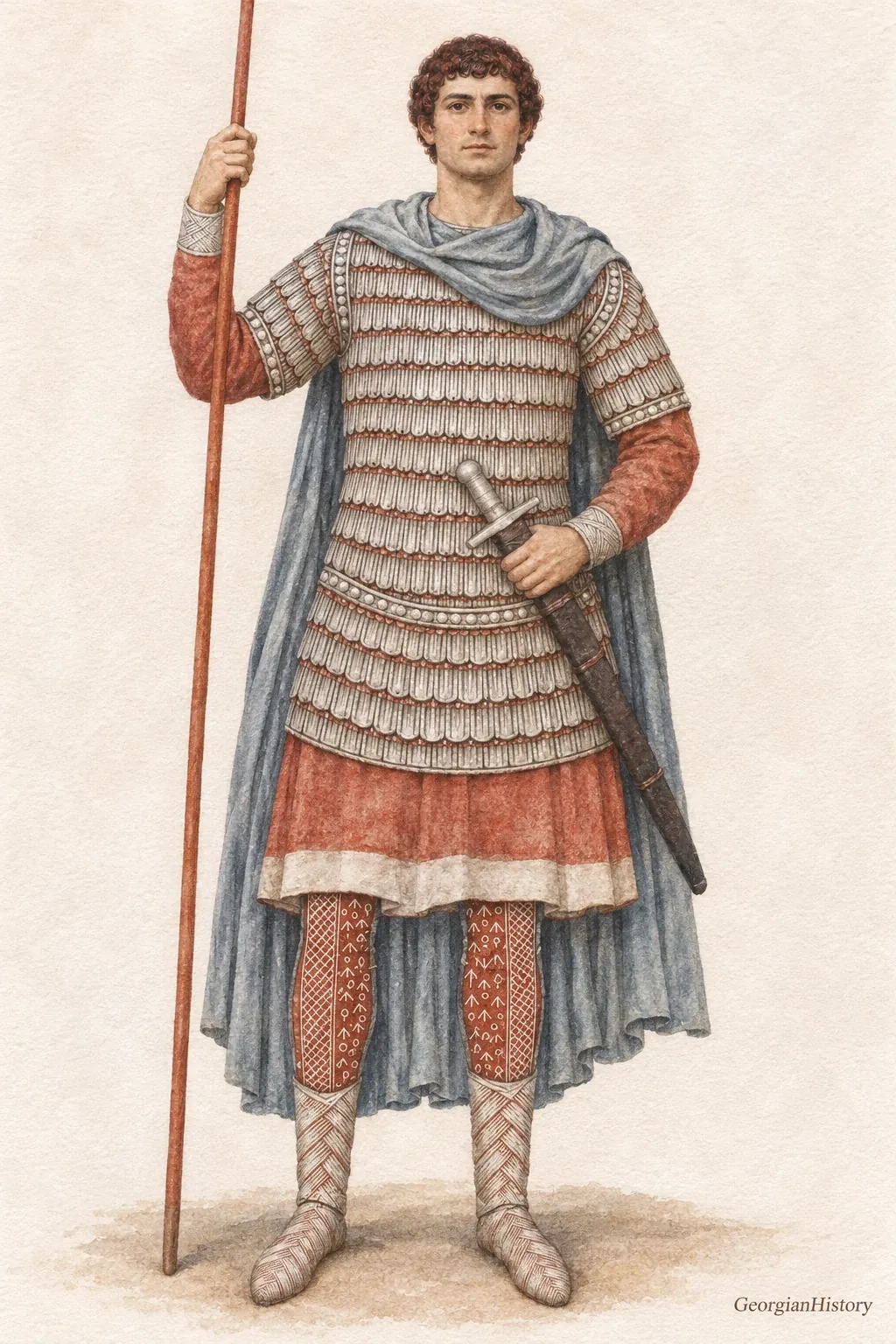
The same figure shows how clothing was worn with the armour. A red hem with a pale border is visible beneath the plates. A blue-grey cloak falls over the shoulders and down the back. Such images are particularly valuable for the history of Georgian warfare. They show how armour, clothing and weapons were arranged together, a relationship that is difficult to recover from individual finds. [3]
The painter depicted a warrior saint and may have combined familiar arms and armour with conventions of church painting. The details of the equipment are therefore compared with other murals, icons and museum objects. Our reconstruction is based on a photograph by S. Sarjveladze. From it we reproduced the length of the armour, the position of the weapons and the patterns on the legs. The rows of plates in the damaged area of the chest were continued from the surviving sections. The facial features and the textures of the materials are interpretive. [2, 3, 5]
Sources and further reading
- 1. M. Didebulidze. The Wall Painting of the Virgin Church at Timotesubani. Location and date.
- 2. M. Tsurtsumia. The Evolution of Splint Armour in Georgia and Byzantium. Byzantina Symmeikta 21, 2011, pp. 68–69 and 81–82, figs. 25–26.
- 3. S. Sarjveladze. Photograph of a warrior saint at Timotesubani. Source photograph.
- 4. M. Tsurtsumia. Medieval Sword and Sabre from the Georgian National Museum. Acta Militaria Mediaevalia XI, 2015, pp. 159–160, fig. 1.
- 5. Warrior Saints in Georgian Medieval Art. Images of warrior saints at Timotesubani, pp. 62–69.