Under Tamar’s Banner
Georgian Banners · Part 1 of 6
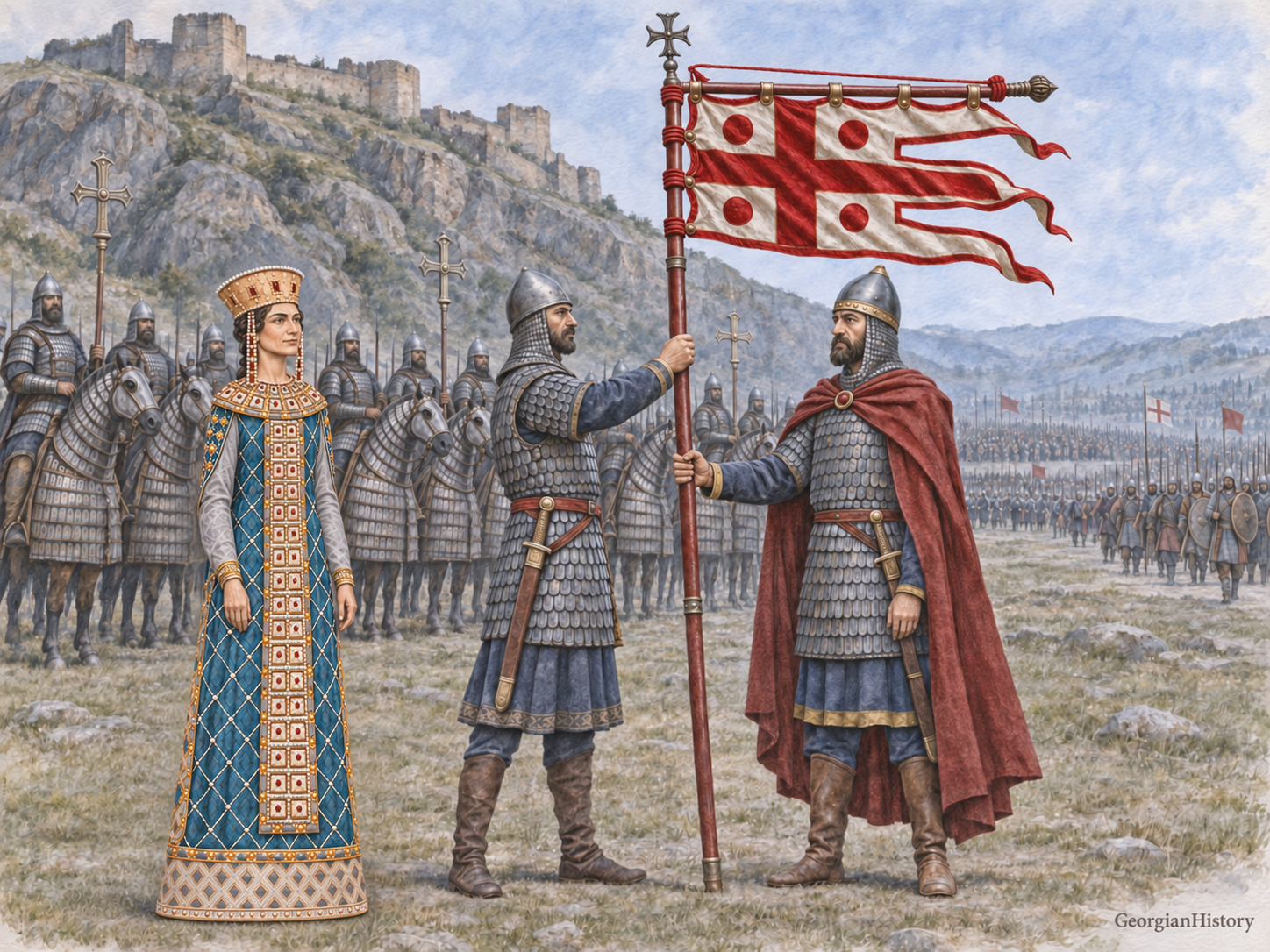
 In the early thirteenth century, around the time of the grape harvest, the Georgian army assembled in Tbilisi. Tamar inspected the arms and horses. Before the army set out, she took the royal banner, entrusted it to Our Lady of Vardzia and blessed both the banner and the troops. She then handed it to Zakaria Mkhargrdzeli. As amirspasalar, or commander-in-chief, Zakaria led the army into Persia.
The chronicler preserves the banner’s name, **Gorgasliani and Davitiani**. The first part refers to Vakhtang Gorgasali, with whom tradition associated the banner’s antiquity. The second carries David’s name. Ivane Javakhishvili took this to mean David the Builder. A dynastic interpretation instead points to the biblical King David, from whom the Bagrationi traced their descent.
White cloth and a red emblem
In his account of the Battle of Shamkhor, the same chronicler calls Gorgasali’s banner white. He links its colour to the tradition of Vakhtang’s expedition to Sind.
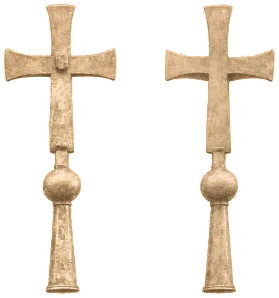
The Persian historian Ravandi also mentions white Georgian banners. In his account of George III’s army fighting its opponents in 1163, white banners and golden crosses appear among the captured spoils. The list gives the colour of the cloth. It names the golden crosses separately, alongside the other booty.
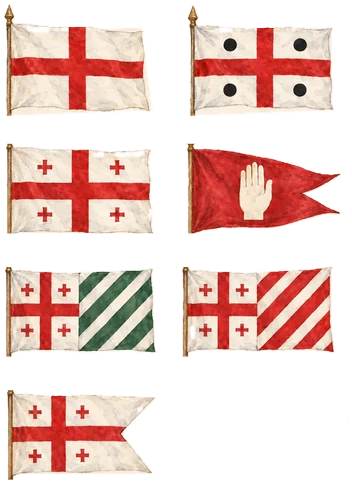
The Armenian historian Step‘anos Orbelian offers another detail. In the reading cited by Mamuka Tsurtsumia, the royal banner was white with a red emblem, while the commander’s was red with a white emblem. The Armenian word *nshan* means a sign or emblem. David Muskhelishvili and Tsurtsumia understand it here as a cross. Ivane Javakhishvili read the passage differently. He understood white to refer to the royal banner’s pole and red to the cloth. The whole design hinges on how a few words are read.
Five crosses on charts
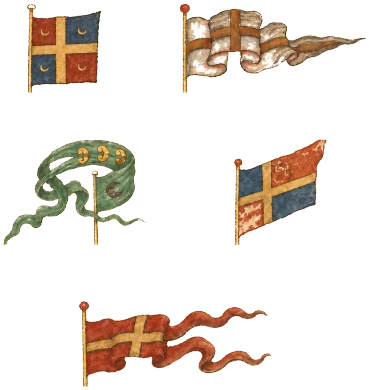
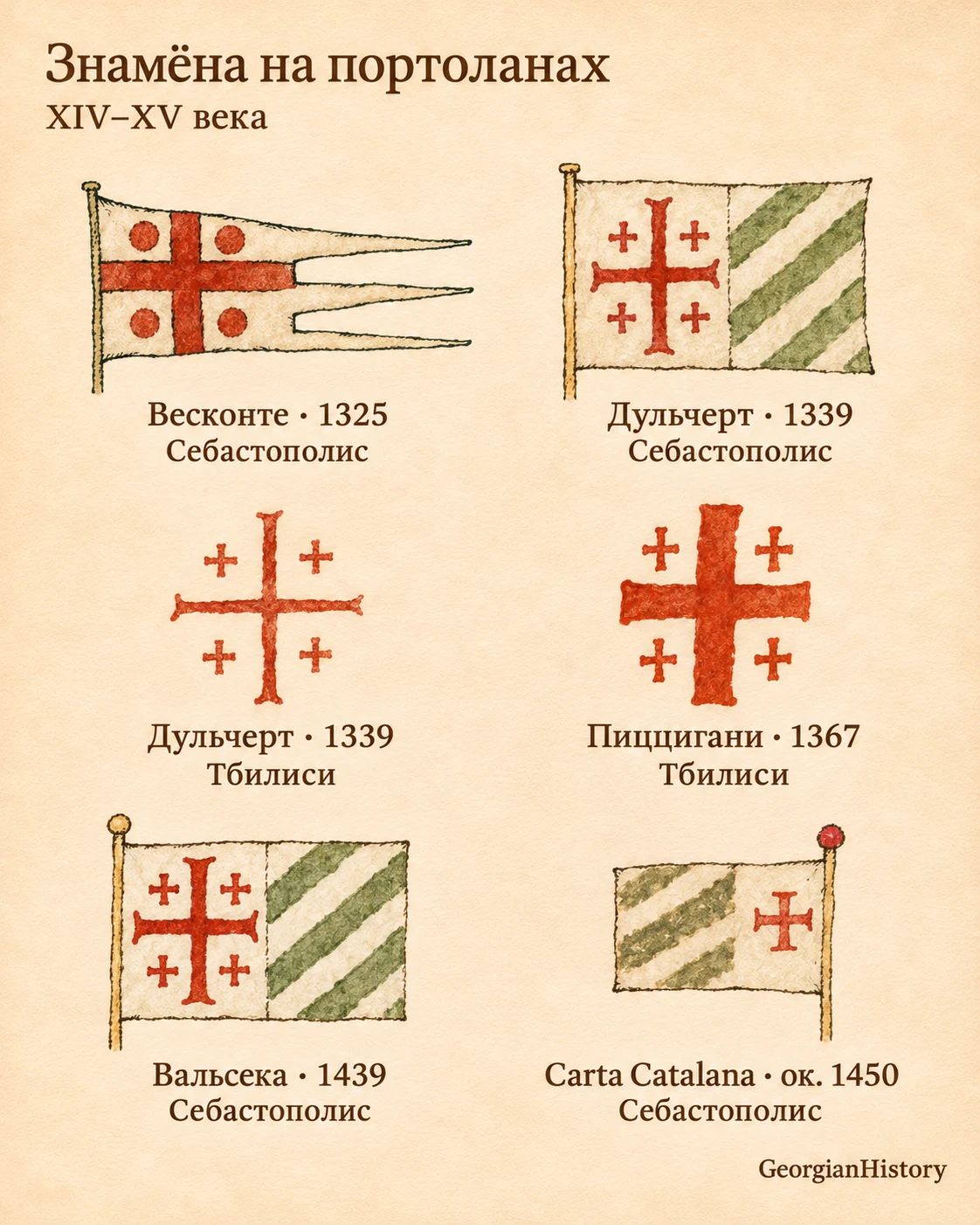
Angelino Dulcert’s portolan, a nautical chart from 1339, shows five red crosses over Tbilisi. At Sebastopolis, medieval Sukhumi, the cartographer placed diagonal stripes next to the crosses. Tsurtsumia describes the stripes as green.
Five crosses appear over Tbilisi again on the Pizzigani brothers’ chart of 1367. More than a century and a half separates Tamar’s expedition from that chart. The appearance of the emblem on the banner she handed to Zakaria remains an open question.
Sources and further reading
- Histories and Eulogies of the Sovereigns, in Kartlis Tskhovreba, vol. II, pp. 103–104.
- Mamuka Tsurtsumia, Georgian Banners and European Portolan Charts, Tbilisi, 2025, pp. 282–283, 288–290.
- Mamuka Tsurtsumia, Once More on the Banner of the Unified Monarchy, 2020.
- Georgian Encyclopedia, “Drosha” (Banner).