The Banners of Odishi on Sixteenth-Century Charts
Georgian Banners · Part 3 of 6
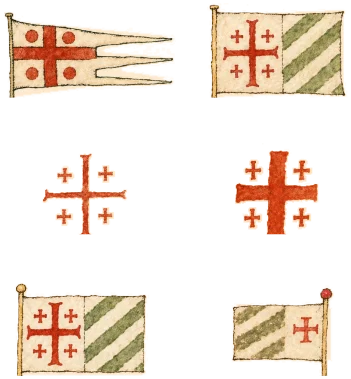
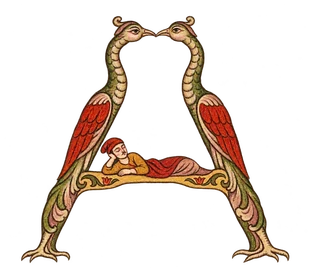 A small banner appears above Cape Pitsunda on Lopo Homem’s 1554 planisphere. A golden cross divides it into red and blue quarters. Mamuka Tsurtsumia identifies a small firesteel in each quarter. Among the chart’s network of rhumb lines, the emblem at Pitsunda stands out for its colour.
Lopo Homem worked in Portugal. His son Diogo followed him into cartography and worked in Venice, among other places. On his charts Odishi, the Mingrelian principality, appears as *Megralia*. The work of father and son shows how the same motif changed when it was drawn on another chart.
A golden cross on different fields
On a Diogo Homem chart dated to around 1560, Tsurtsumia singles out a banner quartered in red and white. On another sheet from 1560, the quarters are red and blue. The golden cross remains at the centre of both designs. In the same group of charts, Tsurtsumia points to a two-tailed banner with a golden cross on a solid red field.
The same cartographers also used other designs. Tsurtsumia compares two green, two-tailed banners on charts by Diogo Homem from 1559 and 1563. One bears a crescent and firesteels, the other small golden crosses.
A principality between two courts
In the mid-sixteenth century, Odishi sought to secure its autonomy from Imereti. In February 1557 the diplomat Antal Verancsics reported that Levan I Dadiani had secured the Ottoman sultan’s recognition of his autonomy from the king of Imereti. His relationship with the sultan, however, still entailed vassalage.
Tsurtsumia links some of the changes in the chart emblems to Odishi’s position. He reads the golden cross as a possible emblem of the principality and associates the crescent and firesteels with Ottoman influence. He interprets the green banner with small crosses as the emblem of a Christian principality owing allegiance to the sultan. Connecting any of these designs to a banner used at the Dadiani court would require separate evidence about the actual cloth.