Sasireti: The King’s Defeat
Bagrat IV, Liparit Baghvashi, and a divided Georgian kingdom in the 1040s. The eristavi’s victory exposed the limits of royal power and the fragility of his own.

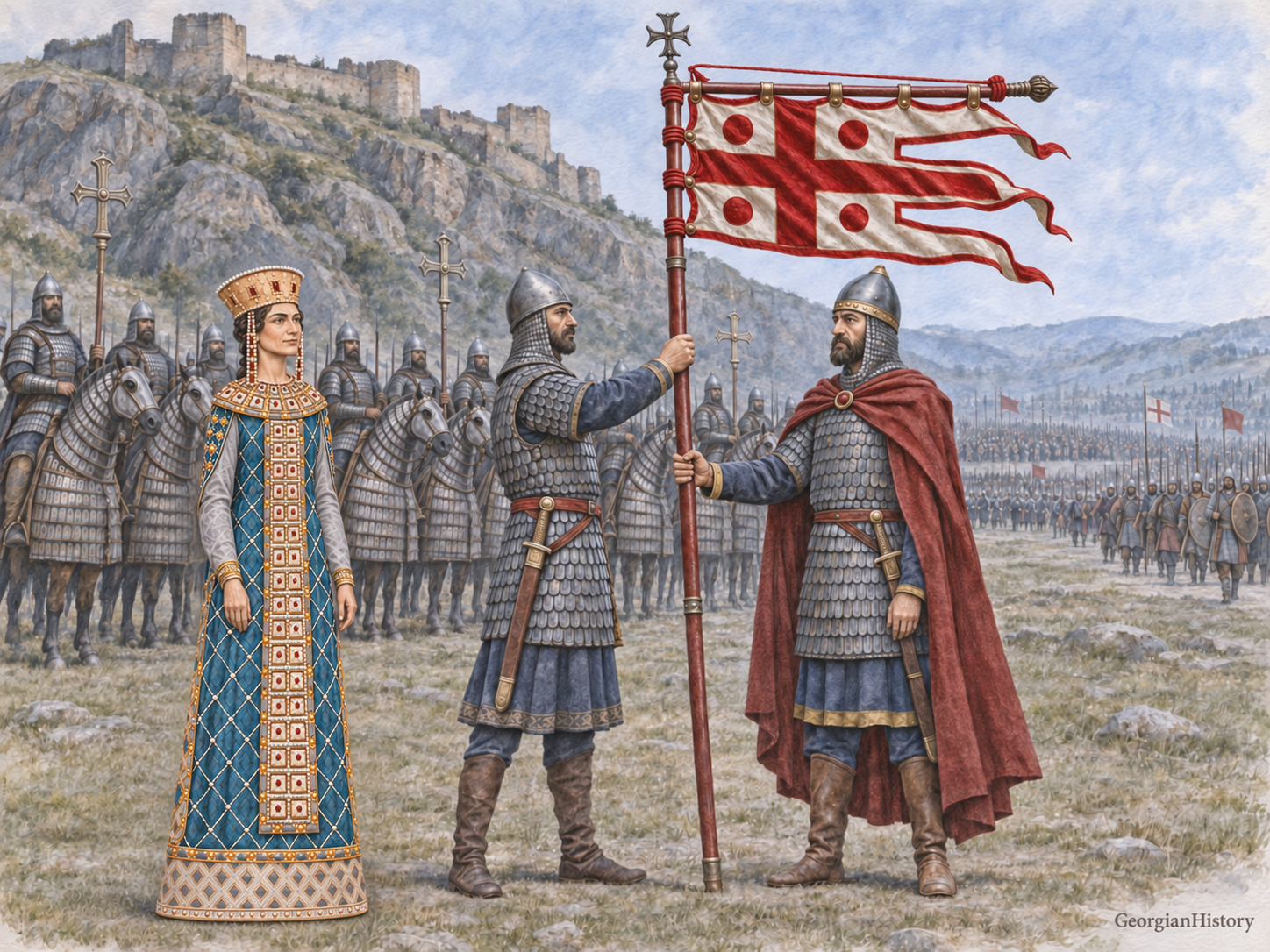
 At the grove of Sasireti, the royal army fled. Prominent supporters of Bagrat IV were taken prisoner, including the eristavi Abuser. Liparit Baghvashi, lord of Kldekari, was the victor. The Georgian king had lost to a man who had once helped strengthen his rule. Sasireti showed how far a split within the kingdom could go when a powerful eristavi combined his own forces with outside support. [1, 2]
Liparit’s military strength had previously served the royal house. He had fought against the Byzantines, taken part in campaigns and sought the submission of Tbilisi. The struggle for that city strained his relationship with the king. After a long siege, Bagrat made peace with the emir without Liparit’s consent. According to the Matiane Kartlisa, from then on the eristavi acted against his ruler. The chronicler links the break to a specific decision at court, where Liparit had powerful opponents. [1, 2]
Byzantium intervened in the ensuing struggle. Liparit received imperial funds and military aid, enabling him to back another claimant to the Georgian throne. That claimant was Demetre, Bagrat’s paternal half-brother. The dispute between king and eristavi took on a dynastic dimension. The opposition could rally around a member of the royal house itself. [1, 2, 3]
The forces on each side kept changing. The chronicle names the Kakhetians and the Armenian king David among Liparit’s allies. Meskhetian nobles also took part in the struggle, backing different sides. The outcome of the war depended on such alliances, making Bagrat’s position particularly vulnerable. The royal title entitled him to demand loyalty. Bringing men to the battlefield and keeping them together was another matter. [1, 3]
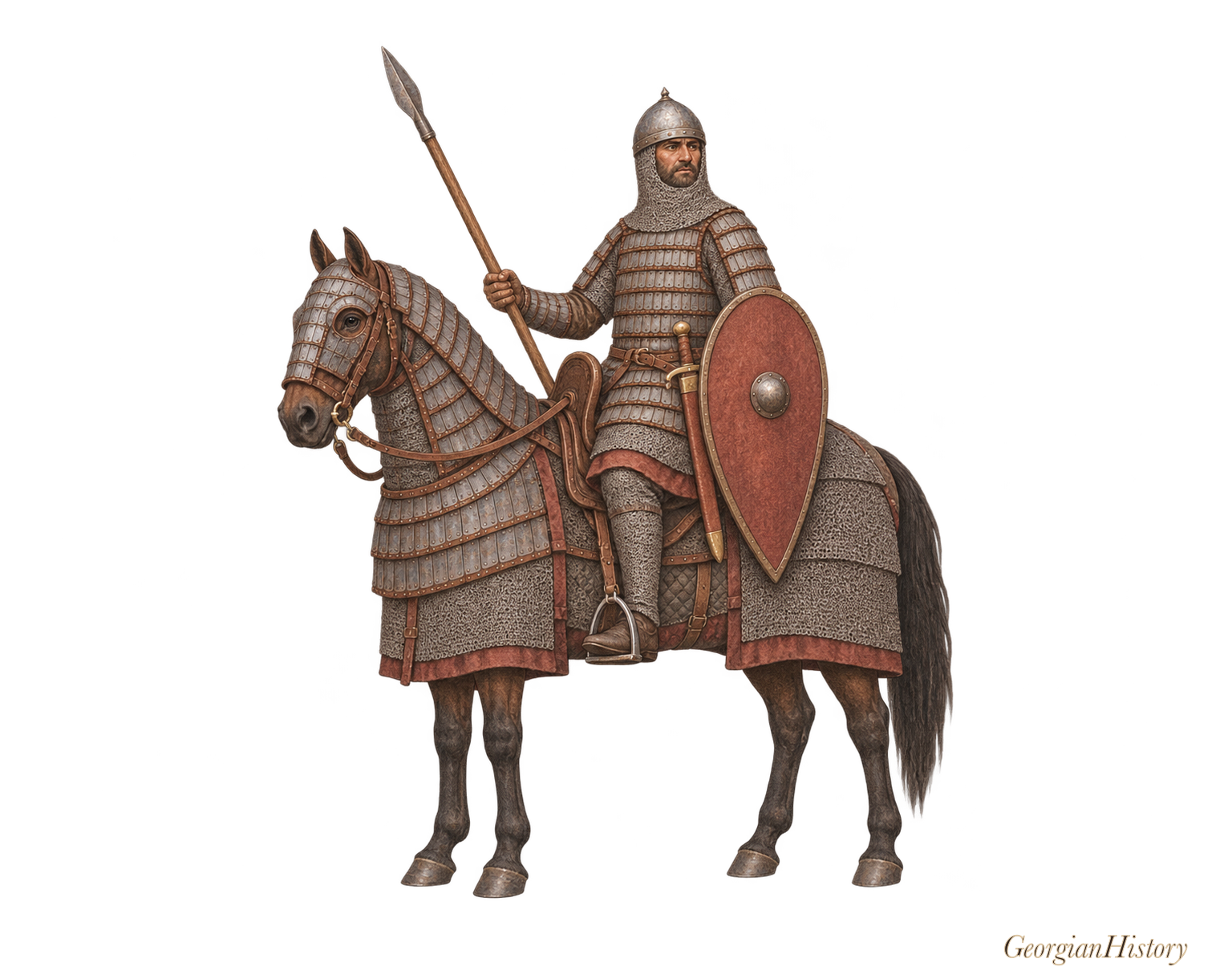
The account of Sasireti survives in a few lines that are difficult to interpret. They mention Varangians, an advance without waiting for the Meskhi, a rout and the capture of nobles. Scholars disagree over who did what. Zurab Papaskiri argued that the Varangians fought for Bagrat, while others counted them among Liparit’s forces. Any confidently drawn reconstruction of the attack would therefore be premature. The king’s defeat itself is clear. [1, 3]
The date also calls for caution. Scholars have proposed both the early 1040s and 1046–1047. Mats Larsson examined this difference in detail, comparing the Georgian chronicle with events in Armenia and the tradition of Yngvarr’s expedition. His identification of the Varangians at Sasireti with Yngvarr’s men remains a hypothesis. The battle can be placed in the 1040s, with the exact year still open to debate. [4]
After the defeat, Bagrat sought terms with the victor. The chronicler reports that the king approached Liparit with a small mounted retinue, but Liparit avoided meeting him. Bagrat withdrew to the western part of his kingdom. He later sought a settlement in Constantinople, where he remained for three years. Imperial support gave Liparit a place in negotiations whose terms the Georgian ruler could no longer set alone. [1, 2]
The eristavi’s power still depended on the support of local nobles. In the late 1050s, Meskhetian aznaurs led by Sula of Kalmakhi rose against him. They seized Liparit and handed him over to the king. He became a monk and ended up in Byzantium. That outcome matters for understanding Sasireti. The battle revealed the strength of a coalition capable of defeating a king, while Liparit’s fall later exposed its fragility. The unity of medieval Georgia had to be secured afresh through fortresses, agreements and the loyalty of individuals. [1, 2]
Portraits of the participants


The ships symbolise the campaign. The Battle of Sasireti took place in Kartli, and the maritime vignette does not show its location or course. Scholars still debate which side the Varangians fought on.
Sources and further reading
- 1. Anonymous. Matiane Kartlisa (მატიანე ქართლისა). In Kartlis Tskhovreba, vol. I, text prepared by S. Qaukhchishvili. Tbilisi, 1955, pp. 297-305, especially 300-301. The break after the siege of Tbilisi, support for Demetre, the defeat at Sasireti, Abuser’s capture and the subsequent struggle. The digital transcription of the relevant section was consulted. The manuscripts were not independently checked.
- 2. Roin Metreveli. ‘Liparit IV Baghvashi’. Georgian Encyclopaedia, Georgian National Academy of Sciences. The online entry is undated and was consulted on 30.10.2026. The standing of the eristavi of Kldekari, relations with Bagrat IV, Byzantine support and Liparit’s fall. The scholarly entry was read in full.
- 3. Z. V. Papaskiri. ‘The “Varangians” of the Georgian Chronicle of Kartli and Some Questions of Rus’–Georgian Contacts in the Eleventh Century’. Istoriya SSSR, 1981, no. 3, pp. 164-172, especially 164-169 for this article. Variant readings and opposing reconstructions of Varangian participation. The full text and notes were read in an online reprint. The hypothesis that troops were sent from Kyiv is treated as such.
- 4. Mats G. Larsson. “Yngvarr’s Expedition and the Georgian Chronicle”. Saga-Book XXII, 1986-1989, pp. 98-108 (1986 article). Comparison of the early and late chronologies of the battle and the limits of the link to Yngvarr’s expedition. The full article was read in PDF. The exact year is disputed.
- 5. National Archives of Georgia. ‘Sasireti’ (სასირეთი). Catalogue of Georgian Historical Documents. Tbilisi, 2018, ‘Description’ section. Places Sasireti in the Tedzami valley near the Mtkvari. The entry does not establish the precise battlefield or the medieval course of the river.