Giorgi III’s Coin from the Palace of Rustavi
Archaeologists found a “king with a falcon” coin in the fourth hall of the medieval palace. Georgian lettering, Arabic royal titles and the date 1174 on a coin of Giorgi III.
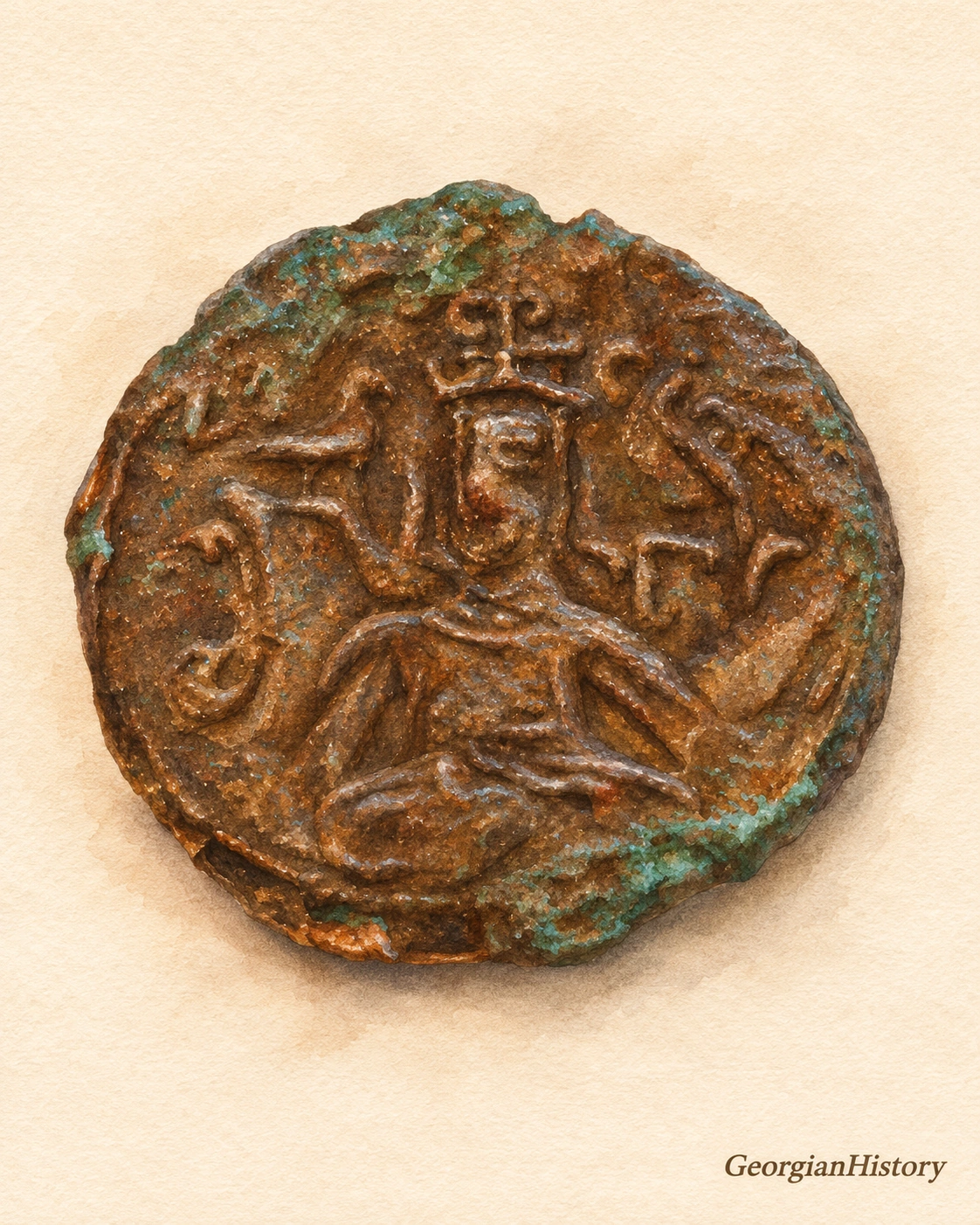
 Archaeologists have discovered a coin of Giorgi III, the father of Queen Tamar, in the medieval palace at Rustavi. The coin came from the fourth hall investigated by the Rustavi History Museum expedition. The city hall reported the discovery on 19 August 2026.
The copper coin belongs to the familiar “king with a falcon” type. Its obverse shows the crowned ruler seated cross-legged, with a hunting bird perched on his raised hand. This depiction of Giorgi III, who reigned from 1156 to 1184, is described in numismatic publications.
Letters of the king’s name appear beside his figure in Mkhedruli script. The date is written in Asomtavruli: year 394 of the K’oronikon, a medieval dating system. For this issue, it corresponds to AD 1174. Two forms of Georgian writing thus share the same side of the coin, identifying the ruler and recording the date.
The reverse carries an Arabic inscription: “King of Kings Giorgi, son of Demetre, Sword of the Messiah.” This short formula combines the royal title, the ruler’s parentage and a Christian description of his authority. Its words express the kingship represented by the crowned figure on the other side.
Arabic legends also occur on other Georgian coins of the twelfth and thirteenth centuries, praising rulers including Tamar and Giorgi IV Lasha. Numismatist Tedo Dundua links the bilingual character of Georgian money to its international circulation. The Rustavi find offers a tangible example of this language of royal authority.
The “king with a falcon” type was known long before the present excavations and is represented in scholarly catalogues and museum collections. This discovery is a new specimen of an already studied issue. Its significance for the archaeology of Rustavi rests above all on its findspot in the medieval palace.
Investigations of the complex have also yielded painted pottery, glass vessels, other household wares and coins. In the fifth hall, archaeologists found a vessel containing millet and a surviving wooden floor that the expedition’s director dates to the ninth or tenth century. These finds belong to different phases of the palace’s history and help researchers study its layout and everyday life.
The coin of Giorgi III adds a ruler’s name and an inscribed date to this evidence. Together with the other excavated material, it provides a source for studying Rustavi during the medieval Kingdom of Georgia.
Sources and further reading
- Rustavi City Hall. Announcement of the discovery of Giorgi III’s coin. 19 August 2026.
- Tedo Dundua. Money in Georgia. Appendix. Tbilisi: Meridian Publishers, 2022, pp. 38, 48, 57–59.
- Irakli Paghava and Vlastimil Novák. Georgian Coins in the Collection of the National Museum Náprstek Museum in Prague. 2013, 34/2, pp. 46–47, catalogue no. 2.
- Sputnik Georgia. Report on the Rustavi coin discovery. 24 August 2026. Photograph credited to Rustavi City Hall.
- Georgian Public Broadcaster, Channel One. Report on the coin discovery. 19 August 2026. Reverse photograph.
 Joint issue of Giorgi III and Tamar →