Georgian Banners in Silver, Wood and Cloth
Georgian Banners · Part 2 of 6
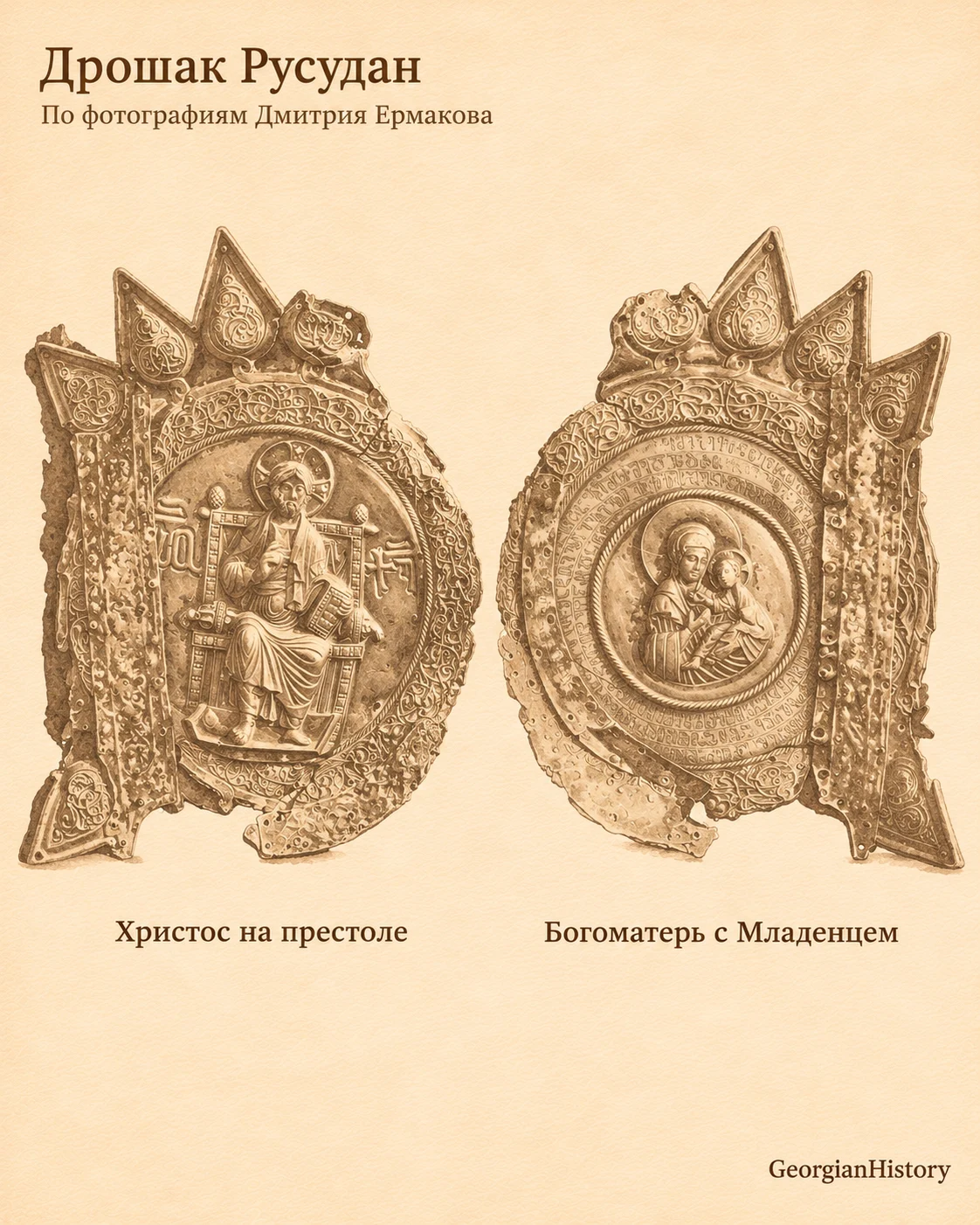
 In 1873, Dmitri Bakradze examined a banner made of two circular plates of gilded silver in the church at Chanieti, a village in Guria. One face showed Christ enthroned, the other the Virgin and Child. Sara Barnaveli calls the object **Rusudan’s droshak** and gives a reading of its inscription that identifies the donor as Rusudan, George III’s sister and Tamar’s aunt.
Two photographs by Dmitri Ermakov show the traces of the object’s long life. The edges of the plates have separated and are torn in places. Several projections bearing embossed floral decoration survive around the rim. On the Virgin’s side, a dedicatory inscription in asomtavruli, an early Georgian script, runs around the medallion. It connects the banner with the person who donated it.
An icon on a pole
Barnaveli calls these banners with rigid pole-mounted panels labara. Photographs of the banner from Khonchiori in Racha show their construction. It has a broad pentagonal panel with a rounded lower edge and an oval medallion below. Sheets of embossed silver were fixed to the panel, medallion and pole. One side bears the Virgin and Child, the other the Crucifixion. Part of the Crucifixion relief had been lost and the area was covered with a plain sheet of silver.
According to Barnaveli, the labarum from Chukuli in Svaneti had a pole about three metres long. Silver reliefs were mounted on the upper wooden panel. The side depicting the Virgin can be seen in a published photograph. Barnaveli noted its compositional resemblance to the Racha example, although the ornament and frames differ.
Aleksandra Japaridze’s expedition saw another labarum in the Betlemi cave church on Mount Kazbek. In 1948 the expedition recorded the banner beside the altar, with its wooden handle resting on the altar surface. The rounded panel had a silver covering, reliefs and inscriptions. The account preserves a rare detail: the object’s position inside the church when it was examined.
The Svan Lem
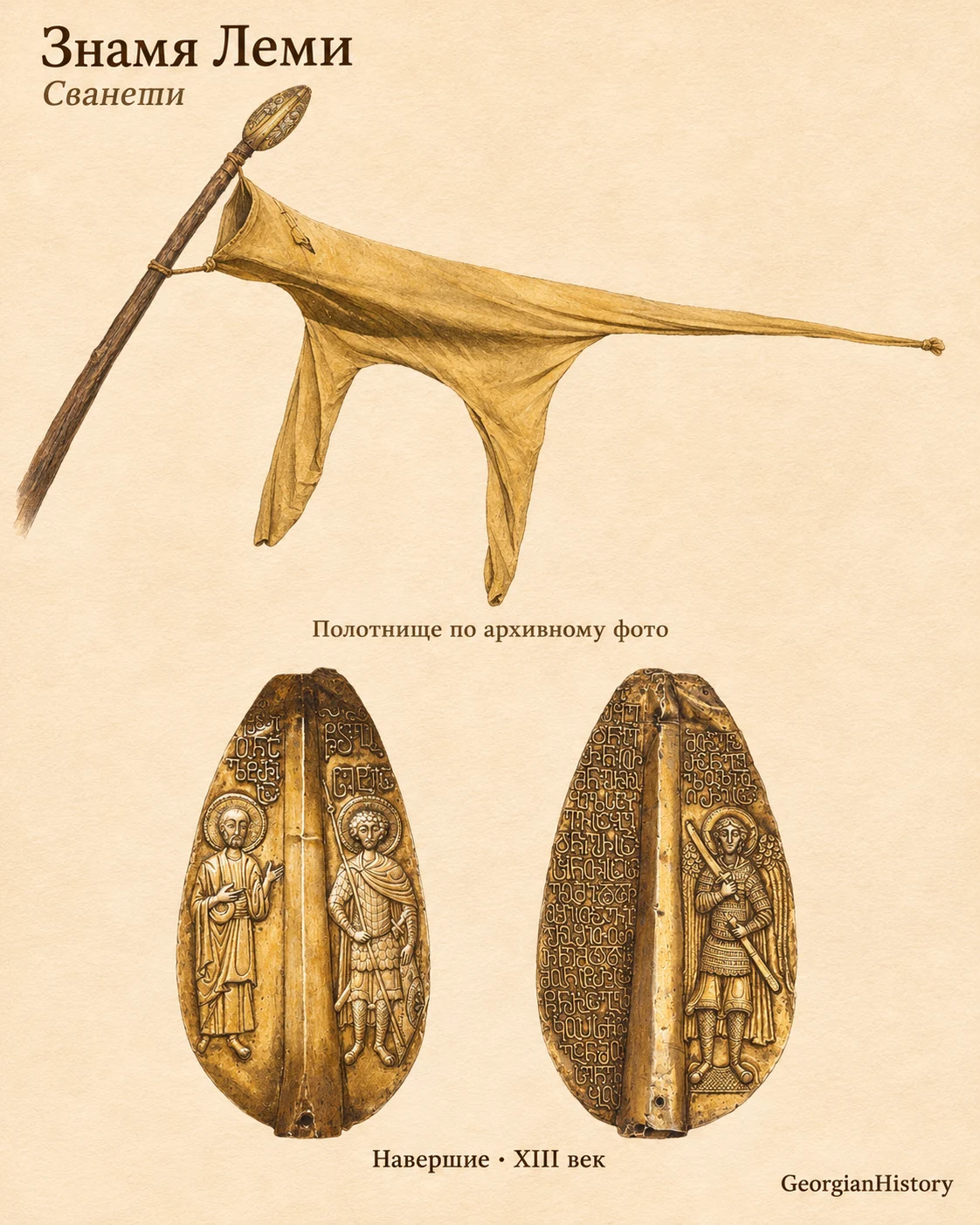
Lem means “lion” in Svan. The cloth that Vera Bardavelidze described was sewn from yellow silk in the shape of an animal. The pole is topped by a gilt-silver finial with figures of saints in relief.
Representatives of Upper Svaneti’s communities came to Seti for the summer festival of Khylish. The Lem was brought out of the Church of Saint George and handed to the banner-bearer. When the riders broke into a gallop, the animal’s silk body filled with air.
Sources and further reading
- Sara Barnaveli, Georgian Banners, Tbilisi, 1953, plates V–IX and XII–XIV.
- Vera Bardavelidze, The Lem Banner, the Wolf-Dog. Ethnographic account of Khylish.
- Tornike Asatiani, The Story of Georgian Heraldry, Tbilisi, 2023, pp. 24–25, fig. 42.
- Aleksandra Japaridze, report on the exploration of Betlemi Cave, in Conquered Peaks, pp. 177–178.