The City That Preserved Its Names
What Georgian, Armenian, and Arabic inscriptions from the 13th- and 14th-century necropolis at Dmanisi reveal about life in the Mashavera valley.
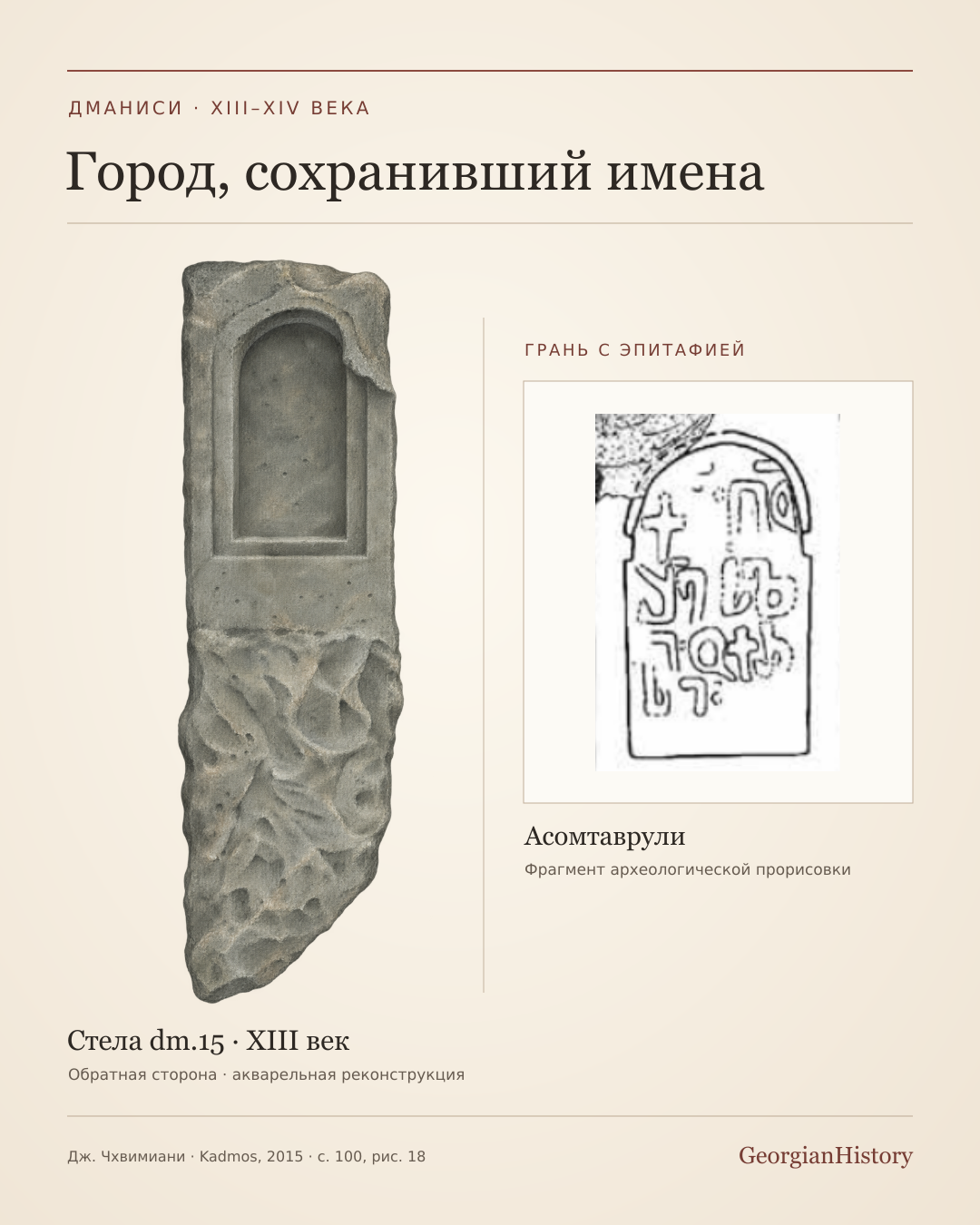
 On one gravestone at Dmanisi a researcher read the name Okro, and on another, Ebia. Abbreviated prayers and a few carved letters preserve a trace of the medieval town’s inhabitants. Their lives remain largely unknown, but the stones preserve the name of the deceased and a prayer for mercy on the soul. Both readings are the researcher’s proposals. The inscriptions contain abbreviations, and the stone bearing Okro’s name is also damaged. [1]
Dmanisi stood in Kvemo Kartli, in the Mashavera valley. Its medieval necropolis offers a way to study the people of a town where different religious and cultural traditions met. Georgian, Armenian and Arabic memorial inscriptions survive here. In a 2025 study, Jimsher Chkhvimiani, Harutyun Khudanyan and Vladimer Kekelia set newly discovered gravestones with Armenian inscriptions in the context of burial locations and the history of the town’s communities. [3]
Chkhvimiani examined two Georgian monuments in detail in a 2015 study. Their inscriptions use the Asomtavruli script. In the proposed readings, one contains a prayer for Okro’s soul and the other a prayer for Ebia’s. From the archaeological context and the letterforms, Chkhvimiani dates the stele bearing Okro’s name to the first half of the thirteenth century and the monument bearing Ebia’s name to the thirteenth century. The finds matter beyond the two names. They overturn the earlier view that gravestones at the site bore no Georgian epitaphs in the High Middle Ages. [1]
Each reading requires careful work with damaged surfaces and abbreviations. A letter must be read alongside neighbouring signs, the shape of the monument and the circumstances of its discovery. A name and a reconstructed life are different kinds of evidence. A name cannot tell us a person’s occupation or ancestry. The workmanship of a gravestone can inform a discussion of status, but it gives no measure of a family’s wealth.
The Muslim burials reveal another aspect of the town’s memory. In a 2023 article, Chkhvimiani examined a family burial area within the remains of circular mausoleum No. 3. Excavations in 1970–1971 investigated this complex. Arabic epitaphs survive on some of the gravestones assembled from several pieces. Here, family remembrance had an architectural space of its own. Its material traces allow us to study the community through individual burial complexes. [2]
Comparing monuments also reveals similarities in workmanship. Chkhvimiani notes that some Christian and Muslim memorials took similar forms. Such observations shed light on cultural contact and the work of stonecutters. A shared technique alone cannot establish that the monuments came from one workshop or that different beliefs merged or lost their significance to the people of the town. [2]
The language of an epitaph also calls for careful reading. It reflects a written and religious tradition, while giving only a partial picture of the languages the deceased may have spoken. The surviving stones do not tell us what proportion of the population each group represented. Any such reconstruction would need to compare the dates, locations and state of preservation of the burials with other finds.
The historical value of the necropolis lies in this combination of evidence. Inscriptions, stone forms and burial locations bring us closer to people whose everyday lives rarely appear in written accounts. Medieval Dmanisi comes into view as a town of families and neighbours who remembered their dead in different ways.
Sources and further reading
- 1. Jimsher Chkhvimiani. Gravestones with Georgian Inscriptions from the High Medieval Period at Dmanisi, Georgia. Kadmos, no. 7, 2015, pp. 77–84 and 100, fig. 18. Readings, dates, description of stele dm.15 and source of the drawing (CC BY-NC 4.0).
- 2. Jimsher Chkhvimiani. One Interesting Group of Graves of the Cemetery of the Dmanisi Medieval Town. History, Archaeology, Ethnology, no. 10, 2023, pp. 299–330. The abstract covers mausoleum No. 3, the 1970–1971 excavations, Arabic epitaphs and similarities in monument forms.
- 3. Jimsher Chkhvimiani, Harutyun Khudanyan, Vladimer Kekelia. Dmanisi Medieval Necropolis – New Epigraphic Evidence. ARAMAZD, 19, 2025, pp. 89–111. The abstract covers Dmanisi’s geography, the languages of its inscriptions and newly discovered Armenian epitaphs.