Adarnase: The Right to Be Called King
Late ninth to early tenth century. How the title of king of the Kartvelians took root in Tao-Klarjeti, and why its adoption is dated differently.
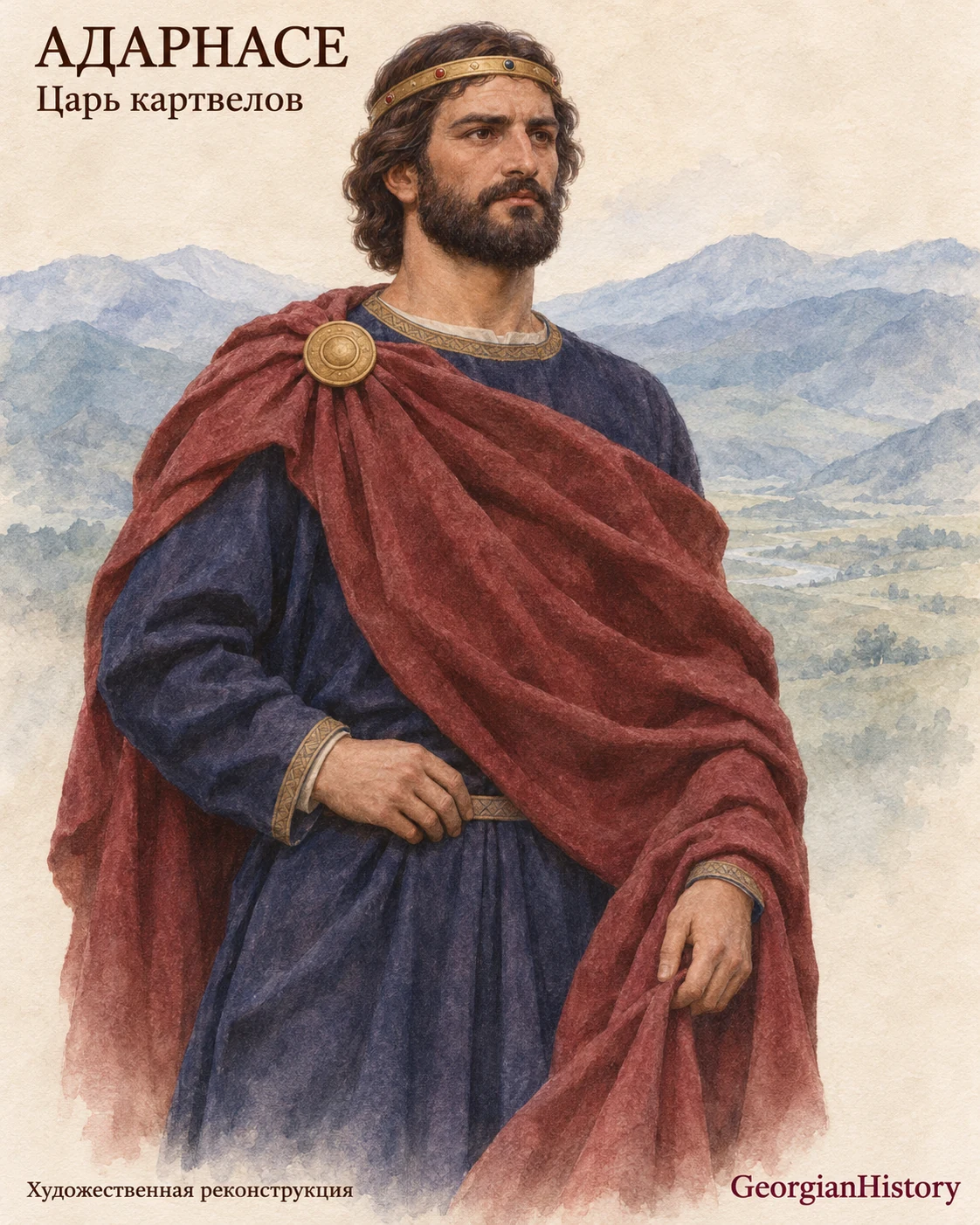
 At the end of the ninth century, a formula appears in the history of the Georgian Bagrationi dynasty that would outlive its first bearer: ქართველთა მეფე — “king of the Kartvelians.” Adarnase, son of David I Kouropalates, assumed this title. The Georgian Encyclopaedia dates the beginning of his reign to 888, while also recording alternative dates of 897 or 899. Behind this discrepancy lies a question about the sequence in which his new authority was recognised. [1]
Adarnase’s path began with a family catastrophe. In 881 his father David was killed by a relative, Nasra. The chronicle of Sumbat Davitisdze records that the dead man left a young son. Nasra fled to Constantinople; he later returned with the support of Bagrat, king of the Abkhazians. The struggle over an inheritance became a confrontation between coalitions in which kinship intertwined with the interests of neighbouring rulers. [2]
Adarnase and Gurgen Kouropalates, accompanied by Gurgen’s sons, opposed Nasra. According to the chronicle, Nasra was defeated, captured and killed near Aspindza in Samtskhe. After recounting his death, Sumbat reports Adarnase’s installation as king of the Kartvelians. This sequence connects the emergence of the title with the resolution of a dynastic crisis. Yet the brief entry describes neither the place of the ceremony, its participants nor the appearance of a crown. [2]
Royal dignity existed alongside another system of honours. Kouropalates was a high Byzantine court title linking a Georgian ruler to the imperial court. Adarnase’s acquisition of this title is dated to 891. Kingship and the dignity of kouropalates therefore cannot be treated as two names for the same office. Their combination in one person strengthened his standing both within the dynasty and in relations with Constantinople. [1, 3]
Rivalry among the Bagrationis nevertheless continued. The National Centre of Manuscripts’ account distinguishes between the formal seniority of the Tao branch and the effective independence of the rulers of Klarjeti. The emergence of a king consequently did not mean that every related prince became an obedient executor of his decisions. The new title changed the hierarchy, but power still depended on a ruler’s own lands, allies and the outcome of armed conflicts. [3]
Relations with the Armenian king Smbat I were equally complex. The historian Yovhannes Draskhanakerttsi associated Adarnase’s elevation with Smbat’s involvement. Georgian scholars identified a chronological difficulty: Smbat came to the throne after the generally accepted date of Adarnase’s accession. These accounts require comparison; turning them into a detailed narrative of a single, precisely dated coronation would be premature. [3]
The historical significance of the change is clearer than its ceremonial details. Royal dignity became established in the political vocabulary of the Georgian Bagrationis and was subsequently inherited by Adarnase’s descendants. The chronicle specifically states that his son David became king of the Kartvelians after his death. A continuity of authority was emerging that extended beyond the personal success of one ruler. [2]
Adarnase’s history needs to be understood within its own time. This was still a world of several ruling houses, overlapping claims and shifting alliances. It was within this fragmented setting that the royal title acquired an enduring bearer and continued into the next generation. Unification remained a distant prospect, but the dynasty already possessed a language through which to assert its seniority.
Sources and further reading
- 1. Nodar Shoshiashvili. “ადარნასე II” (Adarnase II). Georgian Encyclopaedia, Georgian National Academy of Sciences. Online publication date unspecified; checked 5 November 2026. Parentage, the dates 881 and 891, the royal title and alternative dates of 888 / 897–899.
- 2. Sumbat Davitisdze. Life and Account of the Bagrationis. Kartlis Tskhovreba, vol. I, edited by S. Qaukhchishvili. Tbilisi, 1955, pp. 378–380, especially p. 379, lines 7–18, and p. 380, lines 17–20. TITUS electronic transcription: the struggle against Nasra, the royal title and David’s succession. The manuscripts were not independently collated.
- 3. Elene Tsagareishvili. “ადარნასე II” (Adarnase II). Georgian Historical Figures project, National Centre of Manuscripts. Publication date unspecified; checked 5 November 2026. Distinct titles, relations between dynastic branches and the debate over Smbat’s involvement.
- 4. Georgian National Museum. Medieval Georgian Relief Sculpture exhibition: reliefs from Opiza, dated to the ninth century in the museum’s attribution. Checked 5 November 2026. Visual analogy for the clothing silhouette; the Ashot depicted on the relief is not identified as Adarnase.